
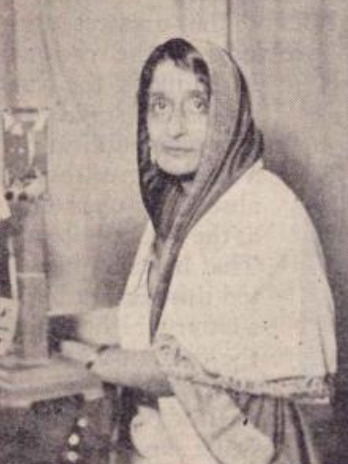
Rajkumari Amrit Kaur (2 February 1887 – 6 February 1964) was an Indian freedom fighter, social reformer and stateswoman. Born a princess, she gave up a life of ease to work as a secretary to Mahatma Gandhi for sixteen years. She was India’s first Health Minister, from 1947 to 1957, and the first woman to hold Cabinet rank in the country. The All India Institute of Medical Sciences in New Delhi is her creation.
Quick Facts
| Full name | Amrit Kaur |
| Born | 2 February 1887, Lucknow |
| Died | 6 February 1964, New Delhi (aged 77) |
| Family | Kapurthala royal house |
| Education | Sherborne School for Girls, Dorset; Oxford |
| Occupation | Freedom fighter, social reformer, politician |
| Offices | Union Minister of Health (1947–1957); President of the World Health Assembly (1950) |
| Founded | All India Institute of Medical Sciences; co-founder of the All India Women’s Conference |
| Religion | Christian |
Early Life
She was born in Lucknow, the only daughter in the large family of Raja Sir Harnam Singh. Her father, a younger son of the ruling house of Kapurthala in Punjab, had become a Christian and so lost his claim to the throne; the British government gave him the management of estates in Oudh. Her mother was the daughter of a Bengali missionary.
She was sent to school in England, at Sherborne in Dorset, where she was head girl and captain of games, and then to Oxford. She came home in 1908, a fine tennis player who won many championships.
Gandhi
Gopal Krishna Gokhale, a friend of her father’s, awakened her interest in the national cause. She met Mahatma Gandhi in 1919 and wished to join him, but her parents would not hear of it. After their deaths she went to his ashram in 1934, and for the next sixteen years was one of his secretaries, living by the rules of the ashram. He called her, in his letters, “my dear idiot” and “rebel”.
She took part in the salt march of 1930 and was jailed. In 1937 she went to Bannu on the North-West Frontier as an emissary of the Congress and was imprisoned on a charge of sedition. During the Quit India movement she led processions in Simla, was beaten in a police lathi charge and jailed again.
The Women’s Movement
She was a founder of the All India Women’s Conference in 1927, its secretary and later its president. She campaigned against child marriage and the seclusion of women and for the vote, and gave evidence on women’s franchise before a parliamentary committee in London. She opposed reserved seats and special treatment, arguing that women should enter public life on equal terms.
The Constituent Assembly
She was a member of the Constituent Assembly and of its committees on fundamental rights and minorities, where she argued for a uniform civil code and against provisions that she feared would allow harmful customs to shelter under religious freedom.
Health Minister
Jawaharlal Nehru made her Health Minister in the first Cabinet of independent India. She held the post for ten years.
- **Malaria:** the national campaign of the 1950s cut cases from many millions a year to a small fraction
- **Tuberculosis:** the BCG vaccination programme, the largest in the world, and a network of clinics and sanatoria
- **Nursing:** the Indian Nursing Council and a college of nursing in Delhi, which now bears her name
- **Leprosy and child welfare:** research institutes and a national council for child welfare
AIIMS
A national medical institute for postgraduate teaching and research had been recommended before independence, but there was no money. She piloted the bill through Parliament in 1956 and raised the funds herself, obtaining a large grant from New Zealand and help from Australia, West Germany, the United States, Sweden and the Rockefeller Foundation. She insisted that it be free of government control in academic matters. She was its first president, and left it her family’s house at Simla as a holiday home for its nurses.
International Work
She led the Indian delegation to the World Health Organization for several years and in 1950 was elected president of the World Health Assembly, the first woman and the first Asian in the post. She was chairman of the Indian Red Cross for fourteen years.
Sport
She founded the National Sports Club of India and started a national coaching scheme, from which the national institute of sports at Patiala developed.
Death
She never married. She sat in the Rajya Sabha until her death in New Delhi on 6 February 1964. Though a practising Christian, she was cremated according to her wish.
Others who shaped the welfare institutions of the new state included Durgabai Deshmukh.
Featured image: Rajkumari Amrit Kaur in 1936. Photo by an unknown photographer, in the public domain, via Wikimedia Commons.



