
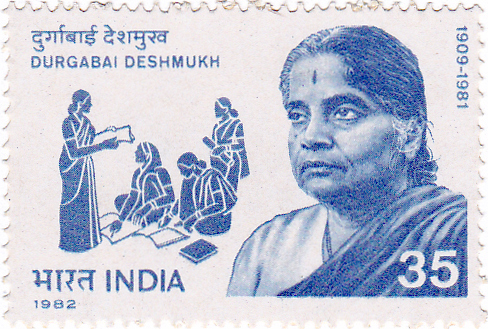
Durgabai Deshmukh (15 July 1909 – 9 May 1981) was an Indian freedom fighter, lawyer, social worker and stateswoman. Married as a child, she walked out of the marriage, led the Salt Satyagraha in Madras, educated herself from primary level after her release from prison, and became a criminal lawyer. She was a member of the Constituent Assembly and of the first Planning Commission, founded the Andhra Mahila Sabha, and created the Central Social Welfare Board. She is called the mother of social work in India.
Quick Facts
| Full name | Durgabai Deshmukh |
| Born | 15 July 1909, Rajahmundry, Andhra Pradesh |
| Died | 9 May 1981, Hyderabad (aged 71) |
| Education | Banaras Hindu University (matriculation); Andhra University (M.A. in political science); Madras University (law) |
| Occupation | Freedom fighter, lawyer, social worker |
| Founded | Andhra Mahila Sabha (1937); Central Social Welfare Board (1953); Council for Social Development (1962) |
| Offices | Member of the Constituent Assembly; Member of the Planning Commission |
| Awards | Padma Vibhushan (1975) |
| Spouse | C. D. Deshmukh (m. 1953) |
Early Life
She was born at Rajahmundry and grew up at Kakinada, in a middle-class Telugu family given to social service. At eight she was married to the adopted son of a landowner. When she reached the age at which she was expected to go to her husband’s house, she told him and her father that she would not; she later helped him to marry again, and they remained on good terms.
At about twelve she left her English-medium school in response to Gandhi’s call, and started a school in her home where she taught Hindi to women. When Mahatma Gandhi visited Kakinada she arranged for him to address a gathering of devadasis and Muslim women, who gave their jewellery to his fund, and interpreted his speech.
At the Congress session held at Kakinada in 1923 she was a girl volunteer at the gate of an exhibition. She refused to let Jawaharlal Nehru enter without a ticket until one was bought for him.
The Salt Satyagraha
In 1930, at twenty, she was a leader of the salt satyagraha in Madras, and when the men were arrested she took charge. She was imprisoned three times between 1930 and 1933. In jail she saw illiterate women convicted of crimes they did not understand, with no one to defend them, and resolved to become a lawyer.
Education
She had no certificate of any kind. On her release she studied privately, passed the matriculation examination of Banaras Hindu University, took a first-class master’s degree in political science from Andhra University and a law degree from Madras in 1942. She built up a successful practice in criminal law at the Madras bar.
Andhra Mahila Sabha
In 1937 she founded the Andhra Mahila Sabha in Madras, at first to coach girls for the Banaras matriculation as she had coached herself. It grew into a large institution, in Madras and later Hyderabad, running hospitals, nursing schools, colleges, hostels and vocational centres for women.
The Constituent Assembly
She was elected to the Constituent Assembly from Madras in 1946 and was the only woman on its panel of chairmen. She spoke for Hindustani as the national language, for the independence of the judiciary and for the property rights of women, and moved amendments on a number of practical matters, among them a lower age limit for election to the upper house.
Planning and Social Welfare
She was a member of the Planning Commission from 1952. At her urging the first Plan provided funds for social welfare, and in 1953 the Central Social Welfare Board was set up with her as chairman. It worked through thousands of voluntary bodies, giving them grants to run services for women, children and the disabled, and for the first time carried such work into villages.
- she proposed separate family courts after seeing them at work in China in 1953; India legislated for them in 1984
- as chairman of the National Committee on Women’s Education, she produced the report of 1959 that set the course for girls’ schooling
- she founded the Council for Social Development in Delhi
Marriage
In January 1953 she married C. D. Deshmukh, the Finance Minister; the Prime Minister was a witness.
Honours
- UNESCO award for outstanding work in literacy (1971)
- Padma Vibhushan (1975)
- Nehru Literacy Award
Her autobiography is titled Chintaman and I.
Death
She died at Hyderabad on 9 May 1981. A metro station in Delhi and hospitals and colleges in Hyderabad and Chennai carry her name.
Featured image: Durgabai Deshmukh, from a 1982 postage stamp of India. Photo by India Post, Government of India, licensed under Government Open Data License – India, via Wikimedia Commons.



