
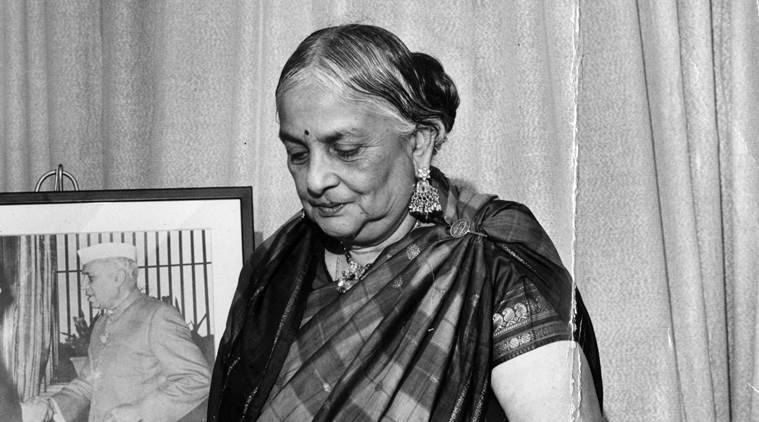
Kamaladevi Chattopadhyay (3 April 1903 – 29 October 1988) was an Indian freedom fighter, socialist, feminist and cultural organiser. She was the first woman in India to stand for election to a legislature and one of the women who forced their way into the Salt Satyagraha. After independence she refused political office and gave forty years to the artisans of India; the survival of many of the country’s handicrafts and handlooms is owed in large part to her.
Quick Facts
| Full name | Kamaladevi Chattopadhyay |
| Born | 3 April 1903, Mangalore, Karnataka |
| Died | 29 October 1988, Bombay (aged 85) |
| Occupation | Freedom fighter, social reformer, writer |
| Known for | Revival of Indian handicrafts and handlooms; the All India Women’s Conference; the Indian Cooperative Union |
| Awards | Padma Bhushan (1955), Ramon Magsaysay Award (1966), Sangeet Natak Akademi Fellowship (1974), Padma Vibhushan (1987) |
| Spouse | Krishna Rao (d. 1919); Harindranath Chattopadhyay (m. 1919, div.) |
| Children | 1 |
Early Life
She was born in Mangalore into a Saraswat Brahmin family. Her father, a district collector, died when she was seven without leaving a will, and the property passed to a stepbrother; her mother, an educated and independent woman, brought her up. She was married at fourteen and widowed within two years.
She went to Madras to study, and there, in 1919, married Harindranath Chattopadhyay, a poet and playwright and the brother of Sarojini Naidu. A widow’s remarriage, and outside her caste, scandalised orthodox opinion. They had a son, travelled in Europe, where she studied sociology in London, and acted together on the stage. She appeared in some of the first Kannada films. The marriage ended in divorce.
The Freedom Movement
She joined the Congress volunteer corps in the early 1920s. In 1926, encouraged by the Irish suffragist Margaret Cousins, she stood for the Madras legislative council, the first woman in India to contest such an election, and lost by a few dozen votes. She was a founder of the All India Women’s Conference and its first organising secretary.
In 1930 she persuaded Mahatma Gandhi, who had meant to keep women out of the salt march, to let them take part. She was among the first to make salt on the Bombay sea-front, sold packets of it outside the stock exchange and the High Court, and was jailed. She was imprisoned several times in all.
She joined the Congress Socialist Party in 1934 and became its president. She spent the early war years abroad, speaking for Indian freedom in the United States and elsewhere.
Refugees
After Partition she turned down offers of high office. She organised the Indian Cooperative Union, which built the town of Faridabad, outside Delhi, to house tens of thousands of refugees from the North-West Frontier, who put up their own homes and workshops on a cooperative basis.
Crafts
From the 1950s she set herself to save the crafts that machine goods and neglect were killing. As the first chairman of the All India Handicrafts Board she travelled to villages across the country, found the weavers, potters, metalworkers, embroiderers and puppeteers, and connected them with designers and markets.
- the Central Cottage Industries Emporium in Delhi, run by her cooperative union
- regional design centres and the Crafts Council of India
- the national awards for master craftspeople
- the Crafts Museum and the revival of many textile traditions
The Arts
She was a moving spirit behind the Sangeet Natak Akademi, of which she was later chairman, the National School of Drama and the Bharatiya Natya Sangh, and encouraged the revival of folk theatre and puppetry.
Honours
- Padma Bhushan (1955) and Padma Vibhushan (1987)
- Ramon Magsaysay Award for community leadership (1966)
- Fellowship of the Sangeet Natak Akademi (1974)
- UNESCO award for the promotion of handicrafts (1977)
Writings
She wrote some twenty books, on crafts, women, socialism and her travels, and a memoir, Inner Recesses, Outer Spaces.
Death
She died in Bombay on 29 October 1988. In the field of dance, a comparable work of revival was done by Rukmini Devi Arundale.
Featured image: Kamaladevi Chattopadhyay. Photo by an unknown photographer, in the public domain, via Wikimedia Commons.



