
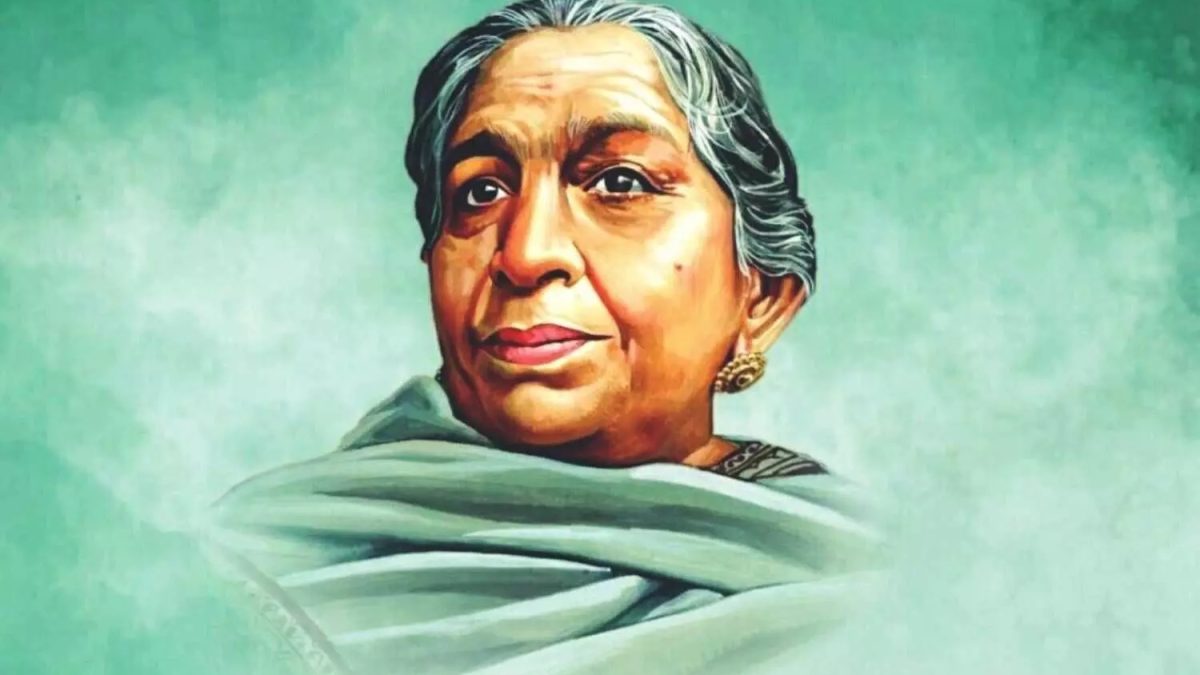
Sarojini Naidu (13 February 1879 – 2 March 1949) was an Indian poet and political leader who played a major part in the freedom struggle. Her lyrical English verse earned her the title “Nightingale of India” (Bharat Kokila). A close associate of Mahatma Gandhi, she was the first Indian woman to become president of the Indian National Congress, in 1925, and after independence she became the first woman to serve as governor of an Indian state.
Quick Facts
| Birth name | Sarojini Chattopadhyay |
| Born | 13 February 1879, Hyderabad, Hyderabad State (now Telangana), India |
| Died | 2 March 1949, Lucknow, United Provinces (aged 70) |
| Known as | Nightingale of India |
| Education | University of Madras; King’s College London; Girton College, Cambridge |
| Party | Indian National Congress |
| Offices | Congress president (1925); Governor of the United Provinces (1947–1949) |
| Spouse | Govindarajulu Naidu (m. 1898) |
| Children | 5, including Padmaja Naidu |
| Notable works | The Golden Threshold, The Bird of Time, The Broken Wing |
Early Life
Sarojini was born in Hyderabad into a Bengali family. Her father, Aghorenath Chattopadhyay, was a scientist and educator who founded Nizam College, and her mother, Varada Sundari Devi, wrote poetry in Bengali. A brilliant student, she passed the University of Madras matriculation examination at 12. At 16 she went to England on a scholarship from the Nizam of Hyderabad and studied at King’s College London and Girton College, Cambridge. There the critics Edmund Gosse and Arthur Symons encouraged her to write about Indian themes.
Poetry
Her first collection, The Golden Threshold, was published in London in 1905, followed by The Bird of Time (1912) and The Broken Wing (1917). Poems such as “In the Bazaars of Hyderabad”, “Palanquin Bearers” and “The Bangle Sellers” are still taught in Indian schools. She wrote little poetry after she entered politics full-time.
Freedom Struggle
Naidu was drawn into the national movement after the partition of Bengal in 1905. She became a powerful public speaker, travelling across India to talk about women’s education, Hindu–Muslim unity and self-rule. She met Gandhi in London in 1914 and became one of his most loyal colleagues. In 1917 she helped found the Women’s India Association and led a delegation demanding votes for women.
In 1925 Naidu presided over the Congress session at Kanpur, the first Indian woman to do so. During the Salt Satyagraha of 1930, after Gandhi was arrested, she led the non-violent raid on the Dharasana salt works in Gujarat, where police beat hundreds of unarmed protesters. She attended the Second Round Table Conference in London with Gandhi in 1931 and was jailed several times, including for 21 months after the Quit India movement began in 1942.
After independence Jawaharlal Nehru‘s government appointed her Governor of the United Provinces (now Uttar Pradesh). She held the post until her death in office on 2 March 1949.
Personal Life
At 19 she married Dr Govindarajulu Naidu, a physician from a different caste and region, which was unusual at the time; her father supported the match. They had five children. Their daughter Padmaja Naidu later became Governor of West Bengal. Sarojini was famous for her wit and affectionately called Gandhi “Mickey Mouse”.
Legacy
Frequently Asked Questions
When and where was Sarojini Naidu born?
Sarojini Naidu was born on 13 February 1879 in Hyderabad, Hyderabad State (now Telangana), India.
When did Sarojini Naidu die?
Died: 2 March 1949, Lucknow, United Provinces (aged 70).
Featured image: Sarojini Naidu, a painted portrait.



