
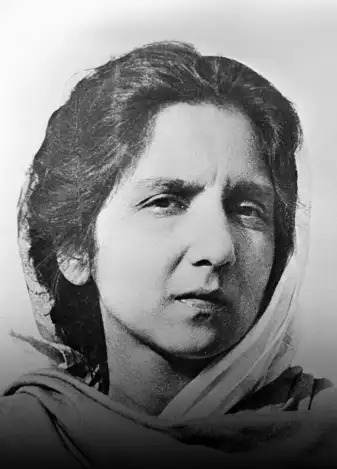
Aruna Asaf Ali (16 July 1909 – 29 July 1996) was an Indian freedom fighter, political activist and publisher. On 9 August 1942, hours after the entire leadership of the Congress had been arrested, she raised the national flag at the Gowalia Tank ground in Bombay and so began the Quit India movement. She then worked underground for nearly four years with a price on her head. After independence she was the first Mayor of Delhi. She was awarded the Bharat Ratna in 1997, a year after her death.
Quick Facts
| Birth name | Aruna Ganguly |
| Born | 16 July 1909, Kalka, Punjab (now Haryana) |
| Died | 29 July 1996, New Delhi (aged 87) |
| Education | Sacred Heart Convent, Lahore; All Saints’ College, Nainital |
| Occupation | Freedom fighter, political activist, publisher |
| Offices | First Mayor of Delhi (1958) |
| Awards | Lenin Peace Prize (1964), Jawaharlal Nehru Award for International Understanding (1991), Padma Vibhushan (1992), Bharat Ratna (1997, posthumous) |
| Spouse | Asaf Ali (m. 1928; d. 1953) |
Early Life
She was born at Kalka, at the foot of the Shimla hills, into a Bengali family of the Brahmo Samaj; her father owned a hotel. She was educated at convent schools in Lahore and Nainital and taught for a time at a girls’ school in Calcutta.
Marriage
At Allahabad she met Asaf Ali, a barrister of Delhi and a leading member of the Congress. He was a Muslim and more than twenty years older. They married in 1928, against the strong opposition of her family. An uncle declared that she was dead to them.
The Freedom Movement
Through her husband she entered the Congress. She was arrested in the salt satyagraha of 1930. When political prisoners were freed under the truce of 1931 she was kept in jail on a charge of vagrancy; the other women prisoners refused to leave without her, and after a public outcry she was released.
In 1932, held in the Tihar jail in Delhi, she went on hunger strike against the treatment of political prisoners. Their conditions were improved, and she was moved to solitary confinement at Ambala. She was less active for some years after her release.
9 August 1942
On 8 August 1942 the Congress, meeting in Bombay, passed the Quit India resolution. Before dawn the next day Mahatma Gandhi, Jawaharlal Nehru, her husband and all the other leaders were arrested.
A flag-hoisting had been announced for that morning at the Gowalia Tank ground. With no one left to conduct it, Aruna Asaf Ali, then thirty-three, presided over the meeting and raised the flag. The police fired tear gas and charged the crowd. See the Quit India movement.
Underground
A warrant was issued, and she disappeared. For almost four years she moved from city to city, directing the resistance with other fugitive leaders, among them Ram Manohar Lohia, with whom she edited the Congress’s secret monthly, Inquilab, and Jayaprakash Narayan. The government offered five thousand rupees for her capture and sold her property.
She fell ill in hiding. Gandhi sent her a note in his own hand: she had done her work, was reduced to a skeleton, and should come out and give herself up, and use the reward for the Harijan cause. She did not. She came out only when the warrant was withdrawn in January 1946. Gandhi, though he disagreed with her methods, called her brave.
In 1946 she supported the mutiny of the ratings of the Royal Indian Navy in Bombay, which the Congress leadership disowned.
After Independence
She found the Congress too cautious. She joined the Socialist Party in 1948 and then, in the early 1950s, the Communist Party of India, which she left after 1956. She helped to found the National Federation of Indian Women in 1954.
In 1958 she was elected the first Mayor of Delhi and did much to improve the city’s services. She resigned, tired of party intrigue.
She rejoined the Congress in the 1960s but took no office. With a colleague she founded a publishing house that brought out the weekly Link and the daily Patriot, newspapers of the left. She remained a friend of the Nehru family while disagreeing with them often.
The Woman
She lived in a small flat in Delhi, travelled by bus into old age, and gave away the money from her awards. She had no children. Asaf Ali, who had been India’s first ambassador to the United States, died in 1953.
Honours
- Lenin Peace Prize (1964)
- Jawaharlal Nehru Award for International Understanding (1991)
- Padma Vibhushan (1992)
- Bharat Ratna (1997)
Death
She died in New Delhi on 29 July 1996. A major road in the city bears her name, and a postage stamp was issued in her honour in 1998.
Featured image: Aruna Asaf Ali in the 1940s. Photo by an unknown photographer, in the public domain, via Wikimedia Commons.



