
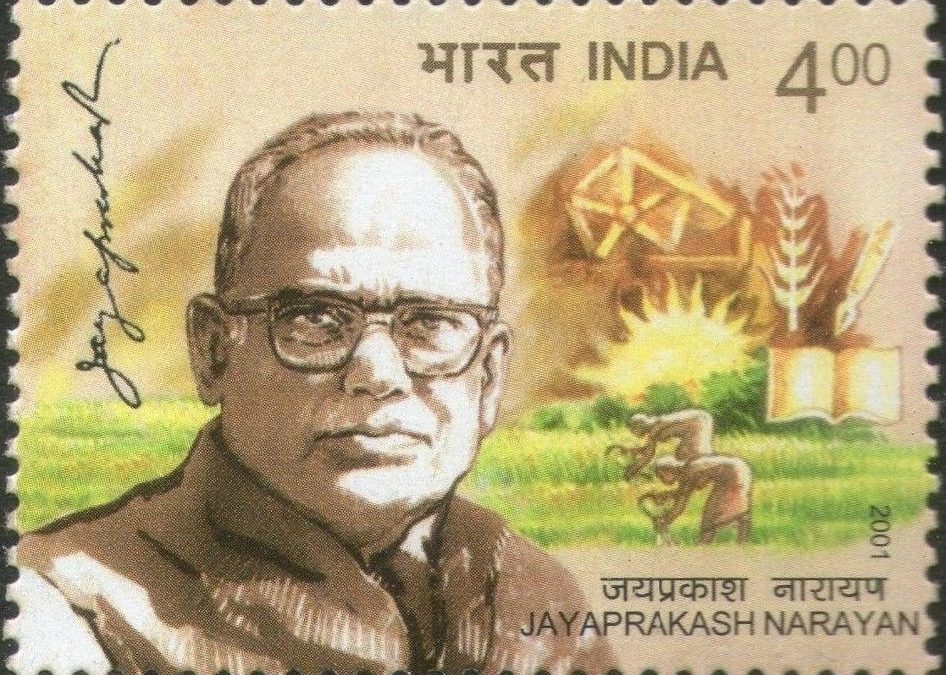
Jayaprakash Narayan (11 October 1902 – 8 October 1979), known as JP and Lok Nayak, the people’s leader, was an Indian freedom fighter, socialist and political thinker. A hero of the Quit India movement, he refused office after independence and gave twenty years to Gandhian village work. In 1974, at seventy-two, he led a students’ movement in Bihar that grew into a national challenge to Indira Gandhi. He was jailed in the Emergency, and the coalition he inspired defeated her in 1977.
Quick Facts
| Full name | Jayaprakash Narayan |
| Born | 11 October 1902, Sitabdiara, Saran district, Bihar |
| Died | 8 October 1979, Patna (aged 76) |
| Education | Universities of California, Iowa, Wisconsin and Ohio State (M.A. in sociology) |
| Occupation | Freedom fighter, socialist leader, social reformer |
| Known for | The Quit India underground; the Bihar movement and Total Revolution |
| Awards | Ramon Magsaysay Award (1965), Bharat Ratna (1999, posthumous) |
| Spouse | Prabhavati Devi |
Early Life
He was born in Sitabdiara, a village on the shifting banks where the Ganga and the Ghaghara meet, the son of a junior official of the canal department. He was a studious boy and won a scholarship to college in Patna. In 1920 he married Prabhavati, the daughter of a leading Bihar Congressman. Weeks before his examinations in 1921 he left the government college in answer to Gandhi’s call for non-cooperation.
America
He sailed for the United States in 1922 and spent seven years there, paying his way by picking fruit, washing dishes, and working in a slaughterhouse and factories. He studied at several universities, took a master’s degree in sociology, and became a convinced Marxist. Prabhavati, meanwhile, lived in Gandhi’s ashram and took a vow of celibacy, which he respected.
The Freedom Movement
He returned in 1929 and joined the Congress at Jawaharlal Nehru‘s invitation. In Nasik jail in 1932 he met other young socialists, and in 1934 they founded the Congress Socialist Party, with JP as general secretary.
Jailed again in 1942, he escaped from Hazaribagh Central Jail with five companions on the night of Diwali, in November, by climbing the wall with a rope of knotted dhotis. He organised an underground resistance, training a guerrilla band in the Nepal hills. He was captured on a train in Punjab in 1943 and tortured in Lahore Fort. When he was released in April 1946 he was, after Gandhi and Nehru, the most popular man in the country.
Sarvodaya
He left the Congress in 1948 and helped build the Socialist Party. Disillusioned with party politics and with Marxism, he announced in 1954 that he was giving his life to Vinoba Bhave‘s land-gift movement. For the next two decades he worked in the villages of Bihar.
He also served as an unofficial peacemaker: with the Naga underground in 1964, on Kashmir, and in 1972 in the Chambal valley, where several hundred dacoits laid down their arms before him. He received the Ramon Magsaysay Award in 1965.
Total Revolution
In 1974 students in Bihar rose against corruption, rising prices and unemployment, and asked him to lead them. He agreed on condition that the movement stay non-violent. On 5 June 1974, at a vast rally in Patna, he called for Sampoorna Kranti, Total Revolution: a change not of government only but of the whole social, economic and moral order. In November he was struck in a police lathi charge.
The movement spread, and the opposition parties gathered behind him. On 12 June 1975 a court set aside Indira Gandhi‘s election. On 25 June, at the Ramlila grounds in Delhi, he asked the police and the army not to obey unlawful orders.
The Emergency
That night the Emergency was proclaimed and he was arrested. Held in solitary detention at Chandigarh, he wrote a prison diary. His kidneys failed, and he was released in November 1975, a dying man dependent on dialysis. See the Emergency of 1975–77.
1977
When elections were called he brought the opposition parties together as the Janata Party and campaigned from his sickbed. After their victory in March 1977 he took the new members of Parliament to Gandhi’s memorial at Rajghat to swear an oath of service. He took no office. He watched the government he had made break up in quarrels.
Death
He died in Patna on 8 October 1979. He was awarded the Bharat Ratna in 1999. A generation of politicians, among them Lalu Prasad Yadav and Nitish Kumar, came out of his movement. The airport at Patna and a hospital in Delhi bear his name.
Featured image: Jayaprakash Narayan, from a 2001 postage stamp of India. Photo by India Post, Government of India, licensed under Government Open Data License – India, via Wikimedia Commons.



