
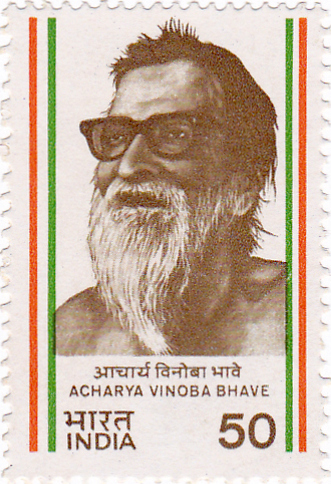
Vinayak Narahari Bhave (11 September 1895 – 15 November 1982), known as Acharya Vinoba Bhave, was an Indian advocate of non-violence, a scholar of religion and the foremost disciple of Mahatma Gandhi. In 1951 he began the Bhoodan, or land-gift, movement, and for thirteen years walked from village to village across India asking those who owned land to give a share to those who had none. He was the first recipient of the Ramon Magsaysay Award for community leadership and was awarded the Bharat Ratna after his death.
Quick Facts
| Full name | Vinayak Narahari Bhave |
| Born | 11 September 1895, Gagode, Raigad district, Maharashtra |
| Died | 15 November 1982, Paunar, Wardha, Maharashtra (aged 87) |
| Occupation | Social reformer, teacher, writer |
| Known for | The Bhoodan and Gramdan movements; Talks on the Gita |
| Awards | Ramon Magsaysay Award (1958), Bharat Ratna (1983, posthumous) |
Early Life
He was born into a Brahmin family in a village on the Konkan coast. His father was a textile technologist at Baroda; his mother, Rukminibai, a devout woman whose simple piety he said shaped him more than any book. He read the saints of Maharashtra and the Gita as a boy and took a vow of celibacy at ten.
In 1916, on his way to Bombay to sit an examination, he burnt his school certificates and went to Benares to study Sanskrit and seek God.
With Gandhi
There he read a report of a speech by Mahatma Gandhi and wrote to him. Gandhi invited him to his ashram at Ahmedabad, where he arrived in June 1916. He taught, spun, cooked and cleaned latrines, and Gandhi wrote to his father that the young man had acquired at a tender age what others reached after long labour.
In 1921 Gandhi sent him to Wardha, in central India, to run a new ashram. He lived there, and at nearby Paunar, for the rest of his life. He was jailed several times in the 1920s and 1930s. In Dhule jail in 1932 he gave a series of talks on the Gita to his fellow prisoners, taken down and published as Talks on the Gita, which has been translated into many languages.
In October 1940 Gandhi chose him, then almost unknown to the country, as the first to offer individual satyagraha against India’s being drawn into the war. Jawaharlal Nehru was the second.
Bhoodan
In April 1951 he was walking through Telangana, where a communist-led peasant rising was being put down by the army. On 18 April, at the village of Pochampally, a group of landless Dalit families told him they needed eighty acres to live. He asked the meeting whether anyone could help. A landowner, Vedire Ramachandra Reddy, stood up and offered a hundred.
Vinoba saw in it an answer both to violence and to the slowness of the law. He walked on, asking each landowner to treat him as a son and give him a sixth of his land. Over thirteen years he covered tens of thousands of kilometres on foot, through nearly every state. More than four million acres were pledged.
The results fell short of the promise. Much of the land given was barren or under dispute, and a large part was never distributed. From the mid-1950s he turned to Gramdan, the gift of a whole village’s land to the community. He also persuaded some of the dacoits of the Chambal ravines to surrender in 1960.
Later Years
He returned to Paunar in the 1960s, founded an ashram for women, and gave himself to study and silence. He knew many languages and wrote on the Quran, the Bible and the Dhammapada as well as the Hindu scriptures.
During the Emergency of 1975–77 he was reported to have called it an era of discipline. The remark, which he later qualified, angered many old associates, among them Jayaprakash Narayan, and critics called him the government’s saint. He also fasted to demand a ban on cow slaughter.
Death
In November 1982, after a heart attack, he refused food, water and medicine, and died on 15 November. He was awarded the Bharat Ratna in 1983.
Featured image: Vinoba Bhave, from a 1983 postage stamp of India. Photo by India Post, Government of India, licensed under Government Open Data License – India, via Wikimedia Commons.



