
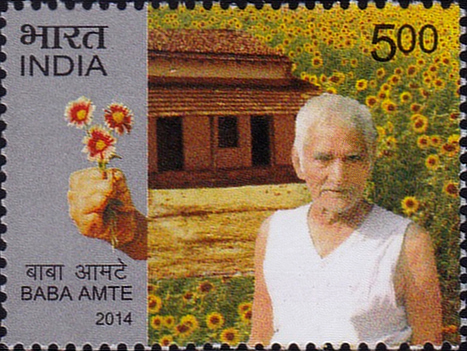
Murlidhar Devidas Amte (26 December 1914 – 9 February 2008), known as Baba Amte, was an Indian social worker who devoted his life to the care and rehabilitation of people suffering from leprosy. At Anandwan, the community he founded in Maharashtra in 1949, he gave patients cast out by their families work, a home and self-respect. He later led marches for national unity and spent a decade on the banks of the Narmada in protest against large dams.
Quick Facts
| Full name | Murlidhar Devidas Amte |
| Born | 26 December 1914, Hinganghat, Wardha district, Maharashtra |
| Died | 9 February 2008, Anandwan, Maharashtra (aged 93) |
| Education | Law degree, Nagpur |
| Occupation | Social worker, lawyer |
| Founded | Maharogi Sewa Samiti and Anandwan, Warora (1949) |
| Awards | Padma Shri (1971), Ramon Magsaysay Award (1985), Padma Vibhushan (1986), UN Human Rights Prize (1988), Templeton Prize (1990), Gandhi Peace Prize (1999) |
| Spouse | Sadhana Amte |
| Children | Vikas Amte, Prakash Amte |
Early Life
He was born into a wealthy Brahmin family of landowners; his father was an officer of the government. “Baba” was a childhood pet name. He had a pampered youth: a gun at fourteen, a sports car with cushions of panther skin, reviews of films for a magazine. He took a law degree and built a good practice at Wardha.
Wardha was the home of Mahatma Gandhi‘s ashram. Amte came under his influence, took to wearing homespun, and was jailed in 1942. When he once faced down British soldiers who were molesting a woman, Gandhi named him Abhay Sadhak, the fearless seeker.
The Encounter
He gave up the law and, to understand the lives of the lowest, worked as a scavenger carrying baskets of night soil. One rainy night he came upon a man lying in a gutter in the last stage of leprosy, his fingers and nose gone, covered in maggots. He ran away in terror.
He was ashamed of the fear more than he had ever been of anything. He went back, fed the man and sheltered him until he died. He then went to Calcutta to study the disease at the School of Tropical Medicine.
Anandwan
In 1949, with his wife Sadhana, two small sons, six leprosy patients, a lame cow and fourteen rupees, he settled on a piece of rocky scrub land given by the government near Warora, in the Chandrapur district. They dug a well and began to farm. He named the place Anandwan, the forest of joy.
His principle was that charity destroys and work builds. The patients, many with damaged hands and feet, cleared land, grew their own food, made their own clothes and shoes, and built workshops, a dairy and houses. Anandwan became a self-supporting community of several thousand, with a hospital, schools for the blind and the deaf, and a college, opened to the surrounding region. He founded further centres at Somnath and Ashokwan.
He is said to have had himself injected with the bacilli to help in the search for a vaccine, without result.
Bharat Jodo
In 1985–86, at seventy and with a spine so damaged that he could not sit and travelled lying in a van, he led a “Knit India” march of young people from Kanyakumari to Kashmir, to speak for unity at a time of violence in Punjab and elsewhere. A second march, from Gujarat to Arunachal Pradesh, followed in 1988.
The Narmada
In 1990 he left Anandwan and went to live at Kasravad, on the bank of the Narmada in Madhya Pradesh, in solidarity with the villagers who would be displaced by the Sardar Sarovar and other dams, a movement led by Medha Patkar. He stayed about a decade. He returned the Padma awards in protest at the treatment of the tribal people of the valley.
Honours
- Ramon Magsaysay Award (1985)
- United Nations Prize in the Field of Human Rights (1988)
- Templeton Prize (1990)
- Right Livelihood Award, shared with Medha Patkar (1991)
- Gandhi Peace Prize (1999)
Family
His elder son, Dr Vikas Amte, and his wife ran Anandwan after him. His younger son, Dr Prakash Amte, and his wife Mandakini run the Lok Biradari Prakalp at Hemalkasa, among the Madia Gond tribe, for which they received the Magsaysay Award in 2008.
Death
He died at Anandwan on 9 February 2008, aged ninety-three, and was buried there, as he had wished, and not cremated. A line of his sums up his creed: work builds, charity destroys.
Featured image: Baba Amte, from a 2014 postage stamp of India. Photo by India Post, Government of India, licensed under Government Open Data License – India, via Wikimedia Commons.



