
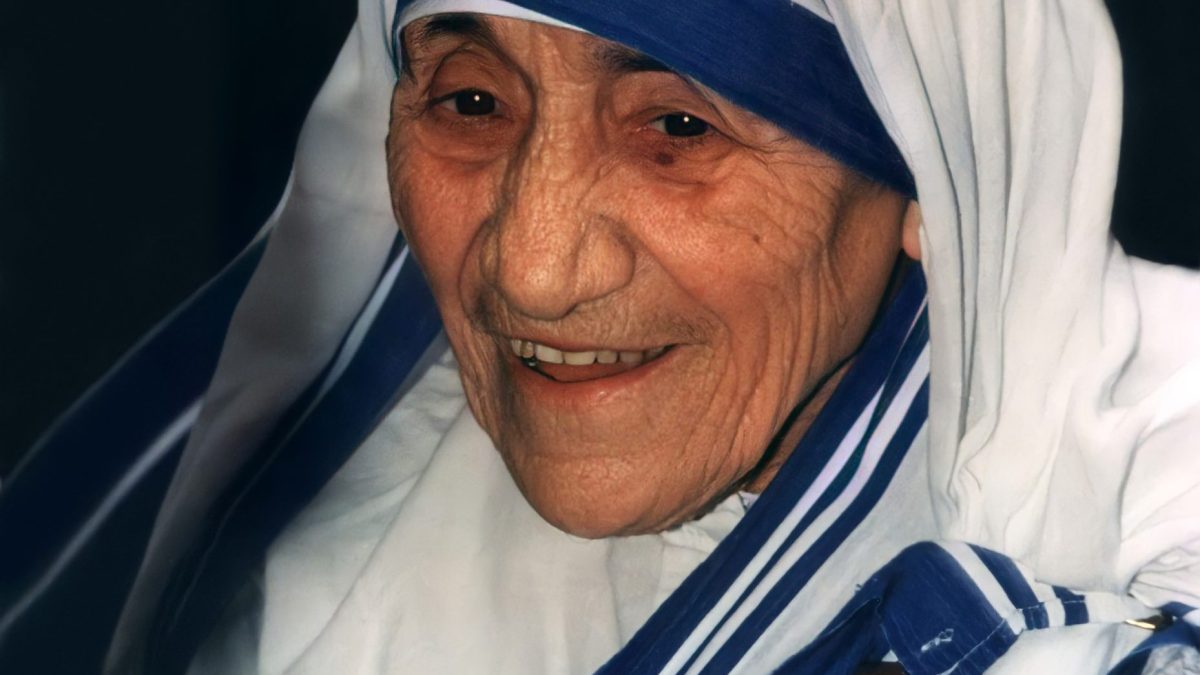
Mother Teresa (26 August 1910 – 5 September 1997), honoured in the Catholic Church as Saint Teresa of Calcutta, was an Albanian-born Indian nun who founded the Missionaries of Charity, a religious congregation devoted to serving “the poorest of the poor”. She lived in India from the age of eighteen, took Indian citizenship, and spent nearly half a century in the slums of Calcutta (now Kolkata). She received the Nobel Peace Prize in 1979 and the Bharat Ratna in 1980, and was declared a saint in 2016.
Quick Facts
| Birth name | Anjezë Gonxhe Bojaxhiu |
| Born | 26 August 1910, Skopje (now in North Macedonia) |
| Died | 5 September 1997 (aged 87), Kolkata, West Bengal, India |
| Nationality | Indian (from 1951) |
| Occupation | Catholic nun, missionary |
| Known for | Founder of the Missionaries of Charity |
| Awards | Padma Shri (1962); Ramon Magsaysay Award (1962); Nobel Peace Prize (1979); Bharat Ratna (1980) |
| Canonised | 4 September 2016, by Pope Francis |
Early Life
She was born into an Albanian Catholic family in Skopje, then part of the Ottoman Empire, the youngest child of Nikola Bojaxhiu, a merchant, and his wife, Dranafile. Her father died when she was about eight. At eighteen she left home to join the Sisters of Loreto in Ireland, where she learned English, and she never saw her mother again.
Loreto Years
She reached India in January 1929 and did her novitiate in Darjeeling, taking the name Teresa after Thérèse of Lisieux. From 1931 she taught geography and history at St. Mary’s School at Entally in Calcutta, a convent school for girls, and became its headmistress in 1944. The Bengal famine of 1943 and the communal killings of 1946 took place around its walls.
Missionaries of Charity
On 10 September 1946, on a train to Darjeeling, she experienced what she called a “call within a call”, to leave the convent and live among the poor. Permission from Rome took two years. In 1948 she put on a white cotton sari with a blue border, took a short course in nursing at Patna and began by teaching slum children in the open air. Former pupils joined her, and on 7 October 1950 the Missionaries of Charity was recognised as a congregation.
In 1952 she opened Nirmal Hriday, a home for the dying, in a pilgrims’ hall beside the Kalighat temple, so that people picked up from the streets could die cared for and according to the rites of their own faith. A children’s home, Shishu Bhavan, a leprosy settlement and many other houses followed. From 1965 the order spread abroad, and by the time of her death about four thousand sisters ran some six hundred houses in more than a hundred countries.
Recognition
India gave her the Padma Shri in 1962 and its highest civilian award, the Bharat Ratna, in 1980. She accepted the Nobel Peace Prize in Oslo in December 1979, asked that the banquet be cancelled and the money given to the poor, and used her lecture to condemn abortion.
Criticism
Her work was not without critics. Doctors and former volunteers questioned the standard of medical care and hygiene in her homes, given the donations the order received. Writers such as Christopher Hitchens attacked her opposition to contraception and abortion, her acceptance of money from disreputable donors and what they saw as a celebration of suffering. Some in India objected that her fame had fixed an image of Calcutta as a city of misery, and others accused the order of seeking conversions, which it denied. Letters published after her death showed that for decades she had felt an absence of God in her own prayer.
Death and Sainthood
After years of heart trouble she stepped down as head of the order in March 1997 and died in Kolkata on 5 September. She was given a state funeral. Pope John Paul II beatified her in 2003, and Pope Francis canonised her at the Vatican on 4 September 2016. Her tomb at the Mother House in Kolkata is a place of pilgrimage.
Frequently Asked Questions
When and where was Mother Teresa born?
Mother Teresa was born on 26 August 1910 in Skopje (now in North Macedonia).
When did Mother Teresa die?
Died: 5 September 1997 (aged 87), Kolkata, West Bengal, India.
What is Mother Teresa known for?
Known for: Founder of the Missionaries of Charity.
What honours has Mother Teresa received?
Padma Shri (1962); Ramon Magsaysay Award (1962); Nobel Peace Prize (1979); Bharat Ratna (1980).
Featured image: Mother Teresa in Washington, D.C., June 1995. Photo by John Mathew Smith, licensed under CC BY-SA 2.0, via Wikimedia Commons.



