
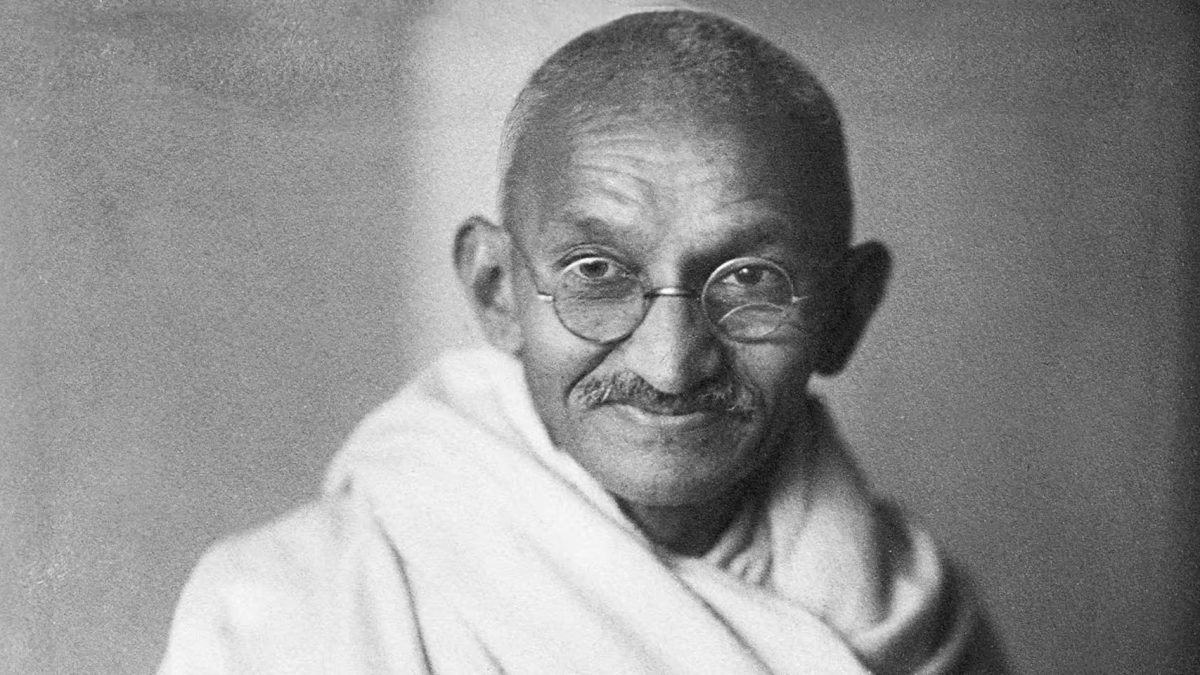
Mahatma Gandhi (2 October 1869 – 30 January 1948), born Mohandas Karamchand Gandhi, was the leader of India’s independence movement against British rule. His method of non-violent resistance, which he called satyagraha (“truth force”), inspired civil rights and freedom movements around the world. Revered in India as the Father of the Nation and affectionately called “Bapu”, he was assassinated months after India became independent. His birthday is marked as Gandhi Jayanti in India and as the International Day of Non-Violence worldwide.
Quick Facts
| Full name | Mohandas Karamchand Gandhi |
| Born | 2 October 1869, Porbandar, Gujarat, India |
| Died | 30 January 1948, New Delhi (aged 78) |
| Known as | Mahatma, Bapu, Father of the Nation |
| Education | Inner Temple, London (barrister) |
| Parents | Karamchand Gandhi, Putlibai |
| Spouse | Kasturba Gandhi (m. 1883; d. 1944) |
| Children | Harilal, Manilal, Ramdas, Devdas |
| Major movements | Champaran, Non-Cooperation, Salt March, Quit India |
Early Life
Gandhi was born in Porbandar, a coastal town in present-day Gujarat, where his father, Karamchand, served as chief minister (diwan) of the princely state. His deeply religious mother, Putlibai, had a lasting influence on his beliefs in fasting, vegetarianism and tolerance. At 13 he was married to Kasturba Makhanji. In 1888 he sailed to London to study law and was called to the bar at the Inner Temple in 1891.
South Africa (1893–1914)
After a failed attempt at a legal career in India, Gandhi went to South Africa in 1893 to work on a legal case. Soon after arriving he was thrown off a first-class train compartment at Pietermaritzburg because of his race. The humiliation turned him into an activist. He founded the Natal Indian Congress in 1894. From 1906 he led mass campaigns of peaceful resistance against discriminatory laws, developing the idea of satyagraha. He also set up the Phoenix Settlement and Tolstoy Farm as communal living experiments.
Leading India’s Freedom Struggle
Gandhi returned to India in 1915. In 1917 he took up the cause of indigo farmers in Champaran, Bihar, and in 1918 he supported peasants in Kheda, Gujarat, with the help of Vallabhbhai Patel. These campaigns made him a national figure.
After the Jallianwala Bagh massacre of 1919, Gandhi launched the Non-Cooperation Movement in 1920. He urged Indians to boycott British goods, courts, schools and titles, and to spin their own khadi cloth. He called the movement off in 1922 after a mob killed policemen at Chauri Chaura. He was then imprisoned for sedition.
In March 1930 Gandhi set out from Sabarmati Ashram on a march of about 385 kilometres to the coastal village of Dandi to protest the British tax on salt. On 6 April he picked up a handful of salt, defying the law. The act sparked civil disobedience across India, and tens of thousands were arrested. The following year he attended the Second Round Table Conference in London.
On 8 August 1942 Gandhi launched the Quit India Movement with the call “Do or Die”, demanding an immediate end to British rule. He and the Congress leadership, including Jawaharlal Nehru, were jailed. Kasturba died in detention at the Aga Khan Palace in Pune in 1944.
Independence and Assassination
India won independence on 15 August 1947, but it came with Partition and terrible communal violence. Gandhi spent those days not celebrating but touring riot-hit areas and fasting for peace between Hindus and Muslims. On 30 January 1948, on his way to a prayer meeting at Birla House in New Delhi, he was shot dead by Nathuram Godse, a Hindu nationalist.
Beliefs and Writings
Gandhi’s philosophy rested on truth (satya), non-violence (ahimsa), self-reliance (swadeshi) and simple living. He campaigned against untouchability, calling the oppressed castes “Harijans”. He edited newspapers including Young India and Harijan. His autobiography, The Story of My Experiments with Truth, remains widely read.
Legacy
Frequently Asked Questions
When and where was Mahatma Gandhi born?
Mahatma Gandhi was born on 2 October 1869 in Porbandar, Gujarat, India.
When did Mahatma Gandhi die?
Died: 30 January 1948, New Delhi (aged 78).



