
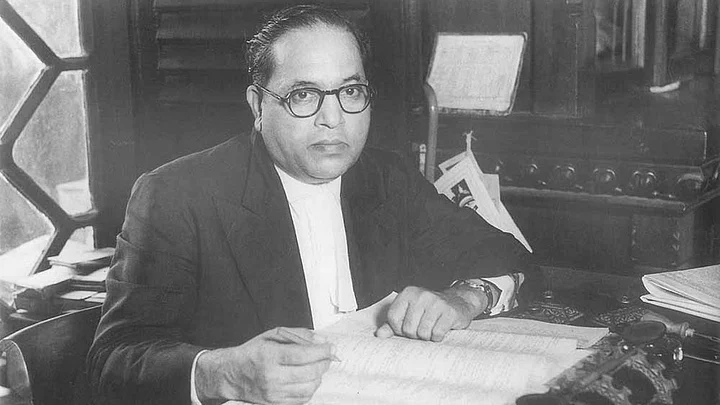
B. R. Ambedkar (14 April 1891 – 6 December 1956), known as Babasaheb, was an Indian jurist, economist, social reformer and politician. He chaired the drafting committee of the Constitution of India. Born into a Dalit family that faced the cruelty of untouchability, he became one of the most highly educated Indians of his time. He devoted his life to fighting caste discrimination, served as independent India’s first Law Minister and, shortly before his death, led a mass conversion to Buddhism.
Quick Facts
| Full name | Bhimrao Ramji Ambedkar |
| Born | 14 April 1891, Mhow (now Dr. Ambedkar Nagar), Madhya Pradesh, India |
| Died | 6 December 1956, Delhi (aged 65) |
| Known as | Babasaheb, Architect of the Indian Constitution |
| Office | 1st Law Minister of India (1947–1951) |
| Education | Elphinstone College, Bombay; Columbia University; London School of Economics; Gray’s Inn |
| Parents | Ramji Maloji Sakpal, Bhimabai |
| Spouses | Ramabai (d. 1935), Savita Ambedkar (m. 1948) |
| Honour | Bharat Ratna (1990, posthumous) |
Early Life
Ambedkar was born in the military cantonment of Mhow, the 14th child of Ramji Maloji Sakpal, a subedar in the British Indian Army. The family belonged to the Mahar caste, which was treated as “untouchable”. At school he was made to sit apart from other children and was not allowed to drink from the common water tap. Despite this, he excelled at his studies. He became one of the first from his community to graduate from Elphinstone College in Bombay.
Education Abroad
With a scholarship from the Maharaja of Baroda, Ambedkar went to Columbia University in New York. There he earned an MA in 1915 and later a PhD in economics. He then studied at the London School of Economics, earning an MSc and a DSc, and qualified as a barrister at Gray’s Inn. His doctorates in economics from both Columbia and the LSE made him one of the best-educated Indians of his generation.
Fight Against Caste
Back in India, Ambedkar launched newspapers such as Mooknayak and founded the Bahishkrit Hitakarini Sabha to support the oppressed classes. In 1927 he led the Mahad Satyagraha to assert Dalits’ right to draw water from a public tank. The same year he publicly burned the Manusmriti, an ancient text he saw as the basis of caste inequality. At the Round Table Conferences in London he demanded separate electorates for the depressed classes. This led to a clash with Mahatma Gandhi, resolved by the Poona Pact of 1932, which instead reserved seats for them. His 1936 essay Annihilation of Caste remains one of the most powerful critiques of the caste system.
Political Career
Ambedkar founded the Independent Labour Party in 1936 and later the Scheduled Castes Federation. From 1942 to 1946 he served as Labour Member of the Viceroy’s Executive Council. He also founded the People’s Education Society to open colleges for poor students.
Architect of the Constitution
After independence, Jawaharlal Nehru invited Ambedkar to be the first Law Minister. In August 1947 he was appointed chairman of the Constitution’s Drafting Committee. He guided the draft through the Constituent Assembly, and the Constitution was adopted on 26 November 1949. It abolished untouchability, guaranteed fundamental rights and provided reservations for Scheduled Castes and Scheduled Tribes. He resigned from the cabinet in 1951 after Parliament stalled his Hindu Code Bill, which sought equal rights for women in marriage and inheritance.
Conversion to Buddhism and Death
Having declared in 1935 that he would not die a Hindu, Ambedkar embraced Buddhism in Nagpur on 14 October 1956. Hundreds of thousands of his followers converted with him. He died in his sleep in Delhi less than two months later, on 6 December 1956. His final work, The Buddha and His Dhamma, was published after his death.
Personal Life
Ambedkar married Ramabai as a teenager; she died in 1935 after years of hardship. In 1948 he married Dr. Sharada Kabir, who took the name Savita Ambedkar.
Legacy and Honours
Frequently Asked Questions
When and where was B. R. Ambedkar born?
B. R. Ambedkar was born on 14 April 1891 in Mhow (now Dr. Ambedkar Nagar), Madhya Pradesh, India.
When did B. R. Ambedkar die?
Died: 6 December 1956, Delhi (aged 65).



