
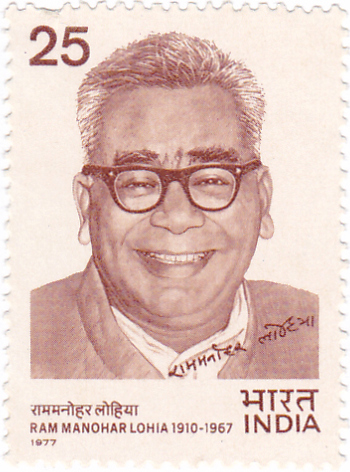
Ram Manohar Lohia (23 March 1910 – 12 October 1967) was an Indian freedom fighter, socialist leader and one of the most original political thinkers of modern India. He ran an underground radio during the Quit India movement, began the struggle for the freedom of Goa, and in the 1960s became the fiercest critic of Jawaharlal Nehru in Parliament. His strategy of uniting all parties against the Congress, and his insistence that power pass to the backward castes, changed the politics of north India.
Quick Facts
| Full name | Ram Manohar Lohia |
| Born | 23 March 1910, Akbarpur, Uttar Pradesh |
| Died | 12 October 1967, New Delhi (aged 57) |
| Education | Banaras Hindu University; Vidyasagar College, Calcutta (B.A.); University of Berlin (Ph.D. in economics, 1933) |
| Occupation | Freedom fighter, politician, political thinker |
| Parties | Congress Socialist Party; Praja Socialist Party; Socialist Party; Samyukta Socialist Party |
| Office | Member of the Lok Sabha (1963–1967) |
| Notable works | Marx, Gandhi and Socialism; Wheel of History; Guilty Men of India’s Partition |
Early Life
He was born at Akbarpur, in what is now the Ambedkar Nagar district, into a family of Marwari merchants. His mother died when he was two. His father, a teacher and a follower of Gandhi, took him to Congress sessions as a boy.
He studied at Benares and Calcutta and went to Germany, where he took a doctorate at Berlin in 1933 with a thesis on the economics of salt taxation, the subject of Gandhi’s march. He saw the rise of the Nazis at first hand.
The Freedom Movement
On his return he helped found the Congress Socialist Party in 1934 and edited its journal. Jawaharlal Nehru put him in charge of the Congress’s new department of foreign affairs.
In 1942, with the leaders in jail, he went underground. With Usha Mehta and others he ran a secret transmitter, the Congress Radio, which broadcast news of the rising for some months. He was arrested in 1944 and tortured in Lahore Fort.
Goa
In June 1946, convalescing in Goa, then under Portuguese rule, he found that public meetings were forbidden. On 18 June he defied the ban and addressed a crowd at Margao in the rain. He was arrested and expelled. The day is observed as Goa Revolution Day.
Socialist Leader
He left the Congress with the other socialists in 1948. Impatient with compromise, he broke with his colleagues in 1955 and formed his own Socialist Party. He was jailed many times in free India for civil disobedience, which he held to be the citizen’s right in a democracy.
Parliament
He entered the Lok Sabha in a by-election in 1963. In his first major speech he said that two hundred and seventy million Indians lived on three annas a day while twenty-five thousand rupees a day were spent on the Prime Minister. The government disputed the figure; the debate, remembered as “three annas against fifteen annas”, put poverty at the centre of Parliament’s attention.
Ideas
- **Caste:** he held that caste, not class alone, was the root of India’s inequality, and demanded that sixty per cent of posts in politics, government and the services go to the backward castes, Dalits, tribal people, women and minorities
- **Language:** he campaigned to end the use of English in public life, as the barrier that shut the common people out of power, in favour of Hindi and the regional languages
- **The four-pillar state:** power divided among village, district, province and centre
- **Seven revolutions:** against inequality between man and woman, of caste, of colour, between nations, of economic exploitation, for privacy against encroachment, and against weapons
- **Neither Marx nor capitalism:** he argued that both rested on large machines and centralised power, and that Asia needed small-unit technology
- **Women:** he held up Draupadi, not Savitri, as the ideal of Indian womanhood
Anti-Congressism
He concluded that the Congress, entrenched in power, could be removed only if all its opponents, from the communists to the Jana Sangh, stood together. In the elections of 1967 the strategy worked: the Congress lost power in nine states, and coalition governments took office across the north.
Death
He never married and owned nothing. He died on 12 October 1967 after an operation at a hospital in New Delhi that now bears his name.
Legacy
The leaders who rose from the backward castes in Uttar Pradesh and Bihar in the following decades, among them Mulayam Singh Yadav and Lalu Prasad Yadav, called themselves his followers. His fellow socialist Jayaprakash Narayan carried the anti-Congress alliance to power at the Centre in 1977.
Featured image: Ram Manohar Lohia, from a 1977 postage stamp of India. Photo by India Post, Government of India, licensed under Government Open Data License – India, via Wikimedia Commons.



