
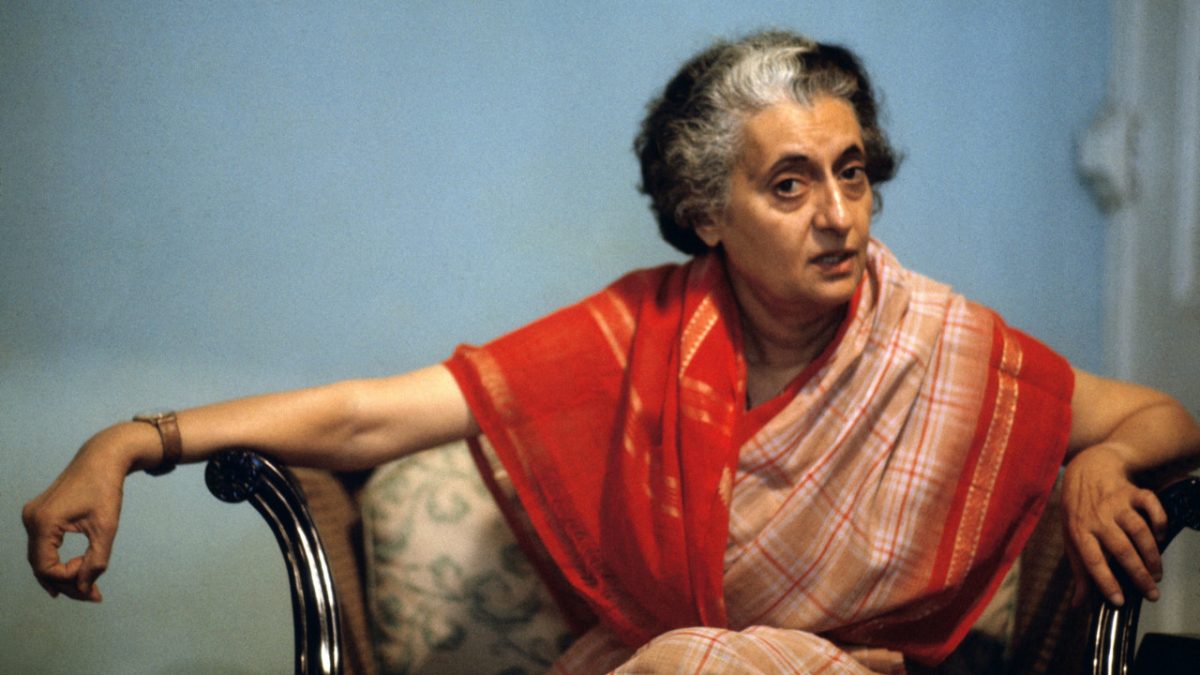
Indira Gandhi (19 November 1917 – 31 October 1984) was India’s first and, to date, only woman Prime Minister. She served from 1966 to 1977 and again from 1980 until her assassination in 1984. The daughter of Jawaharlal Nehru, she was one of the most powerful and controversial leaders in Indian history. She led India to victory in the 1971 war that created Bangladesh, oversaw the Green Revolution and India’s first nuclear test, and imposed the 1975–77 Emergency.
Quick Facts
| Full name | Indira Priyadarshini Gandhi (née Nehru) |
| Born | 19 November 1917, Allahabad (now Prayagraj), India |
| Died | 31 October 1984, New Delhi (aged 66) |
| Office | 3rd Prime Minister of India (1966–1977, 1980–1984) |
| Party | Indian National Congress |
| Education | Visva-Bharati, Santiniketan; Somerville College, Oxford |
| Parents | Jawaharlal Nehru, Kamala Nehru |
| Spouse | Feroze Gandhi (m. 1942; d. 1960) |
| Children | Rajiv Gandhi, Sanjay Gandhi |
| Honour | Bharat Ratna (1971) |
Early Life
Indira was born in Allahabad at Anand Bhawan, the Nehru family home and a centre of the freedom movement. As a child she organised the Vanar Sena (“monkey brigade”), a group of children who helped the independence struggle. She studied at Rabindranath Tagore’s Visva-Bharati in Santiniketan and at Somerville College, Oxford. In 1942 she married Feroze Gandhi, a Congress activist and journalist. The couple were jailed during the Quit India Movement.
Political Rise
After independence Indira acted as hostess and close aide to her father, who was Prime Minister. She became Congress president in 1959. After Nehru’s death she joined Lal Bahadur Shastri’s cabinet as Minister of Information and Broadcasting. When Shastri died suddenly in January 1966, Congress leaders chose her as Prime Minister, expecting her to be easy to control. She quickly proved them wrong.
Prime Minister (1966–1977)
In 1969 Indira Gandhi nationalised 14 major banks. The same year the Congress split, and she took the larger faction with her. In the 1971 general election she won a landslide on the slogan Garibi Hatao (“Remove Poverty”). Her government backed the Green Revolution, which made India self-sufficient in food grains.
In December 1971 India went to war with Pakistan in support of East Pakistan’s independence struggle. The war ended within two weeks with Pakistan’s surrender in Dhaka and the birth of Bangladesh. The victory made Indira Gandhi hugely popular, and she was awarded the Bharat Ratna that year. In 1974 India carried out its first nuclear test, code-named Smiling Buddha, at Pokhran.
In June 1975 the Allahabad High Court found her guilty of electoral malpractice. Amid mass protests she declared a state of Emergency on 25 June 1975. Civil liberties were suspended, the press was censored and opposition leaders were jailed. A forced sterilisation drive linked to her son Sanjay caused widespread anger. When elections were held in 1977, the Congress was heavily defeated and she lost her own seat.
Return to Power (1980–1984)
The Janata government that replaced her soon collapsed, and Indira Gandhi returned to power in January 1980. Months later her son Sanjay was killed in a plane crash. Her final years were marked by militancy in Punjab. In June 1984 she ordered Operation Blue Star, an army assault on armed militants inside the Golden Temple in Amritsar. On 31 October 1984 she was shot dead by two of her Sikh bodyguards at her residence in New Delhi.
Personal Life
Indira and Feroze Gandhi had two sons, Rajiv and Sanjay. Feroze died in 1960. Rajiv succeeded his mother as Prime Minister after her assassination.
Legacy and Honours
Frequently Asked Questions
When and where was Indira Gandhi born?
Indira Gandhi was born on 19 November 1917 in Allahabad (now Prayagraj), India.
When did Indira Gandhi die?
Died: 31 October 1984, New Delhi (aged 66).



