
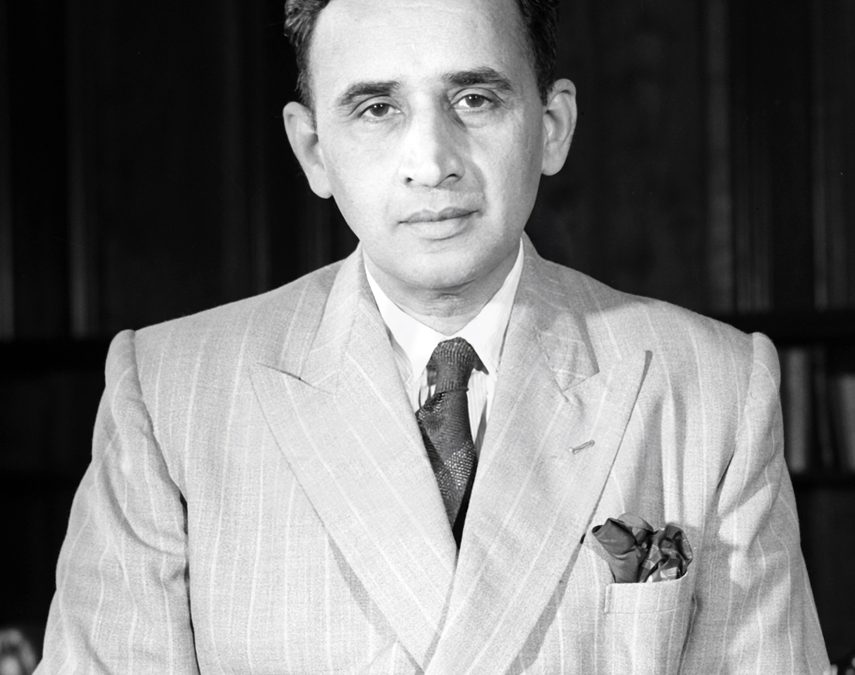
Sir Chintaman Dwarakanath Deshmukh (14 January 1896 – 2 October 1982) was an Indian civil servant and statesman, the first Indian to be Governor of the Reserve Bank of India, from 1943 to 1949, and Union Finance Minister from 1950 to 1956. He guided the country’s finances through the end of the war, Partition and the first Five-Year Plan, and resigned from the Cabinet on a point of principle. He then spent two decades building institutions of education and public life.
Quick Facts
| Full name | Chintaman Dwarakanath Deshmukh |
| Born | 14 January 1896, Nate, Raigad district, Maharashtra |
| Died | 2 October 1982, Hyderabad (aged 86) |
| Education | Elphinstone College, Bombay; Jesus College, Cambridge (natural sciences) |
| Service | Indian Civil Service (1918) |
| Offices | Governor of the Reserve Bank of India (1943–1949); Union Finance Minister (1950–1956); Chairman, University Grants Commission (1956–1961); Vice-Chancellor, University of Delhi (1962–1967) |
| Awards | Ramon Magsaysay Award (1959), Padma Vibhushan (1975) |
| Spouse | Rosina Willcox (d. 1949); Durgabai Deshmukh (m. 1953) |
Early Life
He was born in a village near Mahad on the Konkan coast, the son of a lawyer. He stood first in the matriculation examination of the University of Bombay in 1912, winning the leading scholarship in Sanskrit. At Cambridge he took a degree in natural sciences with a prize in botany, and in 1918 came first in the Indian Civil Service examination held in London.
Civil Servant
He served for twenty years in the Central Provinces and Berar, becoming the youngest revenue and finance secretary in the country. He attended the second Round Table Conference as a secretary, and a memorandum he drafted on the finances of the provinces was adopted as the basis of the award that divided revenues between the Centre and the provinces.
Reserve Bank
He joined the Reserve Bank in 1939 and was appointed its Governor in August 1943, the first Indian in the post. He was knighted the next year.
- **Bretton Woods:** he was a member of the Indian delegation to the conference of 1944 that created the International Monetary Fund and the World Bank, and argued India’s case for a permanent seat on their boards
- **War finance:** he managed the inflation and the sterling balances that the war produced
- **Partition:** he oversaw the division of the bank’s assets with Pakistan
- **Nationalisation:** the bank passed from private shareholders to the state on 1 January 1949
- **Banking law:** the Banking Companies Act of 1949 gave the bank power to regulate commercial banks
Finance Minister
Jawaharlal Nehru made him Finance Minister in 1950, though he belonged to no party; he was elected to Parliament in 1952. He was a member of the Planning Commission and helped to frame the first two Five-Year Plans.
- the State Bank of India, formed in 1955 by taking over the Imperial Bank, to carry banking to the countryside
- the nationalisation of life insurance and the creation of the Life Insurance Corporation in 1956
- the first institutions for industrial finance, and a new Companies Act
Resignation
In 1956 the states were being redrawn on the basis of language. The government proposed to make the city of Bombay a territory ruled from Delhi, separate from the Marathi-speaking state around it. Deshmukh, a Maharashtrian, objected that the Cabinet had not been properly consulted, and resigned in July, telling Parliament so in a speech of unusual bluntness.
Builder of Institutions
- Chairman of the University Grants Commission, 1956–1961, in its formative years
- Vice-Chancellor of the University of Delhi, 1962–1967
- founder and first president of the India International Centre in New Delhi
- president of the Indian Statistical Institute and of the council for applied economic research, and chairman of the National Book Trust
He received the Ramon Magsaysay Award for government service in 1959.
Later Life
In 1969 he stood for President of India as the candidate of opposition parties and came third. He was a lover of Sanskrit, in which he wrote verse, and of gardening.
His first wife, Rosina, an Englishwoman, died in 1949. In 1953 he married Durgabai, the social worker and member of the Planning Commission; Nehru was a witness. They settled at Hyderabad, where he died on 2 October 1982.
Among later governors of the bank he led were I. G. Patel and Raghuram Rajan.
Featured image: C. D. Deshmukh in July 1950. Photo by the Photo Division, Government of India, in the public domain, via Wikimedia Commons.



