
Santiniketan, the “abode of peace”, is a small university town in the Birbhum district of West Bengal, about 160 kilometres from Kolkata. It was the home and life’s work of the poet Rabindranath Tagore. UNESCO inscribed it as a World Heritage Site in 2023.
At a glance
- Location: Bolpur, Birbhum district, West Bengal
- Inscribed: 2023
- Type: Cultural
- Founded: ashram 1863; school 1901; Visva-Bharati 1921
- Founders: Debendranath Tagore and Rabindranath Tagore
History
In 1863 Debendranath Tagore, a leader of the Brahmo Samaj, bought land here and built a house for meditation, which he called Santiniketan. His youngest son, Rabindranath, came to love the open red-earth country.
In 1901 Rabindranath started a school with five pupils. He had hated his own schooling in Calcutta, and wanted children to learn in freedom and close to nature. Classes were, and still are, held under the trees. In 1921, using the money from his Nobel Prize and from lecture tours, he founded Visva-Bharati, a university whose motto is a Sanskrit verse meaning “where the whole world meets in a single nest”. It became a central university in 1951.
A different idea of a university
Tagore invited scholars and artists from China, Japan, Europe and across India. Painting, music and dance were treated as seriously as books. A sister institution at nearby Sriniketan worked on farming and village crafts. Among the students were Satyajit Ray and Amartya Sen; Indira Gandhi also studied here.
What to see
- Santiniketan Griha: the original house built by Debendranath
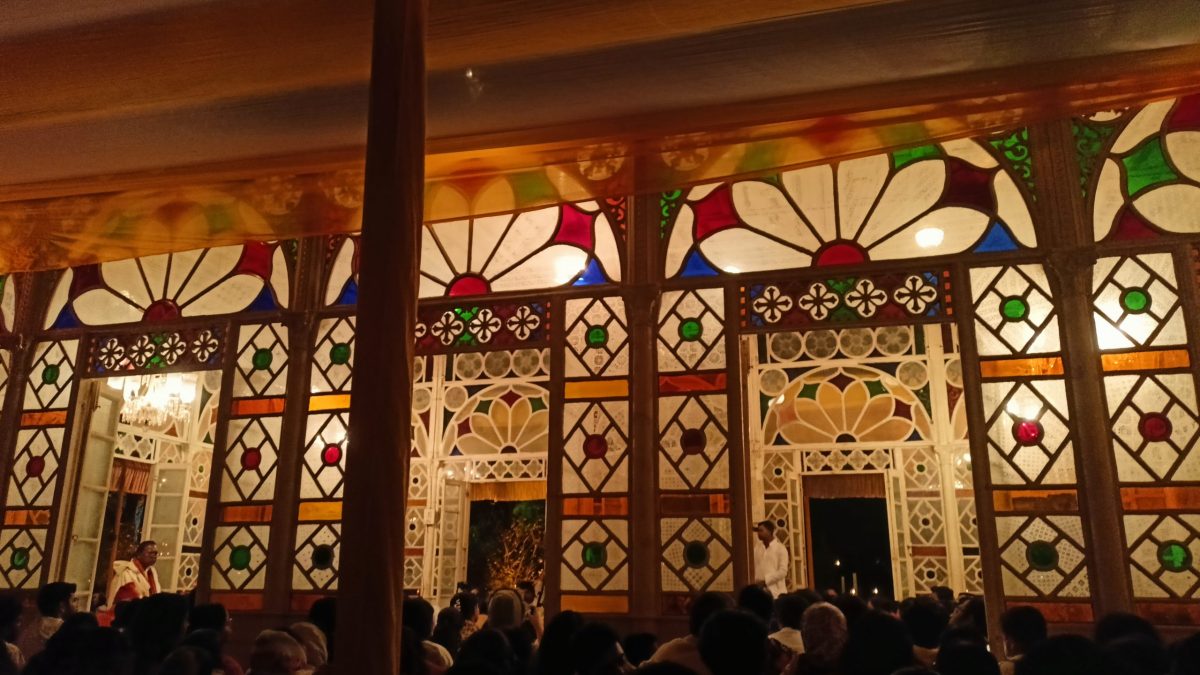
- Upasana Griha: the prayer hall of 1891, walled with coloured Belgian glass
- Uttarayan: the group of five houses in which Tagore lived at different times, including Udayan and the mud-built Shyamali; now a museum
- Kala Bhavana: the art school, with murals and outdoor sculpture by Nandalal Bose, Benode Behari Mukherjee and Ramkinkar Baij
- China Bhavana, Sangit Bhavana and the Black House
The buildings mix ideas from Indian, Japanese, Chinese and South-East Asian architecture with local materials, in deliberate contrast to the colonial style of the time.
Festivals
The spring festival, Basanta Utsav, and the winter fair, Poush Mela, both begun by the Tagores, draw large crowds.
Why it is a World Heritage Site
Santiniketan embodies a vision of education and of an Asian modernism that drew on the traditions of the whole region, and that vision is still practised there.
Visiting
The nearest railway station is Bolpur, about two and a half hours from Kolkata. The campus museums are closed on Wednesdays.
Image: The Upasana Griha, the glass prayer hall, at Santiniketan, West Bengal. Photo by Jitu-saswata mondal, licensed under CC BY-SA 4.0, via Wikimedia Commons.


Leave a Reply