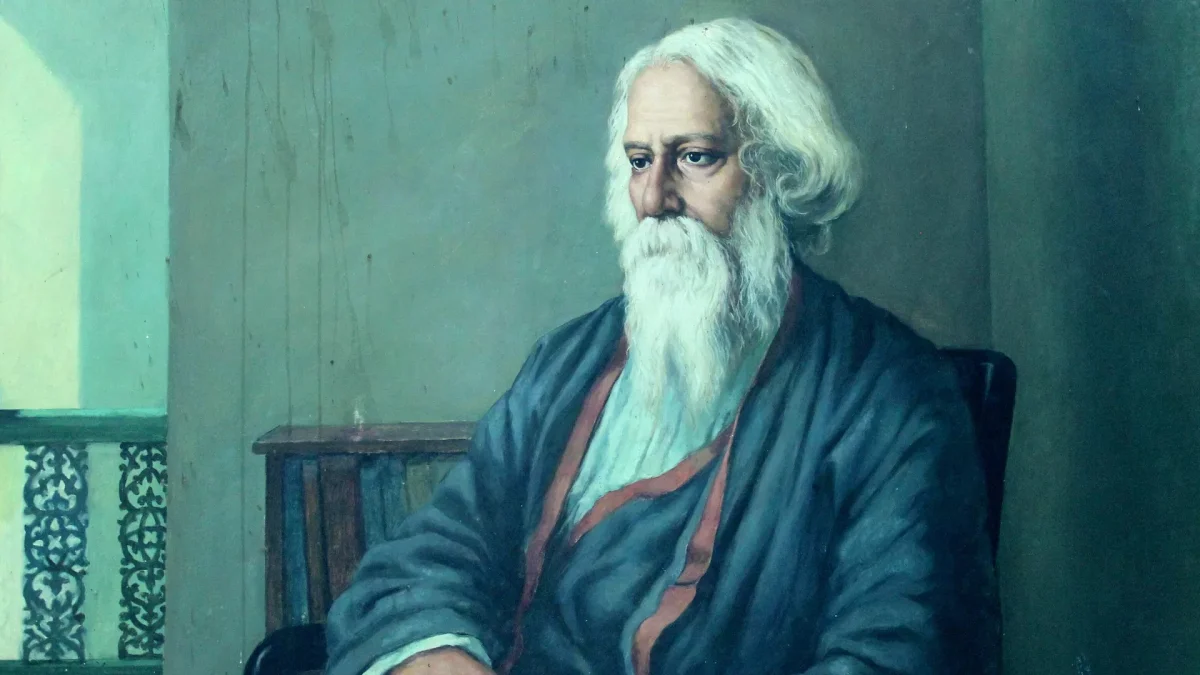
Rabindranath Tagore (7 May 1861 – 7 August 1941) was a Bengali poet, writer, composer, philosopher, educator and painter. He reshaped Bengali literature and music. In 1913 he became the first non-European to win the Nobel Prize in Literature, for Gitanjali. He wrote the national anthems of two nations, India’s “Jana Gana Mana” and Bangladesh’s “Amar Shonar Bangla”, and he founded Visva-Bharati University at Santiniketan. He is revered as Gurudev and is often called the Bard of Bengal.
Quick Facts
| Full name | Rabindranath Tagore (Thakur) |
| Born | 7 May 1861, Jorasanko, Calcutta (now Kolkata), India |
| Died | 7 August 1941, Calcutta (aged 80) |
| Known as | Gurudev; the Bard of Bengal |
| Profession | Poet, novelist, composer, philosopher, educator, painter |
| Father | Debendranath Tagore |
| Spouse | Mrinalini Devi (m. 1883; d. 1902) |
| Famous work | Gitanjali |
| Award | Nobel Prize in Literature (1913) |
| Founded | Visva-Bharati University, Santiniketan (1921) |
Early Life
Tagore was born at Jorasanko, the family mansion in Calcutta, the youngest son of Debendranath Tagore, a religious reformer and leader of the Brahmo Samaj. His family was at the heart of the Bengal Renaissance and filled with writers, musicians and thinkers. Rabindranath disliked formal schooling and was taught largely at home. He began writing poetry as a boy. In 1878 he went to England to study law but returned without a degree.
Literary Career
Tagore wrote across every form: poems, songs, short stories, novels, plays and essays. His short stories, including “Kabuliwala”, “The Postmaster” and “Kshudita Pashan”, brought village and small-town Bengal to life. His novels include Chokher Bali, Gora and Ghare Baire (The Home and the World).
In 1912 Tagore’s own English translations of his devotional poems, published as Gitanjali: Song Offerings with an introduction by W. B. Yeats, created a sensation in the West. In 1913 he was awarded the Nobel Prize in Literature, the first non-European to receive it.
Tagore composed more than 2,000 songs, known as Rabindra Sangeet, which remain central to Bengali culture. He wrote “Jana Gana Mana”, which became India’s national anthem, and “Amar Shonar Bangla”, the national anthem of Bangladesh.
Educator and Thinker
In 1901 Tagore started an open-air school at Santiniketan, where children learned in harmony with nature. It grew into Visva-Bharati University in 1921. His students there later included the filmmaker Satyajit Ray, who adapted several of Tagore’s works for the screen. Tagore travelled the world lecturing on education, humanism and the unity of cultures, and he met figures such as Albert Einstein. He is often credited with popularising the title “Mahatma” for Gandhi, who in turn called him Gurudev.
Nationalism and the Knighthood
The British government knighted Tagore in 1915. In 1919, after the Jallianwala Bagh massacre in Amritsar, he renounced the knighthood in protest. He supported Indian self-rule while warning against narrow nationalism.
Painter
In his late sixties Tagore took up painting and produced thousands of striking works. They were exhibited in Europe and are now considered part of the foundations of modern Indian art.
Personal Life and Death
Tagore married Mrinalini Devi in 1883, and they had five children. He suffered many losses, including the deaths of his wife in 1902 and of several of his children. He died at the family home in Jorasanko on 7 August 1941, aged 80.
Selected Works
Frequently Asked Questions
When and where was Rabindranath Tagore born?
Rabindranath Tagore was born on 7 May 1861 in Jorasanko, Calcutta (now Kolkata), India.
When did Rabindranath Tagore die?
Died: 7 August 1941, Calcutta (aged 80).