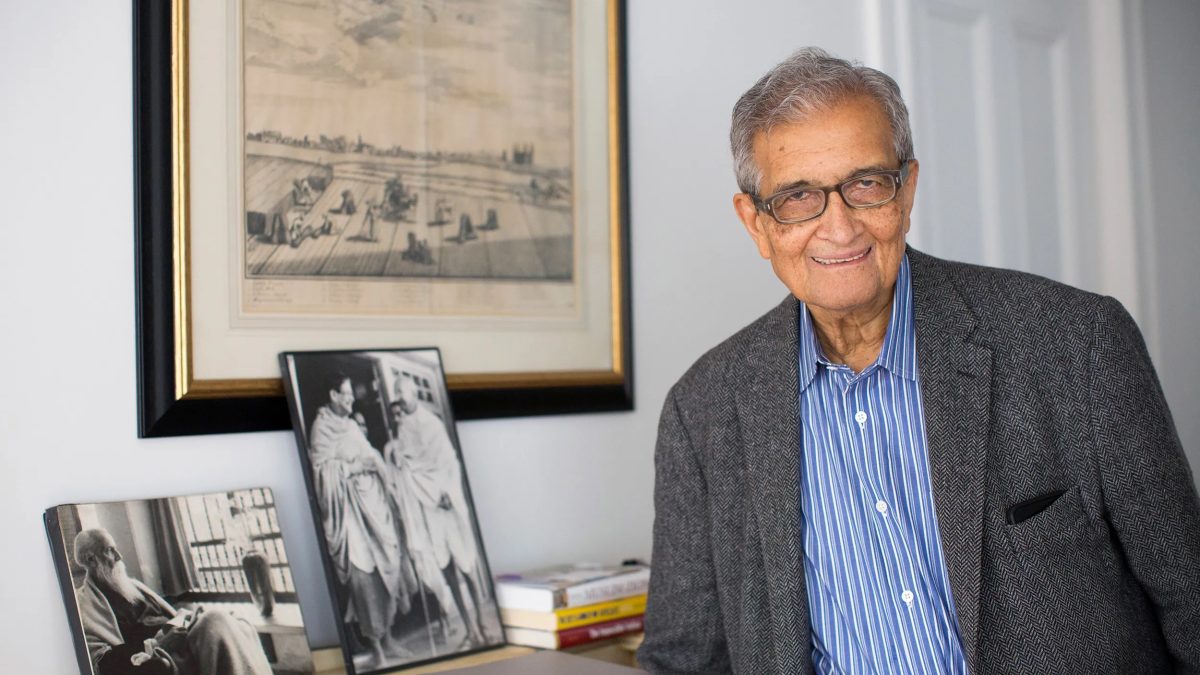
Amartya Sen (born 3 November 1933) is an Indian economist and philosopher who won the Nobel Memorial Prize in Economic Sciences in 1998. His work changed how economists think about poverty, famine, inequality and human well-being. He showed that famines are often caused not by a shortage of food but by people losing the ability to buy it, and he helped create the United Nations’ Human Development Index. He has taught at Cambridge, Oxford, the London School of Economics and Harvard, and he received the Bharat Ratna in 1999.
Quick Facts
| Full name | Amartya Kumar Sen |
| Born | 3 November 1933, Santiniketan, Bengal Presidency (now West Bengal), India |
| Age | 92 |
| Field | Economics, philosophy |
| Education | Presidency College, Calcutta; Trinity College, Cambridge (Ph.D. 1959) |
| Position | Thomas W. Lamont University Professor, Harvard University |
| Known for | Welfare economics, capability approach, studies of famine |
| Spouse | Emma Rothschild (m. 1991) |
| Honours | Nobel Prize in Economics (1998), Bharat Ratna (1999) |
Early Life
Sen was born on the campus of Visva-Bharati at Santiniketan, the school founded by Rabindranath Tagore, who is said to have suggested his name, Amartya, meaning “immortal”. His father, Ashutosh Sen, taught chemistry at Dhaka University, and his maternal grandfather, Kshiti Mohan Sen, was a Sanskrit scholar close to Tagore. As a nine-year-old he saw the Bengal famine of 1943, in which millions died, and as a boy he witnessed communal violence in Dhaka. Both experiences shaped his later work. He studied economics at Presidency College, Calcutta, where he survived oral cancer as a teenager, and then at Trinity College, Cambridge.
Career
At only 22, Sen was asked to set up the economics department at Jadavpur University in Calcutta. After completing his doctorate at Cambridge he taught at the Delhi School of Economics (1963–1971), the London School of Economics (1971–1977) and Oxford University, where he was Drummond Professor of Political Economy.
Sen joined Harvard University in 1987 as a professor of economics and philosophy. From 1998 to 2004 he was Master of Trinity College, Cambridge, the first Asian to head an Oxbridge college, before returning to Harvard. He was also the first chancellor of the revived Nalanda University in Bihar.
Ideas
Personal Life
Sen has been married three times. His first wife was the Bengali writer Nabaneeta Dev Sen, with whom he had two daughters, Antara and Nandana. With his second wife, Eva Colorni, who died in 1985, he had a daughter, Indrani, and a son, Kabir. In 1991 he married the economic historian Emma Rothschild. He has kept his Indian citizenship throughout his career abroad and used his Nobel Prize money to set up the Pratichi Trust, which works on education and health in India and Bangladesh.
Awards and Honours
Selected Books
Frequently Asked Questions
When and where was Amartya Sen born?
Amartya Sen was born on 3 November 1933 in Santiniketan, Bengal Presidency (now West Bengal), India and is 92 years old.
What is Amartya Sen known for?
Known for: Welfare economics, capability approach, studies of famine.
What honours has Amartya Sen received?
Nobel Prize in Economics (1998), Bharat Ratna (1999).
Featured image: Amartya Sen, with photographs of Rabindranath Tagore and Mahatma Gandhi beside him.