Kaushik Basu (born 9 January 1952) is an Indian economist. A professor at Cornell University in the United States, he was Chief Economic Adviser to the Government of India from 2009 to 2012 and Senior Vice-President and Chief Economist of the World Bank from 2012 to 2016, the first Indian to hold that post. He is known for his work in development economics and game theory and for books that explain economics to the general reader.
Quick Facts
| Full name | Kaushik Basu |
| Born | 9 January 1952, Calcutta |
| Age | 74 |
| Education | St Xavier’s Collegiate School, Calcutta; St Stephen’s College, Delhi; London School of Economics (Ph.D., 1976) |
| Occupation | Economist, professor, author |
| Positions | Professor of Economics, Cornell University; Chief Economic Adviser, Government of India (2009–2012); Chief Economist, World Bank (2012–2016) |
| Awards | Padma Bhushan (2008) |
| Spouse | Alaka Malwade Basu |
| Children | 2 |
Early Life
He was born in Calcutta. His father, Keshab Chandra Basu, was a lawyer who had risen from poverty and served as mayor of the city; he hoped his son would follow him into the law. Kaushik went to St Xavier’s Collegiate School and then to St Stephen’s College in Delhi, where he read economics.
Education
At the London School of Economics he heard the lectures of Amartya Sen, gave up the idea of becoming a lawyer and took a doctorate under Sen’s supervision in 1976.
Career
Delhi
He returned to India and taught at the Delhi School of Economics, becoming a professor at thirty-three. In 1992 he founded its Centre for Development Economics.
Cornell
In 1994 he moved to Cornell University, where he holds the Carl Marks chair of international studies and is professor of economics. He has also taught at Princeton, Harvard and the Massachusetts Institute of Technology as a visitor.
Research
- **Child labour:** a much-cited study showing how a ban can, in some conditions, leave poor families better off and in others worse
- **Game theory:** he devised the “traveller’s dilemma” (1994), a puzzle showing that strictly rational players can reach an outcome that common sense rejects
- **Law and economics:** in The Republic of Beliefs he argued that laws work only by changing what people expect of one another
- **Development:** poverty, inequality and the design of anti-poverty programmes
Government of India
In December 2009 he was appointed Chief Economic Adviser in the Ministry of Finance, serving under Pranab Mukherjee and Prime Minister Manmohan Singh. He wrote the annual Economic Survey and advised on inflation, food policy and reform. In a paper of 2011 he proposed that, for bribes that people are forced to pay to obtain what is theirs by right, the giving of the bribe should be made legal while the taking stayed a crime, so that the giver would have reason to report it. The idea caused a storm and was not adopted.
World Bank
From October 2012 to 2016 he was the World Bank’s Chief Economist, overseeing its research and its flagship reports.
Later roles
He was President of the International Economic Association from 2017 to 2021 and is a frequent commentator on the Indian economy, often critical of its recent direction.
Books
- Analytical Development Economics and Prelude to Political Economy
- Beyond the Invisible Hand (2011)
- An Economist in the Real World (2015), on his years in government
- The Republic of Beliefs (2018)
- Policymaker’s Journal (2021), his diaries from Delhi and Washington
- Reason to Be Happy (2024), on using logic in everyday life
Honours
He received the Padma Bhushan in 2008 and holds honorary doctorates from several universities, including IIT Bombay and the University of Bath.
Personal Life
He is married to Alaka Malwade Basu, a demographer and professor at Cornell. They have a daughter and a son. He draws and paints, and has written a play.
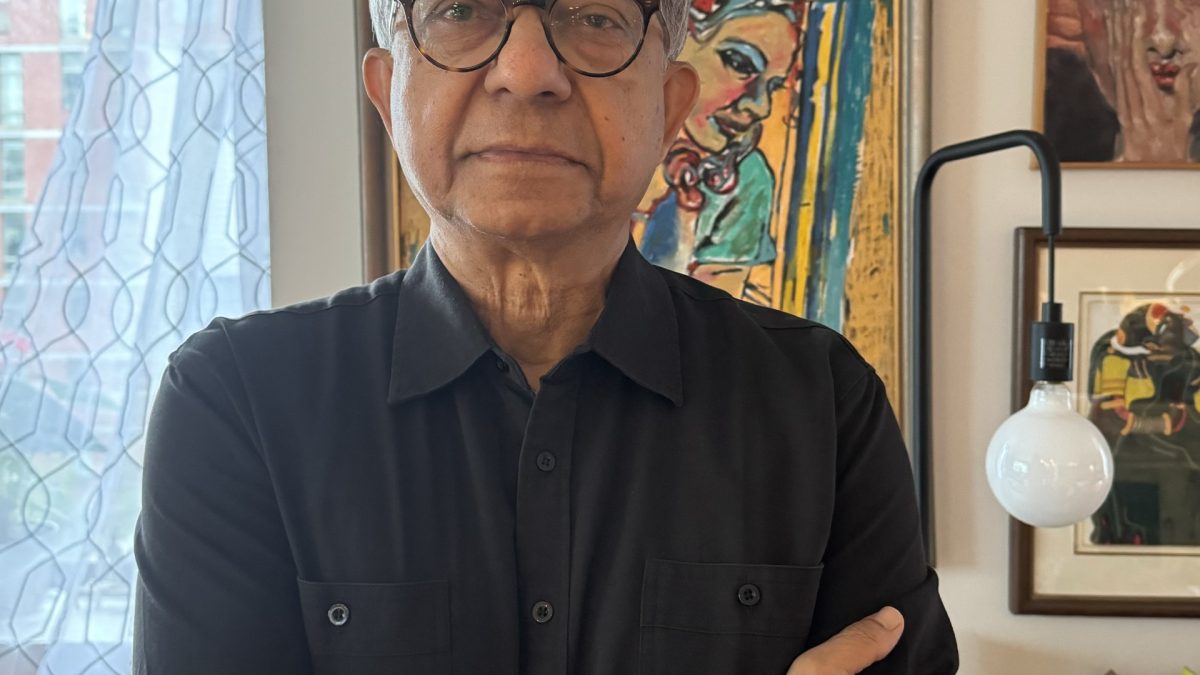
Featured image: Kaushik Basu in his office in New York, August 2025. Photo by Kaushik Basu1952, licensed under CC0, via Wikimedia Commons.