Raja Ramanna (28 January 1925 – 24 September 2004) was an Indian nuclear physicist who led the team that carried out India’s first nuclear test, at Pokhran in May 1974. He directed the Bhabha Atomic Research Centre, chaired the Atomic Energy Commission and served briefly as a minister. He was also a concert-standard pianist and wrote on music and philosophy.
Quick Facts
| Full name | Raja Ramanna |
| Born | 28 January 1925, Tiptur, Tumkur district, Kingdom of Mysore |
| Died | 24 September 2004, Mumbai (aged 79) |
| Field | Nuclear physics |
| Education | Madras Christian College; King’s College London (Ph.D.) |
| Known for | Leading India’s first nuclear test, 1974 |
| Positions | Director, Bhabha Atomic Research Centre; Chairman, Atomic Energy Commission (1983–1987); Minister of State for Defence (1990) |
| Honours | Padma Shri (1968), Padma Bhushan (1973), Padma Vibhushan (1975) |
| Spouse | Malathi Ramanna |
Early Life
He was born at Tiptur in the old Mysore state. His father, B. Ramanna, was in the state’s judicial service, and his mother, Rukmini, loved literature and music. He learnt the piano as a child in Mysore and Bangalore, and for a time thought of music as a career. He was educated at Bishop Cotton Boys’ School in Bangalore and at Madras Christian College, where he took a degree in physics.
Education
He went to King’s College London on a scholarship and took his doctorate in nuclear physics. In London he also earned a licentiate of the Royal School of Music. While still a student he met Homi Bhabha, who offered him a place in his new institute.
Career
With Bhabha
He joined the Tata Institute of Fundamental Research in Bombay in 1949 and moved to the atomic energy establishment at Trombay. He worked on the physics of neutrons and nuclear fission, and took part in the design of Apsara, the first nuclear reactor in Asia outside the Soviet Union, which began operating in 1956. He also set up the training school that produced generations of Indian nuclear scientists.
Pokhran, 1974
He became director of the Bhabha Atomic Research Centre in 1972. With the approval of Indira Gandhi, a small group under him designed and built a nuclear device in secrecy. It was exploded underground at Pokhran in Rajasthan on 18 May 1974. The government described the test, code-named Smiling Buddha, as a peaceful nuclear explosion. Years later Ramanna said plainly that it had been a bomb.
Later offices
- **1978–1981:** Scientific Adviser to the Defence Minister and head of the Defence Research and Development Organisation
- **1983–1987:** Chairman of the Atomic Energy Commission
- **1987:** first director of the National Institute of Advanced Studies in Bangalore, founded by J. R. D. Tata
- **1990:** Minister of State for Defence in the government of V. P. Singh
- **1997–2003:** nominated member of the Rajya Sabha
The Offer from Iraq
In his memoirs he related that on a visit to Baghdad in 1978 he was asked by Saddam Hussein to stay and lead Iraq’s nuclear programme. He left the country as quickly as he could.
Music and Writing
He gave public piano recitals and wrote The Structure of Music in Raga and Western Systems. His autobiography, Years of Pilgrimage, was published in 1991. He was also a student of Sanskrit and Indian philosophy.
Personal Life and Legacy
He was married to Malathi. He died in Mumbai in 2004. The Raja Ramanna Centre for Advanced Technology at Indore, which works on lasers and particle accelerators, is named after him.
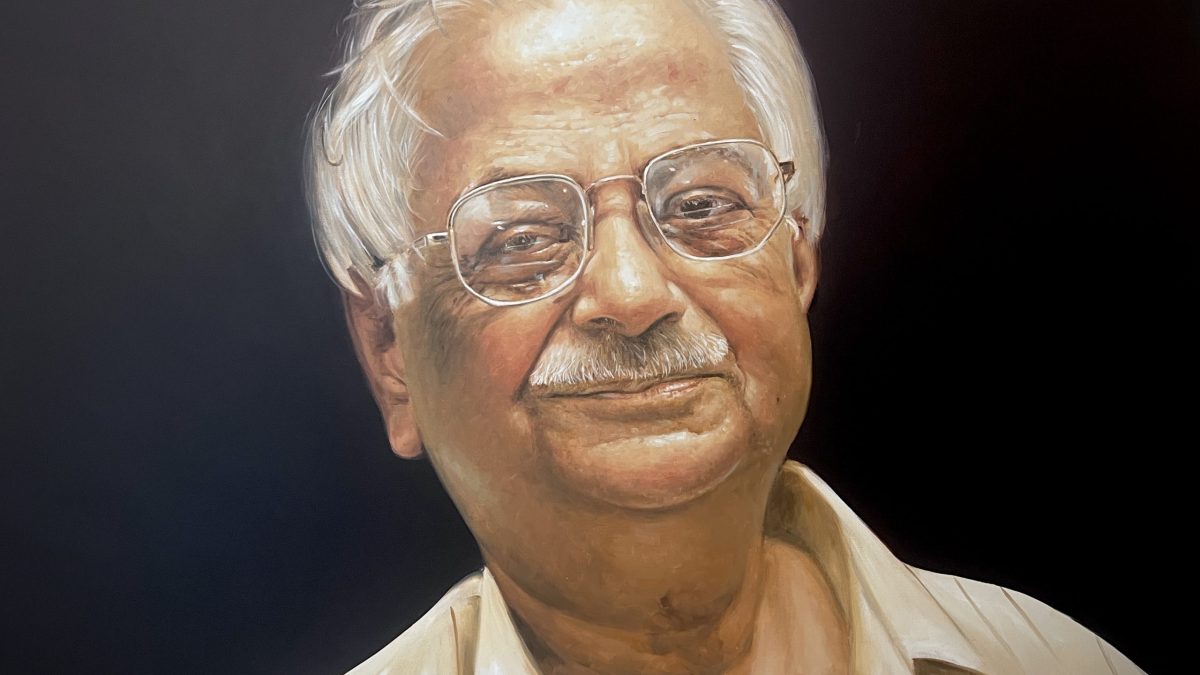
Featured image: Raja Ramanna in an oil portrait by Rajasekharan Parameswaran. Photo by Rajasekharan Parameswaran, licensed under CC BY-SA 4.0, via Wikimedia Commons.