Vikram Sarabhai (12 August 1919 – 30 December 1971) was an Indian physicist and industrialist who is regarded as the father of India’s space programme. He set up the committee that grew into the Indian Space Research Organisation (ISRO) and argued that a poor country could use space technology to solve real problems such as education, communication and weather forecasting. He also founded or helped found many institutions, including the Physical Research Laboratory and the Indian Institute of Management Ahmedabad.
Quick Facts
| Full name | Vikram Ambalal Sarabhai |
| Born | 12 August 1919, Ahmedabad, Bombay Presidency (now Gujarat), India |
| Died | 30 December 1971, Kovalam, Kerala, India (aged 52) |
| Field | Physics, space science |
| Education | Gujarat College, Ahmedabad; St John’s College, Cambridge (Ph.D. 1947) |
| Known for | Founder of India’s space programme |
| Spouse | Mrinalini Sarabhai (m. 1942) |
| Children | Kartikeya Sarabhai, Mallika Sarabhai |
| Honours | Padma Bhushan (1966), Padma Vibhushan (1972, posthumous) |
Early Life
Sarabhai was born into one of Ahmedabad’s leading business families. His father, Ambalal Sarabhai, owned textile mills, and the family home was visited by leaders such as Mahatma Gandhi, Jawaharlal Nehru and Rabindranath Tagore. He was educated at a private school run by his parents, studied at Gujarat College and then went to St John’s College, Cambridge, where he completed the natural sciences tripos in 1940.
Career
When the Second World War broke out, Sarabhai returned to India and studied cosmic rays at the Indian Institute of Science in Bangalore under C. V. Raman. He went back to Cambridge after the war and received his doctorate in 1947. That November he founded the Physical Research Laboratory (PRL) in Ahmedabad, which became the cradle of space science in India. He also ran the family’s businesses and helped set up the Ahmedabad Textile Industry’s Research Association and, in 1961, the Indian Institute of Management Ahmedabad.
After the Soviet Union launched Sputnik, Sarabhai persuaded the government that India needed its own space effort. In 1962 he became chairman of the Indian National Committee for Space Research. With the support of Homi Bhabha, he set up a rocket launching station at Thumba, a fishing village near Thiruvananthapuram, where India’s first sounding rocket was launched on 21 November 1963. The committee became ISRO in 1969. Among the young engineers he recruited and mentored was A. P. J. Abdul Kalam.
After Bhabha’s death in an air crash in 1966, Sarabhai also became chairman of the Atomic Energy Commission. In 1969 he signed an agreement with NASA for the Satellite Instructional Television Experiment (SITE), which in 1975–76 beamed educational programmes to thousands of Indian villages. He also started the project that led to India’s first satellite, Aryabhata, launched in 1975.
Personal Life and Death
In 1942 Sarabhai married the classical dancer Mrinalini Swaminathan, and together they founded the Darpana Academy of Performing Arts in Ahmedabad. Their son, Kartikeya, became an environmental educator, and their daughter, Mallika, a dancer and activist. Sarabhai died in his sleep at Kovalam, Kerala, on 30 December 1971, after attending a rocket launch at Thumba. He was 52.
Awards and Honours
Legacy
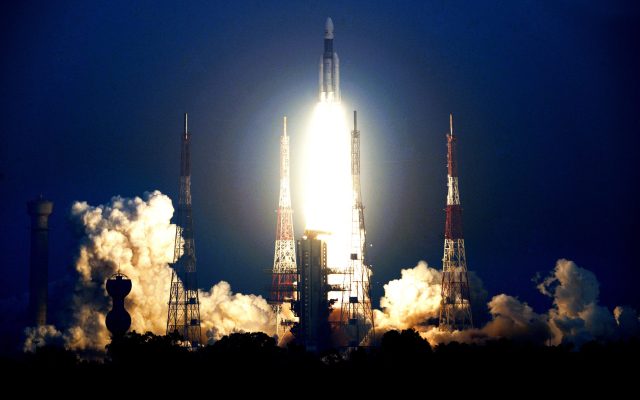
ISRO’s main rocket centre in Thiruvananthapuram is named the Vikram Sarabhai Space Centre. The lander of India’s Chandrayaan Moon missions was named “Vikram” in his honour, and a crater on the Moon also carries his name.
Frequently Asked Questions
When and where was Vikram Sarabhai born?
Vikram Sarabhai was born on 12 August 1919 in Ahmedabad, Bombay Presidency (now Gujarat), India.
When did Vikram Sarabhai die?
Died: 30 December 1971, Kovalam, Kerala, India (aged 52).
What is Vikram Sarabhai known for?
Known for: Founder of India’s space programme.
What honours has Vikram Sarabhai received?
Padma Bhushan (1966), Padma Vibhushan (1972, posthumous).
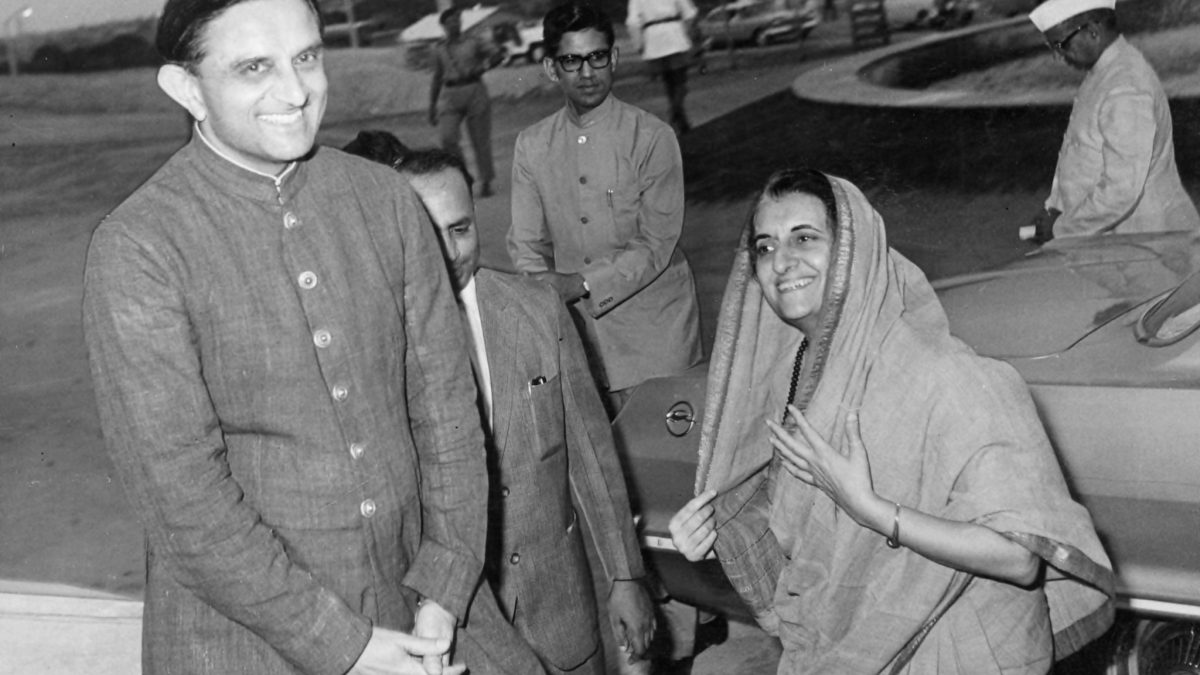
Featured image: Vikram Sarabhai with Prime Minister Indira Gandhi.