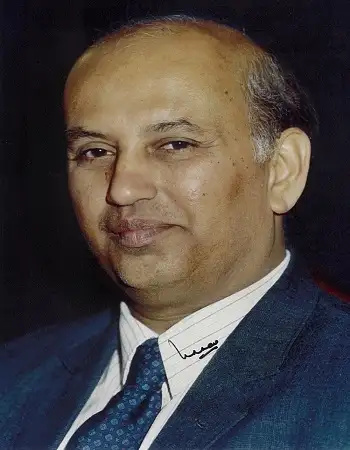
Udupi Ramachandra Rao (10 March 1932 – 24 July 2017) was an Indian space scientist who led the team that built Aryabhata, India’s first satellite, and chaired the Indian Space Research Organisation from 1984 to 1994. He is regarded as the father of India’s satellite programme.
Quick Facts
| Full name | Udupi Ramachandra Rao |
| Born | 10 March 1932, Adamaru, near Udupi, Madras Presidency (now in Karnataka) |
| Died | 24 July 2017, Bengaluru (aged 85) |
| Field | Space science, cosmic ray physics, satellite technology |
| Education | Madras University (B.Sc.); Banaras Hindu University (M.Sc.); Gujarat University (Ph.D., 1960) |
| Known for | Aryabhata; India’s satellite programme |
| Positions | Director, ISRO Satellite Centre; Chairman, ISRO and Space Commission (1984–1994) |
| Honours | Padma Bhushan (1976), Padma Vibhushan (2017) |
| Spouse | Yashoda Rao |
| Children | 2 |
Early Life and Education
He was born at Adamaru, a village near Udupi on the Karnataka coast, into a family of modest means. He went to school in Udupi, took his B.Sc. at Anantapur and Madras University, and his M.Sc. from Banaras Hindu University.
He then joined the Physical Research Laboratory in Ahmedabad as a research student of Vikram Sarabhai, working on cosmic rays, and received his doctorate from Gujarat University in 1960.
Career
America
He went to the Massachusetts Institute of Technology as a researcher and later taught at the University of Texas at Dallas. He worked on experiments carried by the American Pioneer and Explorer spacecraft, and his studies of the solar wind using data from Mariner 2 established his name.
Aryabhata
He returned to the Physical Research Laboratory in 1966. In 1972 Sarabhai’s successor, Satish Dhawan, asked him to build an Indian satellite. With a team of young engineers, most of whom had never seen a satellite, working in tin-roofed sheds at Peenya on the edge of Bangalore, he produced Aryabhata in about thirty months. It was launched by a Soviet rocket on 19 April 1975.
The sheds grew into the ISRO Satellite Centre, of which he was the first director. Under him it built:
- **Bhaskara I and II,** experimental earth-observation satellites
- **APPLE,** India’s first experimental communication satellite, 1981
- **The Rohini satellites,** launched by India’s own SLV-3
- **INSAT and IRS,** the operational communication and remote-sensing systems
Chairman of ISRO
He succeeded Dhawan as chairman in 1984 and served for ten years. In that time ISRO flew the ASLV, developed the Polar Satellite Launch Vehicle, which made its first successful flight in 1994, and began work on the geostationary launcher and its cryogenic engine. The sale of that engine technology by Russia was blocked under American pressure in the early 1990s, and India set out to develop its own.
Later work
After retiring he chaired the governing council of the Physical Research Laboratory and was chancellor of the Indian Institute of Space Science and Technology. He remained an adviser on missions including Chandrayaan-1 and the Mars Orbiter Mission.
Awards
- Padma Bhushan (1976) and Padma Vibhushan (2017)
- Inducted into the Satellite Hall of Fame in Washington in 2013, the first Indian so honoured
- Inducted into the International Astronautical Federation’s Hall of Fame in 2016
Personal Life
He was married to Yashoda, and they had a son and a daughter. He was known for his energy and plain speaking, and went to his office at ISRO almost daily until shortly before his death in Bengaluru in 2017.
Legacy
The ISRO Satellite Centre was renamed the U. R. Rao Satellite Centre in 2018.
Featured image: U. R. Rao in an official ISRO portrait. Photo by Indian Space Research Organisation (ISRO), licensed under Government Open Data License – India, via Wikimedia Commons.