
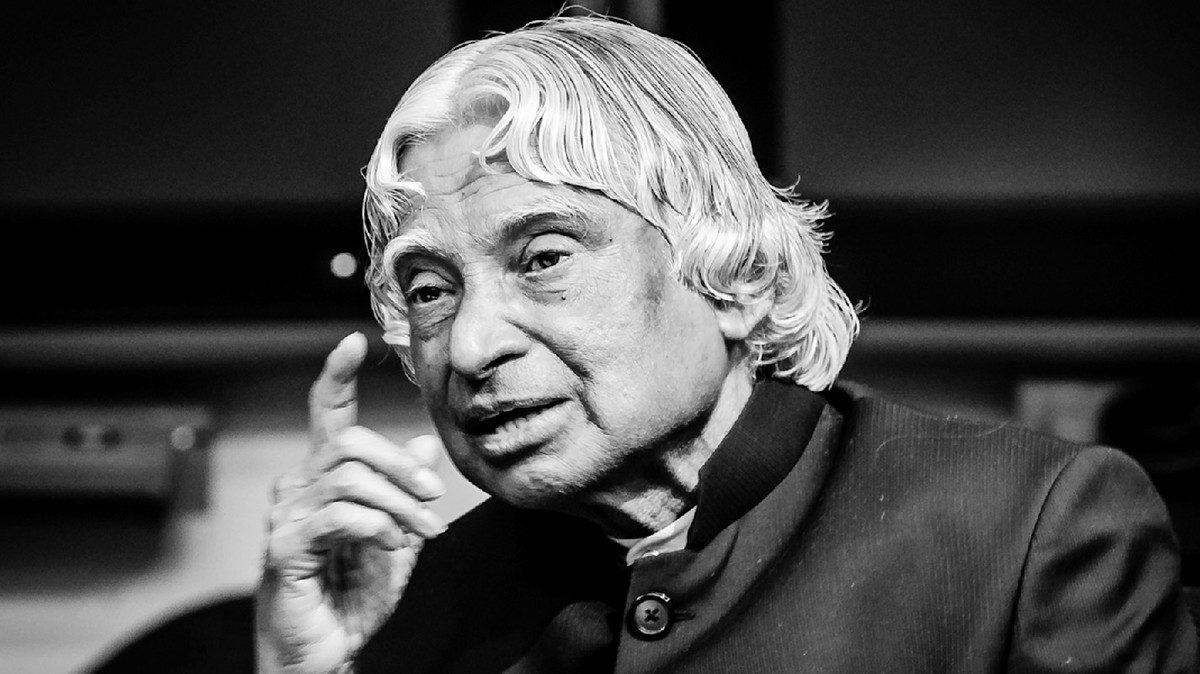
A. P. J. Abdul Kalam (15 October 1931 – 27 July 2015) was an Indian aerospace scientist who served as the 11th President of India from 2002 to 2007. He rose from a modest family in Rameswaram to lead India’s satellite launch vehicle and missile programmes, earning the title “Missile Man of India”. He also played a key role in the 1998 Pokhran nuclear tests. As President he was so popular with young people that he became known as the “People’s President”. He died while giving a lecture to students, doing what he loved most.
Quick Facts
| Full name | Avul Pakir Jainulabdeen Abdul Kalam |
| Born | 15 October 1931, Rameswaram, Tamil Nadu, India |
| Died | 27 July 2015, Shillong, Meghalaya (aged 83) |
| Office | 11th President of India (2002–2007) |
| Known as | Missile Man of India, People’s President |
| Education | St. Joseph’s College, Tiruchirappalli; Madras Institute of Technology |
| Worked at | DRDO, ISRO |
| Honours | Padma Bhushan (1981), Padma Vibhushan (1990), Bharat Ratna (1997) |
Early Life and Education
Kalam was born into a Tamil Muslim family in the temple town of Rameswaram. His father, Jainulabdeen, owned a boat and was an imam at a local mosque. The family was not well off, and as a boy Kalam sold newspapers to help at home. A hard-working student, he studied physics at St. Joseph’s College in Tiruchirappalli and then aerospace engineering at the Madras Institute of Technology. His dream of becoming a fighter pilot ended when he narrowly missed a place in the Indian Air Force.
Scientific Career
Kalam joined the Defence Research and Development Organisation (DRDO) in 1960. He moved to the Indian Space Research Organisation (ISRO) in 1969. There he was project director of India’s first indigenous Satellite Launch Vehicle, the SLV-III, which placed the Rohini satellite into orbit in July 1980. That success made India a member of the small club of space-faring nations.
Returning to DRDO in 1982, Kalam led the Integrated Guided Missile Development Programme. The programme produced missiles including Agni and Prithvi and earned him the nickname “Missile Man of India”. From 1992 to 1999 he was Scientific Adviser to the Defence Minister. In that role he was a central figure in the Pokhran-II nuclear tests of May 1998.
President of India (2002–2007)
In 2002 Kalam was elected President of India with support from both the ruling alliance and the main opposition. As President he travelled widely, met hundreds of thousands of students and opened Rashtrapati Bhavan to the public. He promoted his vision of India as a developed nation by 2020. He was the first scientist and one of the few non-politicians to hold the office.
Later Life and Death
After leaving office, Kalam taught at institutions including the Indian Institutes of Management and the Indian Institute of Science. On 27 July 2015, while delivering a lecture at IIM Shillong, he collapsed from a cardiac arrest and died. He was buried with full state honours in his hometown, Rameswaram, where a memorial now stands. Kalam never married and was known for his simple lifestyle.
Books
Awards and Honours
Frequently Asked Questions
When and where was A. P. J. Abdul Kalam born?
A. P. J. Abdul Kalam was born on 15 October 1931 in Rameswaram, Tamil Nadu, India.
When did A. P. J. Abdul Kalam die?
Died: 27 July 2015, Shillong, Meghalaya (aged 83).
What honours has A. P. J. Abdul Kalam received?
Padma Bhushan (1981), Padma Vibhushan (1990), Bharat Ratna (1997).



