Sir Chandrasekhara Venkata Raman (7 November 1888 – 21 November 1970), known as C. V. Raman, was an Indian physicist who won the Nobel Prize in Physics in 1930 for his work on the scattering of light. His discovery, now called the Raman effect, showed that light changes its wavelength when it passes through a transparent material. He was the first Asian to win a Nobel Prize in any branch of science. He spent his whole career in India, built several of the country’s leading research institutions and received the Bharat Ratna in 1954.
Quick Facts
| Full name | Chandrasekhara Venkata Raman |
| Born | 7 November 1888, Tiruchirappalli, Madras Presidency (now Tamil Nadu), India |
| Died | 21 November 1970, Bangalore (now Bengaluru), India (aged 82) |
| Field | Physics |
| Education | Presidency College, Madras (B.A. 1904, M.A. 1907) |
| Known for | Raman effect (Raman scattering) |
| Spouse | Lokasundari Ammal (m. 1907) |
| Children | 2 (Chandrasekhar and Radhakrishnan) |
| Honours | Nobel Prize in Physics (1930), Bharat Ratna (1954) |
| Remembered on | National Science Day (28 February) |
Early Life
Raman was born in Tiruchirappalli into a Tamil Brahmin family. His father, Chandrasekhara Iyer, taught mathematics and physics, and the family moved to Visakhapatnam when Raman was a child. He was an exceptional student: he finished school at 11, earned his B.A. from Presidency College, Madras, at 16 with a gold medal in physics, and completed his M.A. in 1907. He published his first research paper while still a student.
Career
Because there were few jobs for scientists in India, Raman joined the Indian Finance Service and was posted to Calcutta as an assistant accountant general. In his spare time he did experiments at the Indian Association for the Cultivation of Science (IACS), working early in the morning and late at night, mainly on sound and the physics of musical instruments.
In 1917 Raman gave up his well-paid government post to become the Palit Professor of Physics at the University of Calcutta. On a sea voyage to Europe in 1921 he became curious about why the sea looks blue and began studying how light is scattered. On 28 February 1928, working with his student K. S. Krishnan at IACS, he found that when light passes through a liquid, a small part of the scattered light changes colour. This “Raman effect” gave scientists a new way to study the structure of molecules. He was knighted in 1929 and won the Nobel Prize in Physics in 1930.
In 1933 Raman became the first Indian director of the Indian Institute of Science (IISc) in Bangalore, where his students and colleagues included Homi Bhabha and Vikram Sarabhai. He founded the Indian Academy of Sciences in 1934. After retiring from IISc in 1948 he set up the Raman Research Institute in Bangalore, where he worked on crystals, colours and human vision until his death.
Personal Life
Raman married Lokasundari Ammal in 1907. They had two sons, Chandrasekhar and Venkatraman Radhakrishnan, who became a well-known radio astronomer. Raman’s nephew Subrahmanyan Chandrasekhar won the Nobel Prize in Physics in 1983. Raman was known for his sharp wit, his love of music and his strong belief that Indian science should stand on its own feet.
Awards and Honours
Legacy
India celebrates 28 February, the day the Raman effect was discovered, as National Science Day. Raman spectroscopy, based on his discovery, is used today in chemistry, medicine, materials science and even on Mars rovers. The Raman Research Institute in Bengaluru continues his work.
Frequently Asked Questions
When and where was C. V. Raman born?
C. V. Raman was born on 7 November 1888 in Tiruchirappalli, Madras Presidency (now Tamil Nadu), India.
When did C. V. Raman die?
Died: 21 November 1970, Bangalore (now Bengaluru), India (aged 82).
What is C. V. Raman known for?
Known for: Raman effect (Raman scattering).
What honours has C. V. Raman received?
Nobel Prize in Physics (1930), Bharat Ratna (1954).
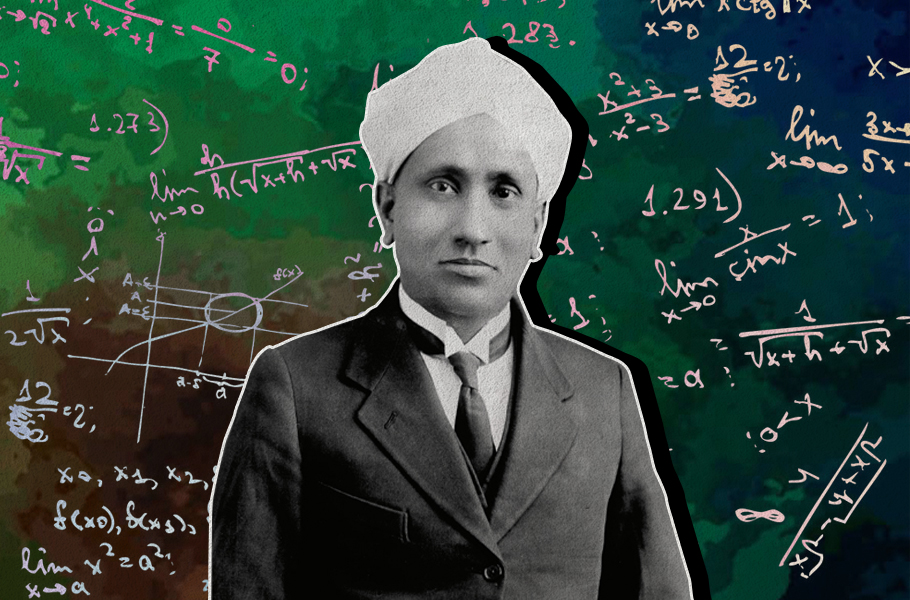
Featured image: C. V. Raman, in an illustration based on a photograph.