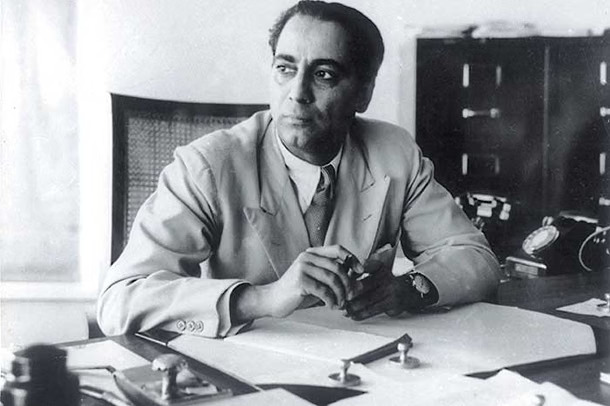
Homi Bhabha (30 October 1909 – 24 January 1966) was an Indian nuclear physicist, known as the father of India’s nuclear programme. He made important contributions to cosmic-ray and particle physics. He founded the Tata Institute of Fundamental Research and the atomic research centre at Trombay, later renamed the Bhabha Atomic Research Centre. As first chairman of India’s Atomic Energy Commission, he designed the country’s long-term nuclear power strategy.
Quick Facts
| Full name | Homi Jehangir Bhabha |
| Born | 30 October 1909, Bombay (now Mumbai), India |
| Died | 24 January 1966, Mont Blanc, France (aged 56) |
| Field | Nuclear and theoretical physics |
| Education | Gonville and Caius College, University of Cambridge |
| Founded | Tata Institute of Fundamental Research (1945); Atomic Energy Establishment, Trombay (1954) |
| Known for | Bhabha scattering; India’s three-stage nuclear power programme |
| Honours | Fellow of the Royal Society (1941), Padma Bhushan (1954) |
Early Life and Education
Bhabha was born into a wealthy, distinguished Parsi family in Bombay with links to the Tata family. He went to the University of Cambridge to study mechanical engineering, as his family wished, but he switched to theoretical physics and earned his doctorate there.
Scientific Work
In the 1930s Bhabha worked with leading European physicists. He described the scattering of electrons by positrons, now called Bhabha scattering. With Walter Heitler he developed a theory of cosmic-ray showers. He was elected a Fellow of the Royal Society in 1941.
Building India’s Nuclear Programme
Stranded in India by the Second World War, Bhabha joined the Indian Institute of Science in Bangalore. With support from the Tata trusts and J. R. D. Tata, he founded the Tata Institute of Fundamental Research in Bombay in 1945. With Jawaharlal Nehru‘s backing, he became the first chairman of the Atomic Energy Commission in 1948. He set up the Atomic Energy Establishment at Trombay, renamed the Bhabha Atomic Research Centre after his death. He devised the three-stage nuclear power programme to use India’s large thorium reserves. In 1955 he presided over the first UN conference on the peaceful uses of atomic energy in Geneva.
Personal Life and Death
Bhabha never married. He was also an accomplished painter and a lover of music and architecture. On 24 January 1966 he was killed when Air India Flight 101 crashed into Mont Blanc in the Alps on the way to Vienna. He was 56.
Legacy
Frequently Asked Questions
When and where was Homi Bhabha born?
Homi Bhabha was born on 30 October 1909 in Bombay (now Mumbai), India.
When did Homi Bhabha die?
Died: 24 January 1966, Mont Blanc, France (aged 56).
What is Homi Bhabha known for?
Known for: Bhabha scattering; India’s three-stage nuclear power programme.
What honours has Homi Bhabha received?
Fellow of the Royal Society (1941), Padma Bhushan (1954).