
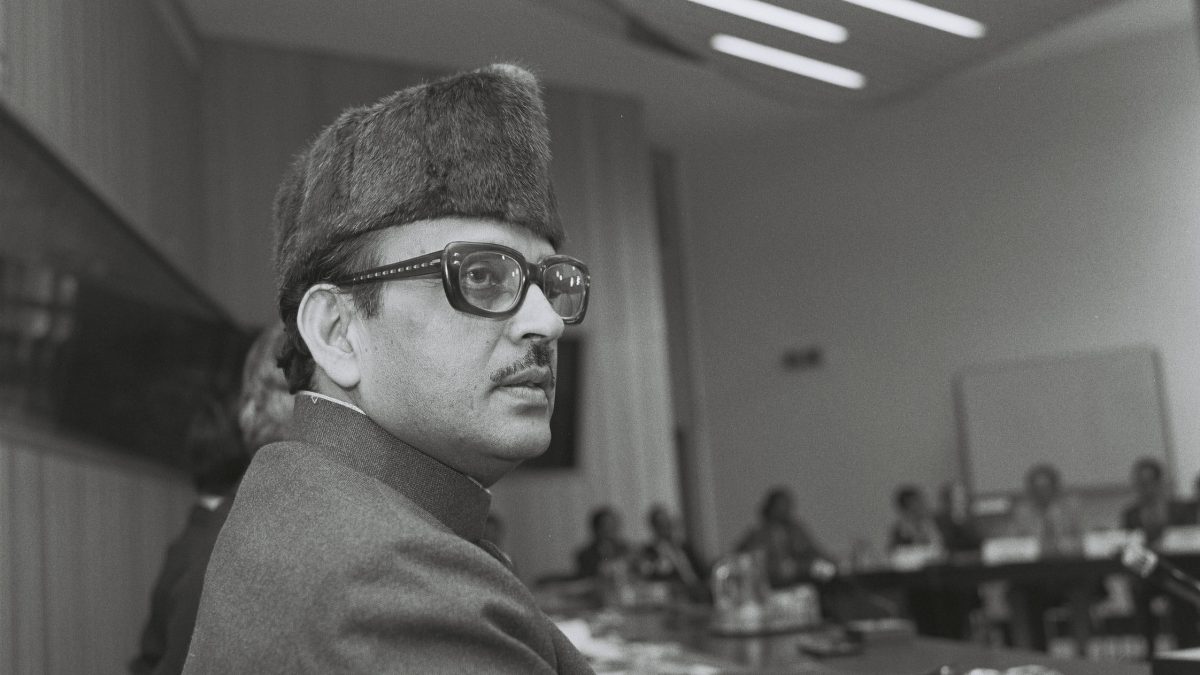
Vishwanath Pratap Singh (25 June 1931 – 27 November 2008) was an Indian politician who was the seventh Prime Minister of India, from December 1989 to November 1990. A member of a princely family of Allahabad district, he was Chief Minister of Uttar Pradesh and then Finance and Defence Minister under Rajiv Gandhi before resigning to lead a campaign against corruption that brought down the Congress government. As Prime Minister he took the decision to reserve government jobs for the Other Backward Classes, which reshaped Indian politics.
Quick Facts
| Full name | Vishwanath Pratap Singh |
| Born | 25 June 1931, Allahabad (now Prayagraj), Uttar Pradesh, India |
| Died | 27 November 2008 (aged 77), New Delhi |
| Offices | Prime Minister of India (1989–1990); Chief Minister of Uttar Pradesh (1980–1982); Finance Minister (1984–1987); Defence Minister (1987) |
| Parties | Indian National Congress; Jan Morcha; Janata Dal |
| Education | University of Allahabad (B.A., LL.B.); Fergusson College, Pune (B.Sc.) |
| Spouse | Sita Kumari |
| Children | 2 sons |
Early Life
Singh was born into the landed family of Daiya and was adopted as a child by the Raja of the neighbouring estate of Manda, to which he succeeded in 1941. He was educated at a boarding school in Dehradun, at Varanasi, at the University of Allahabad, where he studied arts and law, and at Pune, where he took a degree in physics. In 1957 he gave away a large part of his farmland in the Bhoodan movement of Vinoba Bhave.
Political Career
He was elected to the state assembly in 1969 and to the Lok Sabha in 1971 and held junior posts in the commerce ministry. In June 1980 Indira Gandhi made him Chief Minister of Uttar Pradesh. His term was dominated by a campaign against the dacoit gangs of the Chambal and Bundelkhand regions. He resigned in 1982, accepting responsibility after a series of killings, among them that of his own brother, a judge.
As Finance Minister under Rajiv Gandhi from the end of 1984 he cut tax rates and relaxed controls, and at the same time ordered raids on some of the country’s leading industrialists for tax evasion. Moved to the Defence Ministry in January 1987, he began an inquiry into commissions paid on a submarine contract. He resigned that April. When Swedish radio alleged that bribes had been paid in the purchase of Bofors guns, he became the face of the opposition to corruption in high places and was expelled from the Congress.
He formed the Jan Morcha, won a by-election at Allahabad in 1988 and that October united several opposition parties in the Janata Dal. In the election of November 1989 the Congress lost its majority, and he became Prime Minister on 2 December at the head of the National Front, a minority government supported from outside by both the Bharatiya Janata Party and the Left.
His government withdrew the Indian peace-keeping force from Sri Lanka, conferred the Bharat Ratna on B. R. Ambedkar and faced the outbreak of insurgency in Kashmir. On 7 August 1990 he announced that it would implement the report of the Mandal Commission, reserving 27 per cent of central government posts for socially and educationally backward classes. Upper-caste students protested across north India, and some set themselves on fire. The decision was later upheld by the Supreme Court.
That autumn L. K. Advani set out on a chariot procession to Ayodhya. When he was arrested in Bihar on 23 October the BJP withdrew its support, and on 7 November Singh lost a vote of confidence. He resigned after eleven months in office.
Later Years
He declined the prime ministership when it was offered to him in 1996 and withdrew from party politics. Despite cancer and kidney failure he campaigned for farmers and slum dwellers threatened with eviction, and he painted and wrote poetry. He died in New Delhi on 27 November 2008.
Frequently Asked Questions
When and where was V. P. Singh born?
V. P. Singh was born on 25 June 1931 in Allahabad (now Prayagraj), Uttar Pradesh, India.
When did V. P. Singh die?
Died: 27 November 2008 (aged 77), New Delhi.
Featured image: V. P. Singh, then Commerce Minister, at the EEC–India Joint Committee in Brussels, May 1983. Photo by Christian Lambiotte, European Commission, licensed under CC BY 4.0, via Wikimedia Commons.



