
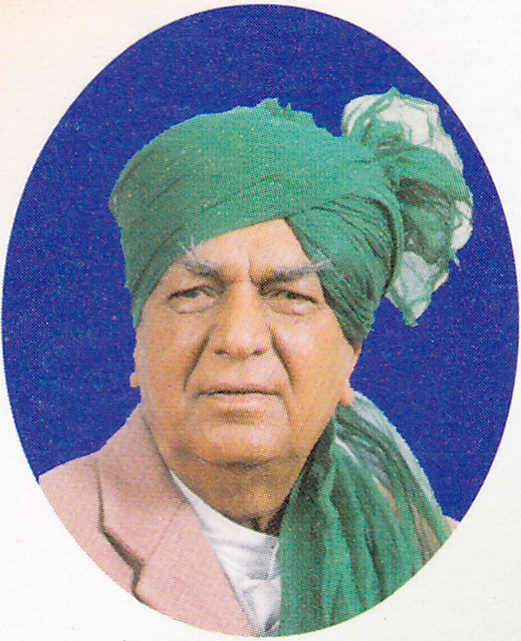
Chaudhary Devi Lal (25 September 1914 – 6 April 2001) was an Indian politician, the leading spokesman of the farmers of north India in his time. He was Chief Minister of Haryana twice and Deputy Prime Minister of India from 1989 to 1991, under two Prime Ministers. In December 1989, elected leader of the winning party in Parliament, he stood up and handed the post to another man. He was known everywhere as Tau, uncle.
Quick Facts
| Full name | Devi Lal Sihag |
| Born | 25 September 1914, Teja Khera, Sirsa district (now Haryana) |
| Died | 6 April 2001, New Delhi (aged 86) |
| Community | Jat |
| Parties | Indian National Congress (to 1971); Lok Dal; Janata Dal; Indian National Lok Dal |
| Offices | Chief Minister of Haryana (1977–1979; 1987–1989); Deputy Prime Minister of India (1989–1990; 1990–1991) |
| Spouse | Harkhi Devi |
| Children | Om Prakash Chautala and others |
Early Life
He was born in a village of the Sirsa district, in the dry south-west of the old Punjab, into a family of substantial Jat landowners. His mother died when he was young. He was a tall, powerful boy and trained as a wrestler.
He left school in the tenth class in 1929 to join the Congress volunteers, and was jailed in 1930 for a year. He was imprisoned several more times up to 1942. He also led agitations of tenant farmers against landlords in his own district, though his family were landlords.
Punjab and Haryana
He was elected to the Punjab assembly in 1952. He became the chief campaigner for the separation of the Hindi-speaking districts as a state of their own, which came about on 1 November 1966, when Haryana was created. He left the Congress in 1971 and was jailed for nineteen months during the Emergency.
Chief Minister, 1977–1979
The Janata Party swept Haryana in 1977 and he became Chief Minister. He was unseated two years later by a revolt within his own party led by Bhajan Lal, who then took nearly the whole government over to the Congress.
The Nyaya Yudh
In 1985 the central government signed an accord in Punjab that provided for the transfer of Chandigarh to that state and left Haryana’s claims on river water and territory unsettled. Devi Lal launched a campaign he called the Nyaya Yudh, the battle for justice. He toured the state for two years. In the election of June 1987 his alliance won 85 of the 90 seats, one of the most complete victories in any Indian state.
Chief Minister, 1987–1989
- **Old-age pension:** a hundred rupees a month to everyone over sixty-five, the first such general pension in India, later copied by every state
- **Loan waiver:** small debts of farmers, artisans and shopkeepers to cooperative banks were written off
- **Villages:** meeting halls for Dalits, compensation for crops lost to hail and flood, and concessions to tractor owners
He had little patience with files and governed by touring and by instinct.
1 December 1989
In the general election of 1989 the opposition, in which he had been the great unifier, defeated Rajiv Gandhi. The Janata Dal’s members of Parliament met to choose a leader. V. P. Singh proposed Devi Lal, and he was elected by acclamation. Devi Lal then rose, thanked them, and said that he would prefer to remain the elder uncle of the country; he proposed V. P. Singh, who was elected. The manoeuvre had been arranged to prevent the election of Chandra Shekhar, who walked out furious.
Deputy Prime Minister
He became Deputy Prime Minister and Minister of Agriculture, and made his son, Om Prakash Chautala, Chief Minister of Haryana. A by-election that the son contested at Meham in 1990 was marked by violence and rigging, and the scandal set Devi Lal against the Prime Minister. He was dismissed in August 1990. Days later V. P. Singh announced the implementation of the Mandal report, partly to counter a farmers’ rally that Devi Lal had called.
When the government fell he held the same post under Chandra Shekhar, from November 1990 to June 1991.
Later Years
He lost the elections of 1991, his own seat included. He was a member of the Rajya Sabha when he died in New Delhi on 6 April 2001. He was cremated on the bank of the Yamuna beside the memorial of Charan Singh, at a spot named Sangharsh Sthal.
Family
His son was Chief Minister of Haryana several times, and a great-grandson, Dushyant Chautala, was Deputy Chief Minister. An earlier champion of the same peasantry was Sir Chhotu Ram.
Featured image: Chaudhary Devi Lal, from a 2001 postage stamp of India. Photo by India Post, Government of India, licensed under Government Open Data License – India, via Wikimedia Commons.



