
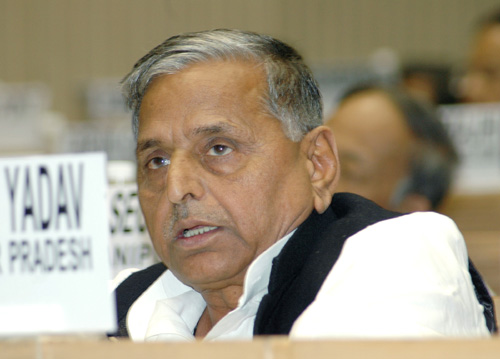
Mulayam Singh Yadav (22 November 1939 – 10 October 2022) was an Indian politician, the founder of the Samajwadi Party, three times Chief Minister of Uttar Pradesh and Defence Minister of India from 1996 to 1998. A village wrestler and schoolteacher who entered the assembly at twenty-eight, he became the foremost leader of the backward castes and of Muslims in India’s largest state. His followers called him Netaji.
Quick Facts
| Full name | Mulayam Singh Yadav |
| Born | 22 November 1939, Saifai, Etawah district, Uttar Pradesh |
| Died | 10 October 2022, Gurugram, Haryana (aged 82) |
| Education | K. K. College, Etawah; A. K. College, Shikohabad; Agra University (M.A. in political science) |
| Party | Samajwadi Party (founder, 1992) |
| Offices | Chief Minister of Uttar Pradesh (1989–1991; 1993–1995; 2003–2007); Union Defence Minister (1996–1998) |
| Awards | Padma Vibhushan (2023, posthumous) |
| Spouse | Malti Devi (d. 2003); Sadhana Gupta (d. 2022) |
| Children | Akhilesh Yadav |
Early Life
He was born in Saifai, a village in the Etawah district, into a farming family of the Yadav community. His father wanted him to be a wrestler, and he trained seriously. He took a master’s degree in political science and taught at a college in Karhal.
As a teenager he was jailed in an agitation over canal rates led by followers of Ram Manohar Lohia, whose ideas about caste and power shaped him. A local socialist legislator, Nathu Singh, saw him wrestle, took him up and gave him his own seat.
Rise
He was elected to the Uttar Pradesh assembly from Jaswantnagar in 1967 and was returned many times. He spent nineteen months in jail during the Emergency and became a minister in the Janata government of 1977, in charge of cooperatives. Through the 1980s, as leader of the opposition, he built an organisation village by village; he was said to know party workers in every district by name.
Chief Minister
1989–1991
He became Chief Minister on 5 December 1989 as leader of the Janata Dal. In 1990 the campaign to build a Ram temple at the site of the Babri Masjid in Ayodhya reached its height. He vowed that the mosque would be protected, and on 30 October and 2 November 1990 police fired on volunteers who tried to storm it; a number were killed. Hindu organisations never forgave him. Muslims saw him as their protector.
The Samajwadi Party
He founded the Samajwadi Party on 4 October 1992. After the demolition of the mosque that December, he allied with Kanshi Ram’s Bahujan Samaj Party; the alliance of backward castes and Dalits won the election of 1993, and he became Chief Minister again. It broke up in June 1995, when Mayawati withdrew support and was besieged in a state guest house by his party’s men, an episode that poisoned relations between the two parties for a generation.
2003–2007
He formed a third government in 2003. It promoted Hindi, gave allowances to the unemployed and to girls completing school, and was criticised for lawlessness.
Defence Minister
He was Defence Minister in the United Front governments from 1996 to 1998, and in 1996 came close to being chosen Prime Minister. He ordered that the bodies of soldiers killed in action be sent home to their families; until then only personal effects had been returned. The agreement to buy Sukhoi fighters from Russia was concluded in his time.
Later Years
The Samajwadi Party won a majority in Uttar Pradesh in 2012, and he made his son, Akhilesh Yadav, Chief Minister. In 2016 a struggle broke out between Akhilesh and Mulayam’s brother Shivpal. Mulayam at first sided with his brother and expelled his son; the party and the Election Commission went with Akhilesh, who took over as president. Mulayam remained the party’s patron and a member of the Lok Sabha.
Controversies
A case alleging assets beyond his known income followed him for years. Remarks of his opposing the death penalty for rape, in 2014, drew wide condemnation.
Personal Life
His first wife, Malti Devi, the mother of Akhilesh, died in 2003. He later acknowledged his marriage to Sadhana Gupta, who died in July 2022. He made Saifai, his village, a showpiece, with an airstrip, a medical university and an annual festival.
Death
He died in a hospital at Gurugram on 10 October 2022 and was cremated at Saifai. He was awarded the Padma Vibhushan the following year.
Featured image: Mulayam Singh Yadav, then Chief Minister of Uttar Pradesh, at the National Development Council, December 2006. Photo by the Planning Commission, licensed under Government Open Data License – India, via Wikimedia Commons.



