Meghnad Saha (6 October 1893 – 16 February 1956) was an Indian astrophysicist whose ionization equation, published in 1920, made it possible to read the temperature and composition of stars from their light and laid a foundation of modern astrophysics. The son of a village shopkeeper, he became a builder of scientific institutions, a campaigner for planning and river control, the reformer of the Indian calendar and an independent member of Parliament.
Quick Facts
| Full name | Meghnad Saha |
| Born | 6 October 1893, Shaoratoli, Dhaka district, Bengal (now Bangladesh) |
| Died | 16 February 1956 (aged 62), New Delhi |
| Field | Astrophysics, nuclear physics |
| Known for | Saha ionization equation; thermal ionization |
| Education | Presidency College, Calcutta; University of Calcutta (D.Sc.) |
| Institutions | University of Allahabad; University of Calcutta; Saha Institute of Nuclear Physics |
| Honours | Fellow of the Royal Society (1927) |
Early Life
Saha was born in a village near Dhaka, the fifth child of a small grocer who saw little use in schooling. A local doctor paid for the boy to board in a nearby town so that he could attend middle school. He won a scholarship to a government school in Dhaka and lost it in 1905 when he joined a boycott of the Governor’s visit during the protests against the partition of Bengal. A private school took him in, and he stood first in East Bengal in the entrance examination.
At Presidency College in Calcutta from 1911 he studied mathematics; Satyendra Nath Bose was his classmate, and Prafulla Chandra Ray and Jagadish Chandra Bose were among his teachers. As a member of a caste considered low, he was at first not allowed to eat with other students in the hostel, an experience that left him a lifelong enemy of caste prejudice.
The Ionization Equation
In 1916 he and Bose were appointed lecturers at the new University College of Science. They taught themselves German to follow the new physics and together published the first English translation of Einstein’s papers on relativity.
Astronomers had long classified stars by the dark lines in their spectra but could not explain why the lines differed. In 1920 Saha applied the thermodynamics of chemical reactions to the stripping of electrons from atoms in a hot gas. His equation gives the proportion of atoms ionized at a given temperature and pressure. With it the sequence of stellar spectra could be understood as, above all, a sequence of temperature, and the abundance of elements in stars could be worked out. He developed the idea further during visits to laboratories in London and Berlin and was elected a Fellow of the Royal Society in 1927.
Institution Builder
From 1923 to 1938 he was professor of physics at the University of Allahabad, where he built a school of research and founded what is now the National Academy of Sciences, India. He returned to Calcutta as Palit Professor, brought nuclear physics into the curriculum, built the country’s first cyclotron and established the Institute of Nuclear Physics, which was named after him after his death. He founded the journal Science and Culture in 1935 to argue for the use of science in national development.
Public Life
Devastating floods in Bengal turned him to the study of rivers, and his proposals helped shape the Damodar Valley project. He worked with Subhas Chandra Bose and Jawaharlal Nehru on the National Planning Committee of 1938 and argued for large-scale industry over a village economy. In 1952 he was elected to the Lok Sabha from Calcutta as an independent and was a forceful critic of government policy on education, refugees and atomic energy. As chairman of the Calendar Reform Committee he prepared the unified national calendar, based on the Saka era, adopted in 1957.
Death and Legacy
He collapsed and died of a heart attack in New Delhi on 16 February 1956, on his way to a meeting of the Planning Commission. He was proposed for the Nobel Prize several times. The equation that bears his name is taught to every student of astrophysics.
Frequently Asked Questions
When and where was Meghnad Saha born?
Meghnad Saha was born on 6 October 1893 in Shaoratoli, Dhaka district, Bengal (now Bangladesh).
When did Meghnad Saha die?
Died: 16 February 1956 (aged 62), New Delhi.
What is Meghnad Saha known for?
Known for: Saha ionization equation; thermal ionization.
What honours has Meghnad Saha received?
Fellow of the Royal Society (1927).
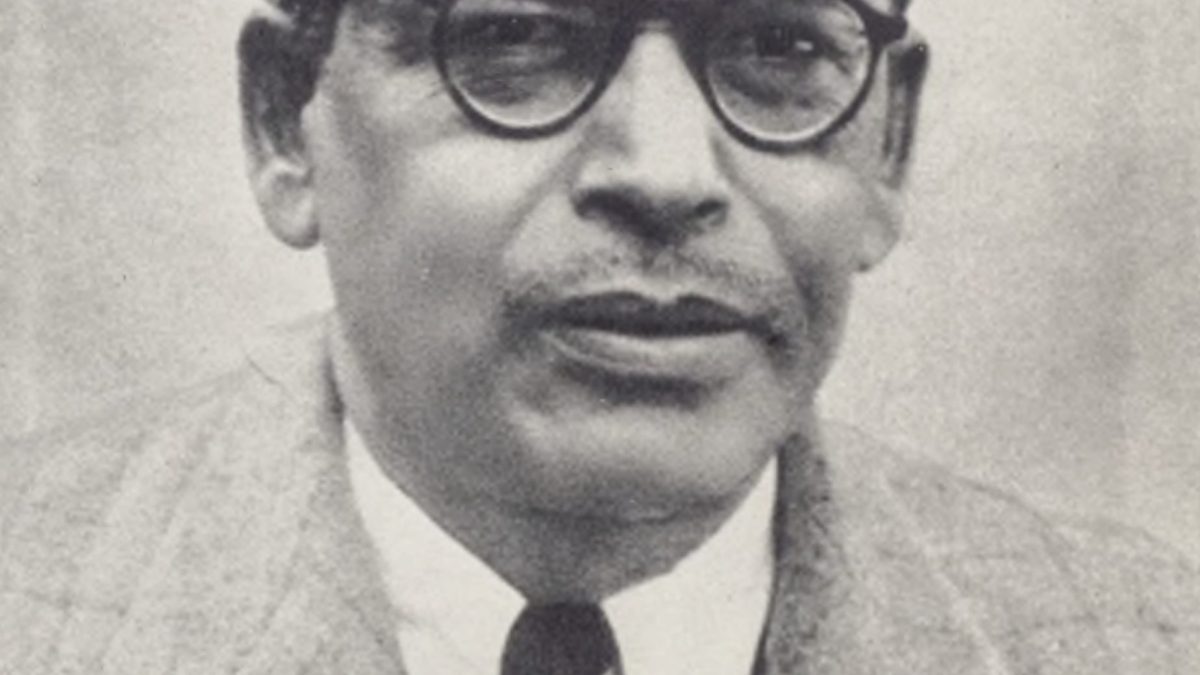
Featured image: Meghnad Saha, signed photograph. Photo by an unknown photographer, in the public domain, via Wikimedia Commons.