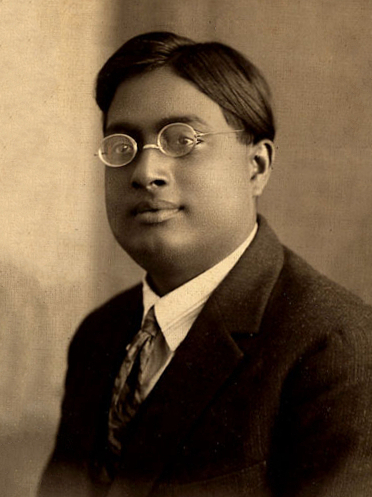
Satyendra Nath Bose (1 January 1894 – 4 February 1974) was an Indian theoretical physicist whose paper of 1924, sent to Albert Einstein from Dacca, founded quantum statistics. The class of particles that obey the rules he discovered are called bosons in his honour. He was also a teacher, a polymath and a champion of science in the Bengali language.
Quick Facts
| Full name | Satyendra Nath Bose |
| Born | 1 January 1894, Calcutta, Bengal Presidency |
| Died | 4 February 1974, Calcutta (aged 80) |
| Field | Theoretical physics, mathematics |
| Education | Presidency College, Calcutta (B.Sc., M.Sc.) |
| Known for | Bose-Einstein statistics, Bose-Einstein condensate, the boson |
| Positions | Professor of Physics, Dacca University; Khaira Professor, Calcutta University; Vice-Chancellor, Visva-Bharati; National Professor |
| Honours | Padma Vibhushan (1954), Fellow of the Royal Society (1958) |
| Spouse | Ushabati Ghosh (m. 1914) |
Early Life and Education
He was born in Calcutta, the eldest of seven children and the only son of Surendranath Bose, who worked for the East Indian Railway. He studied at the Hindu School and at Presidency College, where his teachers included Jagadish Chandra Bose and Prafulla Chandra Ray and his classmates Meghnad Saha. He stood first in both the B.Sc. and the M.Sc. in mixed mathematics, the latter in 1915 with marks that became a legend in the university.
Career
Calcutta
In 1917 he and Saha became lecturers at the new University College of Science. They taught themselves German to read the new physics, and in 1919 published the first English translation of Einstein’s papers on relativity.
The paper of 1924
In 1921 Bose joined the newly founded Dacca University. While teaching Planck’s law of radiation, he found a way to derive it without the classical assumptions that had troubled physicists, by counting particles of light as indistinguishable from one another. A British journal rejected the paper. In June 1924 he sent it to Einstein with a request to arrange its publication in German. Einstein saw its importance at once, translated it himself and had it published in the Zeitschrift für Physik with a note of praise. He then extended the method to atoms, predicting a new state of matter at very low temperatures, the Bose-Einstein condensate, which was produced in a laboratory in 1995.
Europe and after
The paper earned Bose two years in Europe, where he worked in Paris with Marie Curie and Louis de Broglie and met Einstein in Berlin. He returned to Dacca as professor and head of physics in 1927, though he had no doctorate, on Einstein’s recommendation. He moved to Calcutta University as Khaira Professor in 1945, and after retiring served as Vice-Chancellor of Visva-Bharati from 1956 to 1958. He was made National Professor in 1959.
The Nobel Question
Bose was nominated for the Nobel Prize several times but never received it, though several later prizes went to work built on his statistics. The physicist Paul Dirac coined the word “boson”. Bose himself said he had received all the recognition he deserved.
Other Interests
He worked in chemistry, mineralogy and biology, read widely in several languages, and played the esraj. He believed that science must be taught in the mother tongue, and in 1948 founded the Bangiya Bijnan Parishad to publish science in Bengali. He was a nominated member of the Rajya Sabha from 1952.
Personal Life and Legacy
He married Ushabati Ghosh in 1914; they had nine children, of whom seven survived. He died in Calcutta in 1974. The S. N. Bose National Centre for Basic Sciences in Kolkata was founded in 1986.
Featured image: Satyendra Nath Bose in 1925. Photo by an unknown photographer, in the public domain, via Wikimedia Commons.