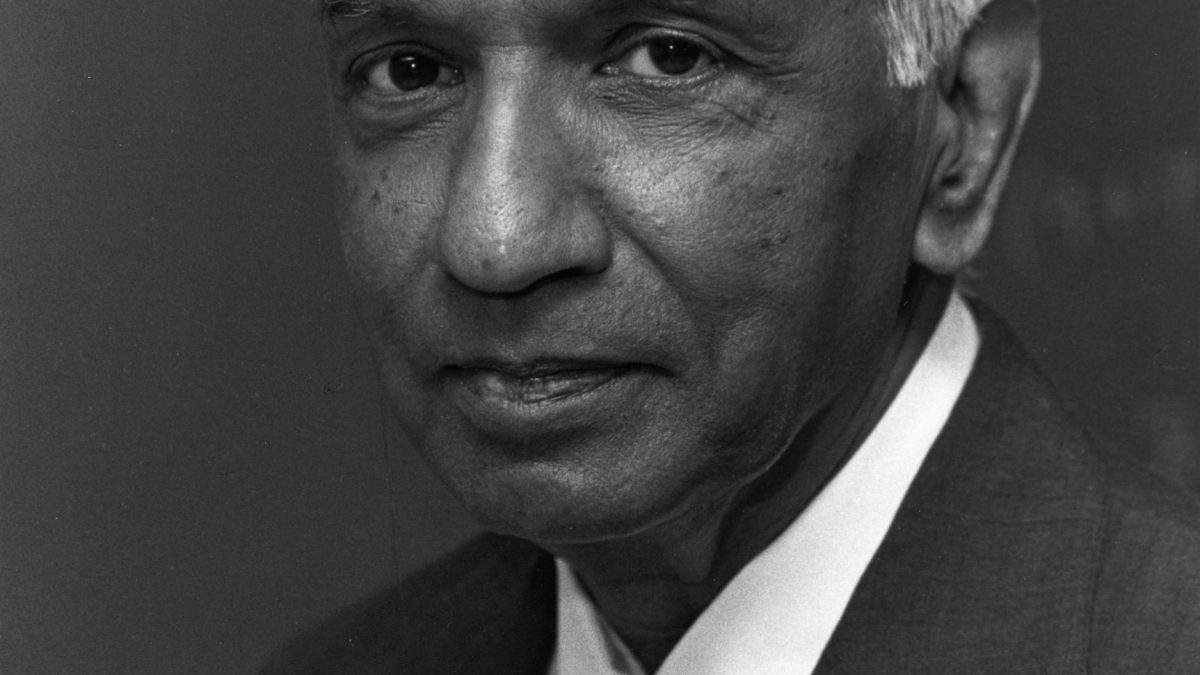
Subrahmanyan Chandrasekhar (19 October 1910 – 21 August 1995), known to colleagues as Chandra, was an Indian-American astrophysicist, one of the greatest of the twentieth century. At nineteen, on a voyage from India to England, he calculated that a dying star above a certain mass cannot settle into a stable white dwarf, a result now called the Chandrasekhar limit, which opened the way to the understanding of neutron stars and black holes. He shared the Nobel Prize in Physics in 1983. He was the nephew of C. V. Raman.
Quick Facts
| Full name | Subrahmanyan Chandrasekhar |
| Born | 19 October 1910, Lahore, British India |
| Died | 21 August 1995 (aged 84), Chicago, United States |
| Citizenship | Indian by birth; American from 1953 |
| Field | Astrophysics |
| Known for | Chandrasekhar limit; stellar structure; radiative transfer; mathematical theory of black holes |
| Education | Presidency College, Madras (B.Sc.); Trinity College, Cambridge (Ph.D.) |
| Institution | University of Chicago (1937–1995) |
| Awards | Nobel Prize in Physics (1983); Copley Medal (1984); National Medal of Science (1966); Padma Vibhushan (1968) |
| Spouse | Lalitha Doraiswamy (m. 1936) |
Early Life
Chandrasekhar was born in Lahore, where his father, C. Subrahmanyan Ayyar, a Tamil Brahmin from the Thanjavur region, was posted as an officer of the railway accounts service. He was one of ten children. The family returned to Madras when he was about eight, and he was taught at home until he was eleven, his mother, Sitalakshmi, who had translated Ibsen into Tamil, encouraging his reading. He went to the Hindu High School and then to Presidency College, where he took an honours degree in physics in 1930. He had published his first research paper as an undergraduate.
The Limit
In July 1930 he sailed for England on a government scholarship. During the voyage he combined the new quantum statistics with Einstein’s special relativity to study white dwarfs, the dense remnants of burnt-out stars. He found that the pressure of their electrons could support a star only up to a mass of about 1.4 times that of the Sun. Above it, nothing in known physics would stop the star collapsing.
He took his doctorate at Cambridge in 1933 under R. H. Fowler and was elected a Fellow of Trinity College. On 11 January 1935 he presented his full results to the Royal Astronomical Society. Sir Arthur Eddington, the most eminent astrophysicist of the day, who had encouraged the work, then rose and ridiculed its conclusion, saying that there should be a law of nature to prevent a star from behaving in so absurd a way. Few were willing to contradict Eddington in public, and the idea was set aside for decades. Chandrasekhar wrote it up in a book and turned to other problems. He was eventually proved right.
Chicago
In 1937 he joined the University of Chicago, working at first at its Yerkes Observatory in Wisconsin, and he remained with the university for the rest of his life. He had married Lalitha Doraiswamy, a fellow physics student from Madras, in 1936. He became an American citizen in 1953.
His way of working was unusual. He would choose a field, master it over several years, write a definitive book on it and move on. In this manner he treated the structure of stars, the motions of stars within galaxies, the transfer of radiation through atmospheres, the stability of fluids, the equilibrium of rotating bodies, and, when he was past sixty, the mathematical theory of black holes. His last book, completed in the year he died, was a commentary on Newton’s Principia.
From 1952 to 1971 he edited The Astrophysical Journal and made it the leading journal of its field. As a teacher he was exacting: it is often told that for one course he drove some hundred miles each week from the observatory to Chicago to lecture to a class of two, T. D. Lee and C. N. Yang, who went on to win the Nobel Prize before he did.
Honours
He received the Nobel Prize in Physics in 1983, shared with William Fowler, for his studies of the structure and evolution of stars. He was a Fellow of the Royal Society from 1944 and received its Royal and Copley medals, the National Medal of Science of the United States and the Padma Vibhushan.
Death and Legacy
He died of a heart attack in Chicago on 21 August 1995. NASA named its orbiting X-ray telescope, launched in 1999, the Chandra X-ray Observatory. The limit that bears his name governs the fate of stars and the explosions by which astronomers measure the expansion of the universe.
Featured image: Subrahmanyan Chandrasekhar. Photo by AIP Emilio Segrè Visual Archives, licensed under Attribution, via Wikimedia Commons.