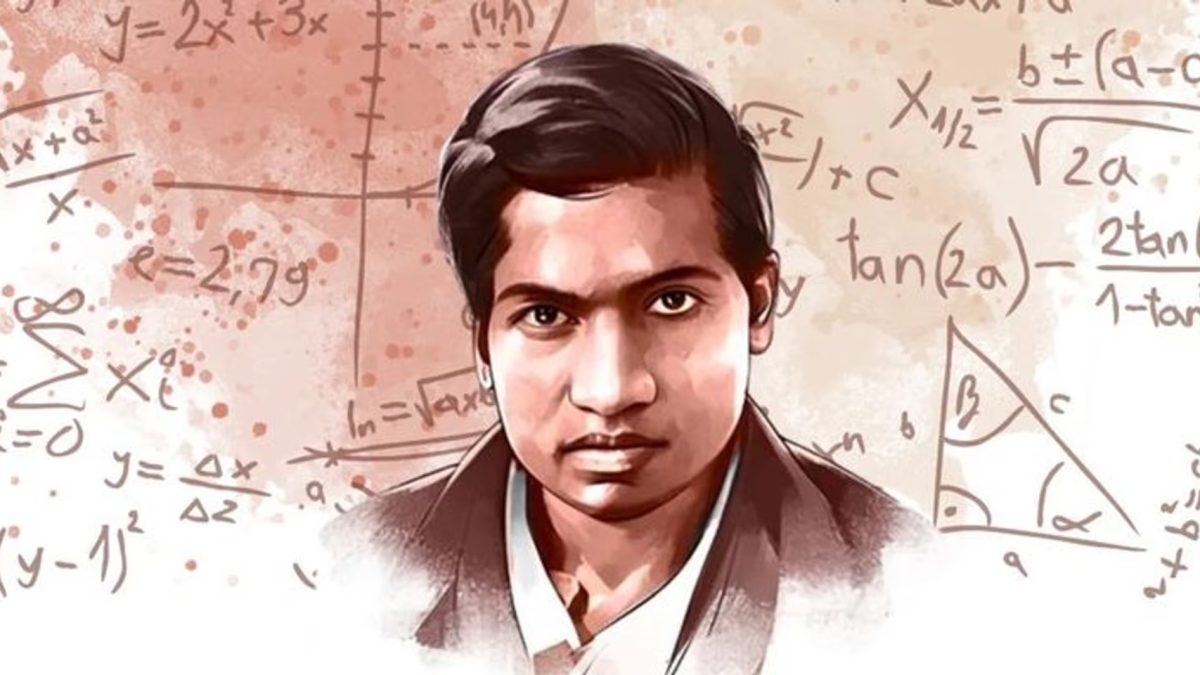
Srinivasa Ramanujan (22 December 1887 – 26 April 1920) was an Indian mathematician who, with almost no formal training, made major contributions to number theory, infinite series and continued fractions. Working alone in South India, he filled notebooks with thousands of results before a letter to the Cambridge mathematician G. H. Hardy brought him to England in 1914. He became one of the youngest Fellows of the Royal Society. He died at 32, but his ideas are still being studied by mathematicians today.
Quick Facts
| Full name | Srinivasa Ramanujan Aiyangar |
| Born | 22 December 1887, Erode, Madras Presidency (now Tamil Nadu), India |
| Died | 26 April 1920, Kumbakonam, Madras Presidency (aged 32) |
| Field | Mathematics |
| Education | Government Arts College, Kumbakonam; Pachaiyappa’s College, Madras; Trinity College, Cambridge |
| Known for | Number theory, partitions, infinite series, mock theta functions |
| Spouse | Janaki Ammal (m. 1909) |
| Honours | Fellow of the Royal Society (1918), Fellow of Trinity College, Cambridge (1918) |
| Remembered on | National Mathematics Day (22 December) |
Early Life
Ramanujan was born in his grandmother’s house in Erode and grew up in Kumbakonam, where his father, K. Srinivasa Iyengar, worked as a clerk in a sari shop. His mother, Komalatammal, sang at a local temple. He showed an unusual gift for mathematics as a child. At about 16 he got hold of a book listing thousands of mathematical results, G. S. Carr’s Synopsis, and began working them out for himself and going far beyond them.
Struggle in India
Ramanujan won a scholarship to the Government Arts College in Kumbakonam, but he was so absorbed in mathematics that he failed his other subjects and lost it. He later failed again at Pachaiyappa’s College in Madras. Without a degree, he lived in poverty, recording his discoveries in notebooks. In 1909 he married Janaki, and in 1912 he found a job as a clerk at the Madras Port Trust, where his superiors encouraged his work. His first paper was published in the Journal of the Indian Mathematical Society in 1911.
Cambridge
In January 1913 Ramanujan wrote to G. H. Hardy at Trinity College, Cambridge, enclosing pages of formulas. Hardy and his colleague J. E. Littlewood realised they were the work of a genius. Hardy arranged for him to come to England, and Ramanujan sailed in March 1914.
Over five years at Cambridge, Ramanujan published a series of important papers, some of them with Hardy. Their work on partitions, the number of ways a whole number can be written as a sum, gave a remarkably accurate formula. He also produced fast-converging series for the number pi and studied what are now called Ramanujan primes and the Ramanujan tau function. In 1918 he was elected a Fellow of the Royal Society and became the first Indian Fellow of Trinity College.
A famous story tells how Hardy visited him in hospital and remarked that his taxi’s number, 1729, seemed dull. Ramanujan replied at once that it was very interesting: it is the smallest number that can be written as the sum of two cubes in two different ways. It is now called the Hardy–Ramanujan number.
Illness and Death
The English climate, wartime food shortages and his strict vegetarian diet damaged Ramanujan’s health, and he spent long periods in sanatoriums. He returned to India in 1919 and died in Kumbakonam on 26 April 1920, aged 32. Even in his last year he continued to work, writing to Hardy about his discovery of “mock theta functions”.
Legacy
Ramanujan left behind three notebooks and a set of loose pages, the “lost notebook”, rediscovered in 1976, containing nearly 4,000 results. Mathematicians have spent decades proving them, and his ideas are now used in areas from computer science to the physics of black holes. India celebrates his birthday as National Mathematics Day. His life was told in the book and film The Man Who Knew Infinity (2015). Along with C. V. Raman, he is one of the best-known figures of modern Indian science.
Frequently Asked Questions
When and where was Srinivasa Ramanujan born?
Srinivasa Ramanujan was born on 22 December 1887 in Erode, Madras Presidency (now Tamil Nadu), India.
When did Srinivasa Ramanujan die?
Died: 26 April 1920, Kumbakonam, Madras Presidency (aged 32).
What is Srinivasa Ramanujan known for?
Known for: Number theory, partitions, infinite series, mock theta functions.
What honours has Srinivasa Ramanujan received?
Fellow of the Royal Society (1918), Fellow of Trinity College, Cambridge (1918).
Featured image: Srinivasa Ramanujan, an illustrated portrait.