Sir Jagadish Chandra Bose (30 November 1858 – 23 November 1937) was an Indian physicist, biologist and writer, and the first modern scientist from India to win international recognition. In the 1890s, in a small room at Presidency College in Calcutta, he generated and studied radio waves of very short wavelength and invented detectors that anticipated later semiconductor devices. He then turned to plants, building instruments of extraordinary sensitivity to show that they respond to stimuli much as animals do. He founded the Bose Institute in 1917.
Quick Facts
| Full name | Jagadish Chandra Bose |
| Born | 30 November 1858, Mymensingh, Bengal (now Bangladesh) |
| Died | 23 November 1937 (aged 78), Giridih |
| Fields | Physics, biophysics, plant physiology |
| Known for | Millimetre-wave research; crystal detector; crescograph |
| Education | St. Xavier’s College, Calcutta; Christ’s College, Cambridge; University of London |
| Institutions | Presidency College, Calcutta; Bose Institute |
| Honours | Knighthood (1917); Fellow of the Royal Society (1920) |
| Spouse | Abala Bose |
Early Life
Bose was born at Mymensingh, where his father was a deputy magistrate; the family home was in Bikrampur, near Dhaka. His father sent him first to a village school taught in Bengali, among the sons of fishermen and farm workers, so that he would know his own language and people before learning English. He later said this was the root of his love of nature. He studied at St. Xavier’s College in Calcutta, where a Jesuit teacher awakened his interest in physics, and then in England, first medicine, which ill health forced him to give up, then natural sciences at Cambridge.
Presidency College
He was appointed professor of physics at Presidency College in 1885 at a salary much lower than that paid to Europeans in the same post. He taught for three years without accepting any pay, until the authorities gave way and paid him in full with arrears. He had no laboratory and built his apparatus with the help of a local tinsmith.
Radio Research
In 1894 he began to investigate the electric waves that Heinrich Hertz had discovered. He produced waves only a few millimetres long and showed that they were reflected, refracted and polarised like light. At a public demonstration in Calcutta in 1895 he sent waves through walls, and through the body of the Lieutenant-Governor, to ring a bell and explode gunpowder in another room. He lectured on this work at the Royal Institution in London in 1897.
To detect the waves he devised receivers using contacts of metal and of crystals such as galena, the latter patented in the United States in 1904, and a mercury detector of the kind used in the first transatlantic wireless reception. He was not interested in commercial telegraphy and, on principle, did not seek to profit from his inventions. Engineers a century later recognised his work as the starting point of microwave technology.
Plants
Noticing that his detectors showed “fatigue” and recovery, he began to compare the responses of metals, plants and animal tissue. From about 1900 he devoted himself to plant physiology. His crescograph magnified the growth of a plant ten thousand times and more, and other instruments recorded the pulse of sap and the electrical response of leaves to touch, heat, poison and anaesthetics. Many physiologists resisted his conclusions, and some of his wider claims have not stood, but the electrical signalling in plants that he described is now a field of research.
Bose Institute and Writing
He was knighted in 1917 and in 1920 became a Fellow of the Royal Society. On his birthday in 1917 he opened the Bose Institute in Calcutta, dedicated, as he said, to the nation, as a place of research open to all. He wrote Bengali essays of great beauty, collected as Abyakta, and one of the earliest works of science fiction in the language. He was a lifelong friend of Rabindranath Tagore. His wife, Abala Bose, was a pioneer of women’s education.
Death and Legacy
He died at Giridih on 23 November 1937. A crater on the Moon is named after him, and he is honoured as a father of radio science and of experimental science in India.
Frequently Asked Questions
When and where was Jagadish Chandra Bose born?
Jagadish Chandra Bose was born on 30 November 1858 in Mymensingh, Bengal (now Bangladesh).
When did Jagadish Chandra Bose die?
Died: 23 November 1937 (aged 78), Giridih.
What is Jagadish Chandra Bose known for?
Known for: Millimetre-wave research; crystal detector; crescograph.
What honours has Jagadish Chandra Bose received?
Knighthood (1917); Fellow of the Royal Society (1920).
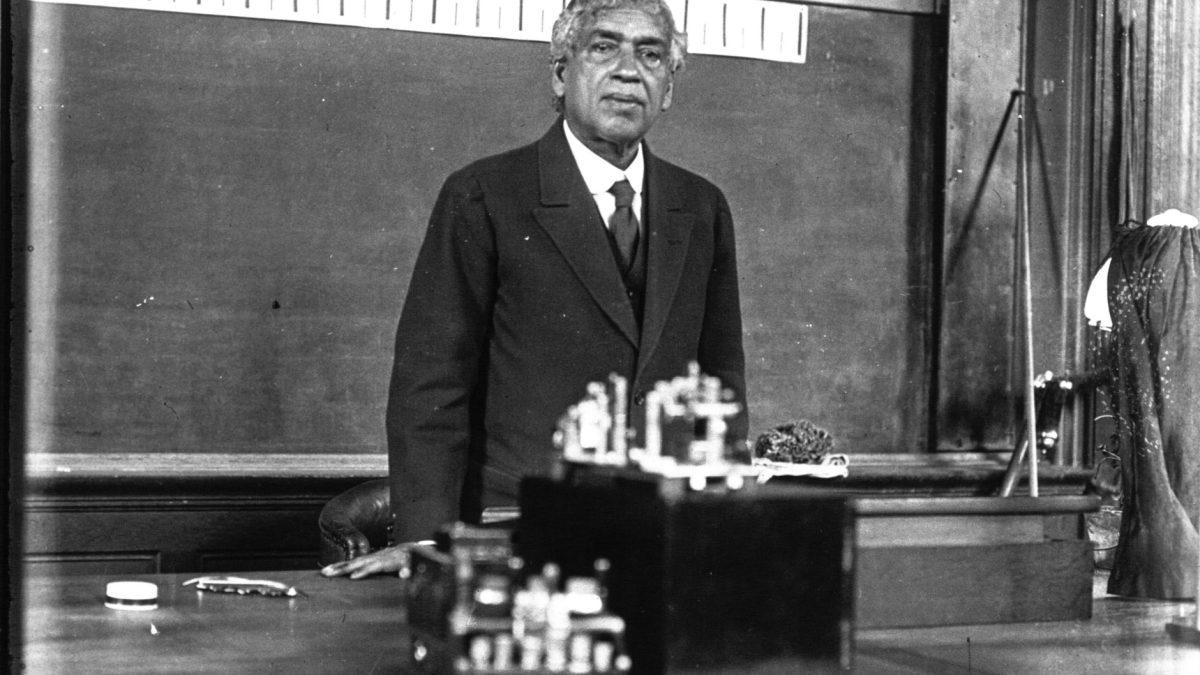
Featured image: Jagadish Chandra Bose lecturing on the response of plants at the Sorbonne, Paris, 1926. Photo by Agence de presse Meurisse, in the public domain, via Wikimedia Commons.