
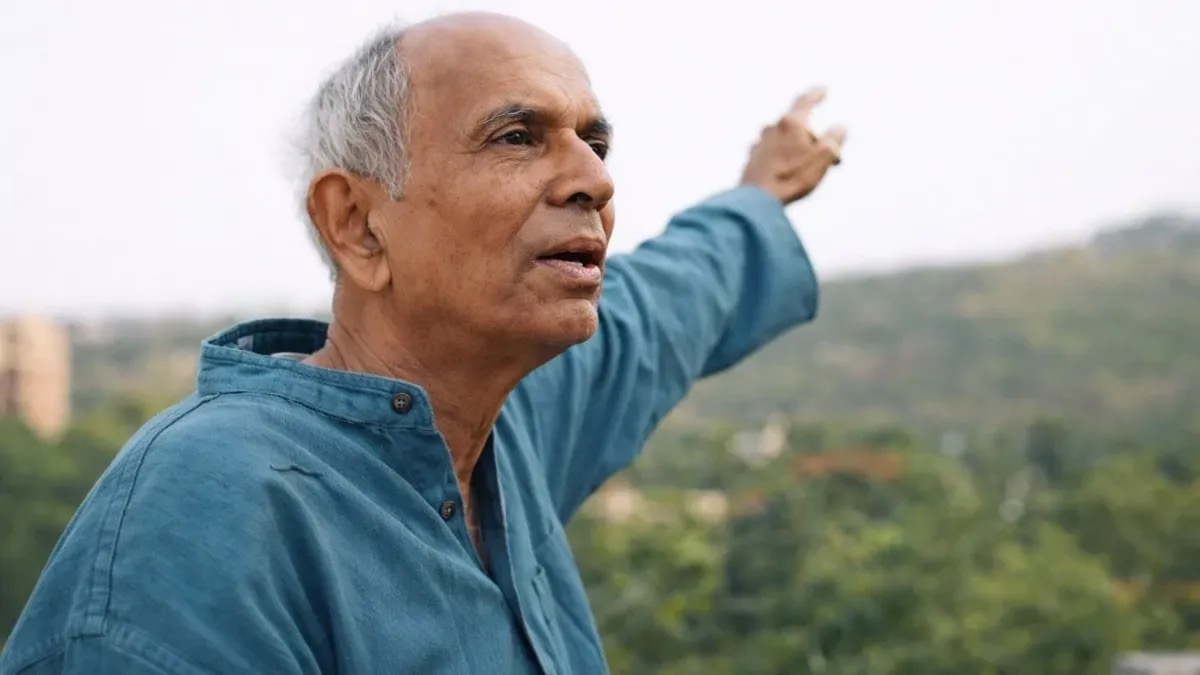
Madhav Dhananjaya Gadgil (24 May 1942 to 7 January 2026) was an Indian ecologist, academic, writer and columnist. He founded the Centre for Ecological Sciences at the Indian Institute of Science (IISc), Bengaluru, and served on the Scientific Advisory Council to the Prime Minister. In 2010 he was appointed head of the Western Ghats Ecology Expert Panel, popularly known as the Gadgil Commission, whose 2011 report started a national debate about development and conservation in one of the world's biodiversity hotspots. He won the Volvo Environment Prize and the Tyler Prize for Environmental Achievement, received the Padma Shri in 1981 and the Padma Bhushan in 2006, and was named a Champion of the Earth by the United Nations in 2024. He died in Pune on 7 January 2026, aged 83. Many describe him as a "people's scientist" because of his belief that conservation succeeds only when local communities have a say in it.
Madhav Gadgil at a Glance
| Born | 24 May 1942, Pune, Maharashtra |
| Died | 7 January 2026, Pune (aged 83) |
| Education | BSc Biology, Fergusson College (1963); MSc Zoology, University of Mumbai (1965); PhD, Harvard University (1969) |
| Profession | Ecologist, academic, author |
| Institutions | Indian Institute of Science (1973 to 2004); founder of the Centre for Ecological Sciences |
| Known for | Western Ghats Ecology Expert Panel (Gadgil Commission); People's Biodiversity Registers |
| Honours | Padma Shri (1981), Padma Bhushan (2006), Volvo Environment Prize (2003), Tyler Prize (2015), UN Champions of the Earth (2024) |
| Spouse | Sulochana Gadgil (meteorologist, died July 2025) |
Early Life and Education
Madhav Gadgil was born on 24 May 1942 in Pune. His father, Dhananjay Ramchandra Gadgil, was a Cambridge-trained economist, a former director of the Gokhale Institute and the author of the "Gadgil formula" for sharing central assistance among states, and his mother was Pramila. He graduated in biology from Fergusson College of the University of Pune in 1963 and took a master's degree in zoology from the University of Mumbai in 1965. He was also an active sportsman in his college years and held the Maharashtra State Junior and Pune University high jump records in 1959 and 1961.
He went to Harvard University, where he was encouraged by Giles Mead, then curator of fishes at the Museum of Comparative Zoology. He planned to do research under Mead, but after hearing lectures by the ecologist E. O. Wilson he changed subjects, and he did his doctoral research on mathematical ecology and fish behaviour under William Bossert, one of Wilson's former students. He received his PhD in 1969, and then won an IBM fellowship to continue work at the Harvard Computing Center while also teaching biology at the university for two years. His doctoral thesis is reported to have been a citation classic.
Career
Return to India and IISc
Gadgil returned to India in 1971 and worked for two years as a scientific officer at the Agharkar Research Institute in Pune. In 1973 he joined the Indian Institute of Science in Bengaluru, beginning an association that lasted more than thirty years, until he retired in 2004 as chairman of the Centre for Ecological Sciences. At IISc he established two research centres, the Centre of Theoretical Studies and the Centre for Ecological Sciences. He was also a visiting professor at Stanford University in 1991 and the University of California, Berkeley in 1995. After he retired he moved back to Pune, resumed his association with the Agharkar Research Institute and held the Damodar Dharmanand Kosambi chair as a visiting research professor at the University of Goa.
Early Policy Work
In 1976, when the Karnataka government decided to look into protecting the state's bamboo resources, Gadgil was asked to carry out a study, which is reported to have influenced the government to curb the subsidies given to forest-based industries. From 1986 to 1990 he was a member of the Scientific Advisory Council to the Prime Minister, and in that period he assisted in establishing the first biosphere reserve in India in the Nilgiris in 1986. From 1998 to 2002 he chaired the Science and Technology Advisory Panel of the Global Environment Facility, an agency under the United Nations. He also served on the NCERT's environmental education panel, the National Advisory Council and the National Tiger Conservation Authority, and chaired the committee that proposed an environmental education curriculum for schools.
Biodiversity and People
He is credited with introducing quantitative studies of ecology and animal behaviour in India and with treating humans as a vital part of ecosystems. His research covered population biology, conservation biology, human ecology and ecological history, and it is documented in more than 250 scientific articles. His contributions as a member of the drafting committee are reported to have helped in preparing the Biological Diversity Act 2002 and in the manual he prepared for People's Biodiversity Registers, which record local knowledge of plants and animals village by village. His first English-language book, This Fissured Land, a study of India's ecological history, appeared in 1992, written with Ramachandra Guha. It was followed by Ecology and Equity: The Use and Abuse of Nature in Contemporary India (1995), Nurturing Biodiversity: An Indian Agenda (1998), Diversity: The Cornerstone of Life and Ecological Journeys (both 2005), and Science, Democracy and Ecology in India (2013).
The Western Ghats Ecology Expert Panel
In 2010 the Government of India set up the Western Ghats Ecology Expert Panel to examine the ecological issues of the region, and Gadgil chaired it. In 2011 it submitted a report that marked about 64 per cent of the Western Ghats region as Ecologically Sensitive Area. The report attracted both support and opposition: environmentalists welcomed its recommendations, while the state governments of neighbouring states and the Syro-Malabar Catholic Church of Kerala disapproved. This paved the way for the later commission led by K. Kasturirangan, which diluted the recommendations to a level more acceptable to the state governments. Gadgil's approach, which called for greater decision-making power for local communities, remains one of the most discussed ideas in Indian environmental policy, and it also appears in the work of other environmental figures such as Sunderlal Bahuguna and Rajendra Singh.
Contribution to India's Development
Gadgil's work challenged the idea that environmental protection and human welfare are opposed. In books such as Ecology and Equity he argued, with Ramachandra Guha, that the use and abuse of nature in India are linked to questions of who benefits and who bears the cost. His work on biosphere reserves, biodiversity law and People's Biodiversity Registers aimed to protect nature while giving local communities a role. The Western Ghats report, whatever the response to it, forced governments and citizens to confront the question of how much development a fragile ecological region can bear. Other Indian ecologists and conservationists whose work belongs to the same tradition include Salim Ali.
Awards and Honours
- Padma Shri (1981) and Padma Bhushan (2006)
- Shanti Swarup Bhatnagar Prize (1986)
- Karnataka Rajyotsava Prashasti (1983)
- Volvo Environment Prize (2003), shared with Muhammad Yunus
- Harvard Centennial Medal (2002)
- H. K. Firodia Award (2007)
- Georgescu-Roegen Award, TERI (2014), recognising the panel and its chairman
- John and Alice Tyler Prize for Environmental Achievement (2015), shared with Jane Lubchenco, making him the second Indian after M. S. Swaminathan to win it
- Fergusson Gaurav Puraskar (2019)
- United Nations Champions of the Earth (2024)
- Fellow of the Indian National Science Academy (1984), the Indian Academy of Sciences and the National Academy of Sciences, India (1990), and the Third World Academy of Sciences; Foreign Associate of the US National Academy of Sciences (1991)
Personal Life and Death
Gadgil was married to Sulochana Gadgil, a meteorologist and Harvard scholar whom he met during his Fergusson College years, and she died in July 2025. They had a daughter, a journalist and Spanish teacher, and a son, the mathematician Siddhartha Gadgil. Madhav Gadgil died in Pune on 7 January 2026 after a brief illness, aged 83, and his son confirmed the news. His life story has been recorded in a Marathi biographical book, Vidnyanyatri: Dr. Madhav Gadgil, by A. P. Deshpande. Two species have been named in his honour, a tree, Elaeocarpus gadgilii, and a frog, Micrixalus gadgili.
Legacy
Gadgil's legacy lies in the ideas as much as in the institutions. He helped to establish ecology as a quantitative science in India, trained generations of ecologists at IISc, and brought the principle of community participation into conservation law and practice. His Western Ghats report, while contested, remains a reference point for any discussion of development in the region. The debates it started, over how to balance economic needs, the rights of local people and the protection of biodiversity, will continue, and a fair assessment must note that governments and communities disagreed with parts of his approach.
Frequently Asked Questions
Who was Madhav Gadgil?
He was an Indian ecologist who founded the Centre for Ecological Sciences at IISc and chaired the Western Ghats Ecology Expert Panel.
When did Madhav Gadgil die?
He died on 7 January 2026 in Pune at the age of 83.
What is the Gadgil Commission?
It is the popular name of the Western Ghats Ecology Expert Panel, set up in 2010, whose 2011 report marked about 64 per cent of the Western Ghats as Ecologically Sensitive Area.
Which awards did he receive?
His honours include the Padma Shri, the Padma Bhushan, the Volvo Environment Prize, the Tyler Prize and the UN Champions of the Earth award.




Leave a Reply