
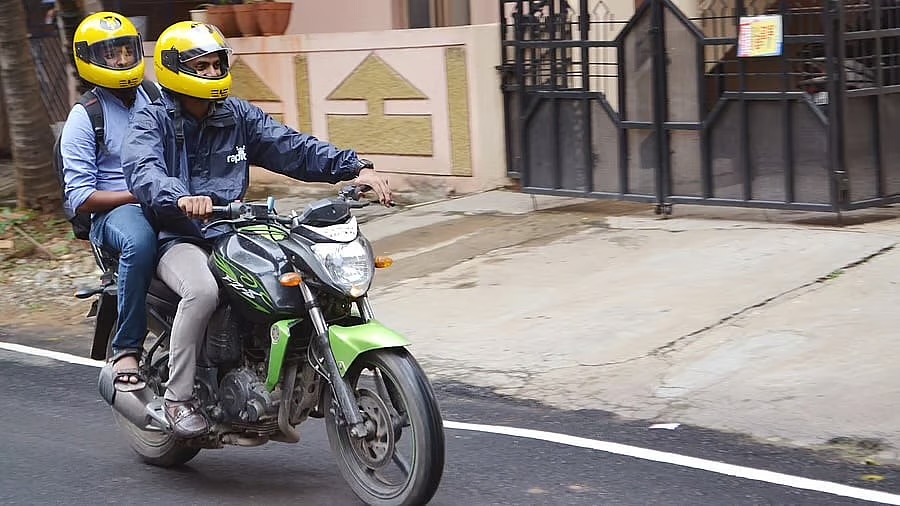
The Supreme Court on Friday, November 20, 2026, dismissed an appeal by the Karnataka government against a High Court decision that allowed bike-taxis to operate as public transport. The ruling removes the legal brakes on taxi aggregators such as Ola, Uber and Rapido offering two-wheeler taxi services in the state, and it ends, at least at the level of the apex court, a long-running tug of war between the state's transport authorities and the companies and riders who built a business around the motorcycle taxi.
The Bench was headed by Justice Satish Chandra Sharma, and his remarks from the Bench were as notable as the order itself. He said regulation was better than a blanket ban. He added, in an observation that gave the hearing a very human touch, that even the staff in his own office opt to travel by bike-taxi rather than by autorickshaws and cabs because of the considerable difference in fares. He also noted that bike-taxis equipped with GPS are safer for women, and that two-wheeler taxis are already operating across 25 states. Those three points, regulation over prohibition, affordability and safety through technology, form the practical core of the case for bike-taxis.
To understand how the dispute reached the Supreme Court, it helps to follow the sequence in the lower courts. A Single Bench of the Karnataka High Court had, in April of last year, stopped bike-taxi services pending the framing of a policy by the state. A Division Bench set that order aside in January 2026. In doing so, the Division Bench held that taxi aggregators and individual motorcycle owners possessed what it called a "crystallised right to obtain permits for operating motorcycles as taxis under the Motor Vehicles Act, 1988." It also held that motorcycles fall within the category of "transport vehicles," and directed the state authorities to positively consider applications for carriage permits for motorcycles. It was that decision that Karnataka took to the Supreme Court, and that the Supreme Court has now left standing.
Karnataka's case deserves a fair hearing, because it was not frivolous. The state government had found bike-taxis dangerous, saying they were not meant for public transport given the low safety standards of motorcycles and the higher accident fatality rates associated with them. Represented by advocate Sanchit Garga, it argued that restricting the use of two-wheelers as taxis was reasonable, proportionate and in the public interest. The state also stressed that it had not imposed a blanket prohibition on the commercial use of motorcycles. Its submission was that it had only restricted their use for carrying passengers, and that riders continued to have viable alternative livelihoods, including under the Karnataka Platform-Based Gig Workers (Social Security and Welfare) Act, 2025, which provides statutory protection and welfare measures for gig workers.
The state's legal argument focused on discretion. It told the court that the High Court's January 2026 decision had effectively reduced the discretionary powers of the State and Regional Transport Authorities to grant or refuse permits to a "mere formality." In its words, the statutory framework clearly contemplates that granting a permit is not automatic but subject to scrutiny on considerations of public safety, suitability of the vehicle and regulatory preparedness. It also argued that the High Court had misconstrued the definitions in the 1988 Act by "equating motorcycles with motor cabs and contract carriages," when the latter are, by definition, vehicles constructed or adapted for carrying passengers for hire or reward, which motorcycles are not.
That is a technical argument about the words of a statute, and it is worth noting what the Supreme Court's order does and does not say about it. Based on the reporting available, the court dismissed the appeal, and the observations from the Bench pointed to regulation as the better course. The reporting does not describe a detailed new reading of the Motor Vehicles Act, so the practical effect is that the Division Bench's decision stands. For riders and aggregators, that means the right to seek permits for motorcycle taxis is something the courts have now recognised, while the state still has the task of deciding how permits will be processed and what safety conditions will apply.
For commuters, the stakes are everyday ones. In congested cities, a motorcycle taxi can cut through traffic that traps cars and autorickshaws, and, as the judge pointed out, it is often considerably cheaper. For a student, a junior office worker or a daily-wage earner, that fare difference is not an abstraction. For the riders themselves, many of whom are gig workers, the services represent a source of income that has been repeatedly disrupted by crackdowns. A bike taxi association had, as far back as August 2026, sought a halt to the crackdown and urged the state to adopt a clear policy framework, according to The Hindu's earlier coverage. The Supreme Court's remark that regulation beats a blanket ban lines up with exactly that request.
The safety questions the state raised do not disappear because the appeal failed. Motorcycles offer riders and passengers little protection in a crash, and any serious policy will have to deal with helmets for both rider and pillion, vehicle fitness checks, rider training, insurance, and the verification of drivers. The judge's point about GPS and women's safety shows one way technology can help: tracked trips, identifiable drivers and emergency features are things aggregators can offer that an informal arrangement cannot. But it is for the state to decide which of these should be mandatory, and the Supreme Court's reasoning invites it to do that through regulation rather than prohibition.
There is also the question of competing interests. Autorickshaw and cab drivers have often objected to bike-taxis, arguing that they undercut fares and take away business, and some of that tension is likely to persist now that the legal route for bike-taxis has been cleared. The Supreme Court's decision does not settle that economic argument. What it does is move the debate from the courtroom to the policy table, where the questions are about fare structures, permit numbers, safe operating zones and the treatment of drivers across the different kinds of vehicle.
Beyond Karnataka, the order will be read carefully elsewhere. The Bench noted that two-wheeler taxis already operate across 25 states, which means the case was not about a novel idea but about whether one state could stand apart from a pattern that is common nationwide. Other states with restrictions or ongoing disputes over bike taxis may look at the court's emphasis on regulation and ask themselves whether their own bans can be defended. That said, each state has its own rules and its own transport authorities, and a ruling on an appeal from one High Court does not automatically rewrite the law in another.
For Karnataka, the immediate next step is administrative. The Division Bench had directed the state authorities to positively consider applications for carriage permits for motorcycles, and that direction now stands. The government will have to decide how quickly and under what conditions it processes permit applications, and whether it wants to bring in a dedicated policy for two-wheeler taxis. Given that the High Court's earlier single-judge order had stopped services precisely until a policy was framed, many will now ask why such a policy has not already been drawn up, and the Supreme Court's emphasis on regulation makes that question harder to avoid.
For aggregators, the order offers clarity but also responsibility. Ola, Uber and Rapido can now plan their operations in the state with more certainty, but they will also be watched closely on safety incidents, rider welfare and compliance. The state's reference to its gig workers' welfare law is a reminder that regulators increasingly look at the conditions of platform workers, not only at the vehicles. How aggregators handle insurance, working hours and payments to riders will shape whether the public sees this as a victory for commuters or as a loophole for platforms.
What the judgment ultimately reflects is a pragmatic view of urban transport. Cities that do not offer enough affordable, flexible options push people toward whatever works, and bike-taxis have become one of those options. The Bench's comments about its own staff choosing them over autos and cabs suggest an understanding that a blanket ban would not make the demand disappear; it would simply push it into unregulated corners. By pointing to regulation, the court has asked the state to do the harder work of making a popular service safe, instead of prohibiting it.
The coming months will show whether Karnataka takes up that challenge. If it frames clear, enforceable rules on safety, permits and rider welfare, the court's decision could become the foundation of a more orderly two-wheeler taxi sector. If it does not, the same disputes that landed in the Supreme Court may return in other forms. For now, the legal question is settled: bike-taxis can seek to operate as public transport in Karnataka, and the debate has moved on to how well they will be regulated.




Leave a Reply