
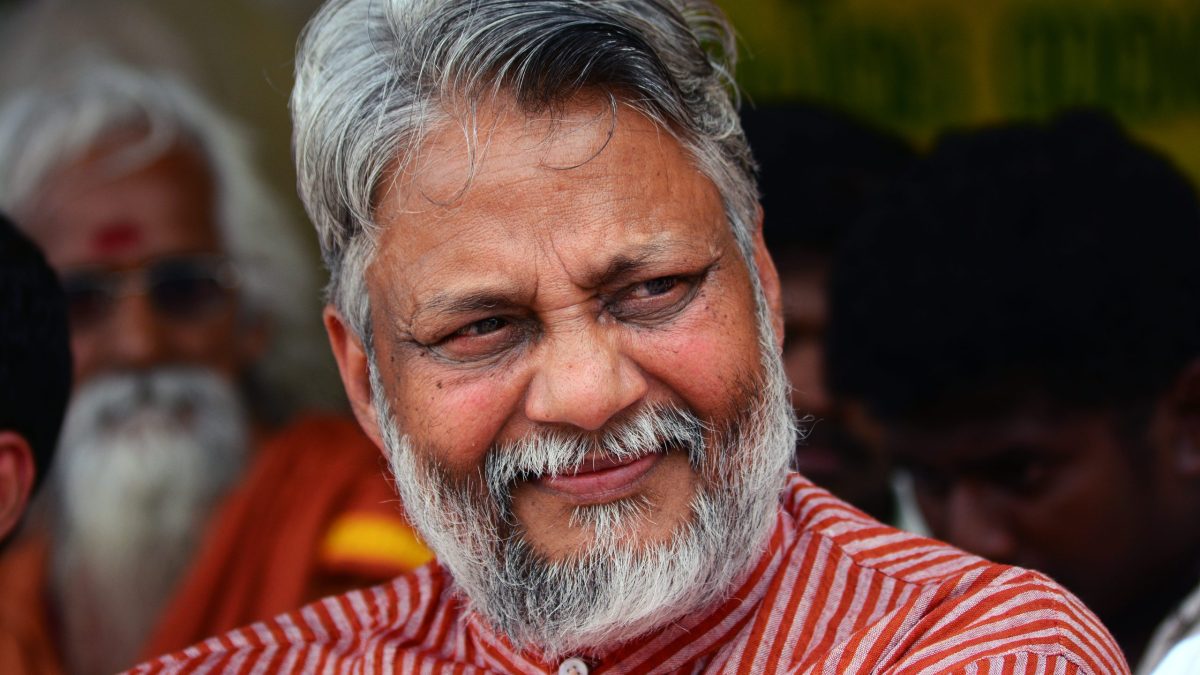
Rajendra Singh (born 6 August 1959) is an Indian water conservationist known as the “Waterman of India”. Working in the dry Alwar district of Rajasthan since 1985, he and his organisation, Tarun Bharat Sangh, have helped villagers build thousands of johads, traditional earthen dams that capture rainwater. The work brought groundwater back to more than a thousand villages and revived several rivers that had run dry. He won the Ramon Magsaysay Award in 2001 and the Stockholm Water Prize in 2015.
Quick Facts
| Full name | Rajendra Singh |
| Born | 6 August 1959, Daula, Baghpat district, Uttar Pradesh, India |
| Age | 67 |
| Known as | Waterman of India (Jal Purush) |
| Organisation | Tarun Bharat Sangh |
| Education | Degree in Ayurvedic medicine; M.A. in Hindi literature |
| Known for | Johads, river revival in Rajasthan |
| Honours | Ramon Magsaysay Award (2001), Stockholm Water Prize (2015) |
Early Life
Singh was born in a farming family in Daula village in western Uttar Pradesh. As a schoolboy he was influenced by a Gandhian visitor to his village who involved him in local clean-up and anti-alcohol work. He studied Ayurvedic medicine and took a master’s degree in Hindi literature, then joined government service in Jaipur in 1980. Unhappy with office work, he resigned in 1984.
Work
In 1985 Singh and four friends took a bus to the last stop in Thanagazi block, Alwar district, intending to start a clinic and school. An old villager, Mangu Lal Meena, told him that the villagers needed water more than medicine and showed him the remains of old johads. Singh began digging out a pond in Gopalpura village with his own hands. After the next monsoon the wells nearby filled, and neighbouring villages asked for help.
Over the following decades Tarun Bharat Sangh and village communities built more than 11,000 johads and other water-harvesting structures. As groundwater rose, the Arvari river, dry for decades, began to flow all year, followed by the Ruparel, Sarsa, Bhagani and Jahajwali. Villagers along the Arvari formed a “river parliament” to manage its water. Farming and forests returned to an area the government had once declared a “dark zone”.
Singh has also campaigned against mining in the Aravalli hills near the Sariska Tiger Reserve, and for the protection of the Ganga. He was a member of the National Ganga River Basin Authority and has led walks along rivers across India to promote community water management.
Awards and Honours
Legacy
Singh’s work showed that cheap, traditional methods managed by villagers themselves could solve water shortages that large projects had failed to fix. His model has been studied and copied in other dry regions of India and abroad.
Frequently Asked Questions
When and where was Rajendra Singh born?
Rajendra Singh was born on 6 August 1959 in Daula, Baghpat district, Uttar Pradesh, India and is 67 years old.
What is Rajendra Singh known for?
Known for: Johads, river revival in Rajasthan.
What honours has Rajendra Singh received?
Ramon Magsaysay Award (2001), Stockholm Water Prize (2015).
Featured image: Rajendra Singh, the water conservationist known as the “Waterman of India”, 2017. Photo by Mullookkaaran, licensed under CC BY-SA 4.0, via Wikimedia Commons.



