
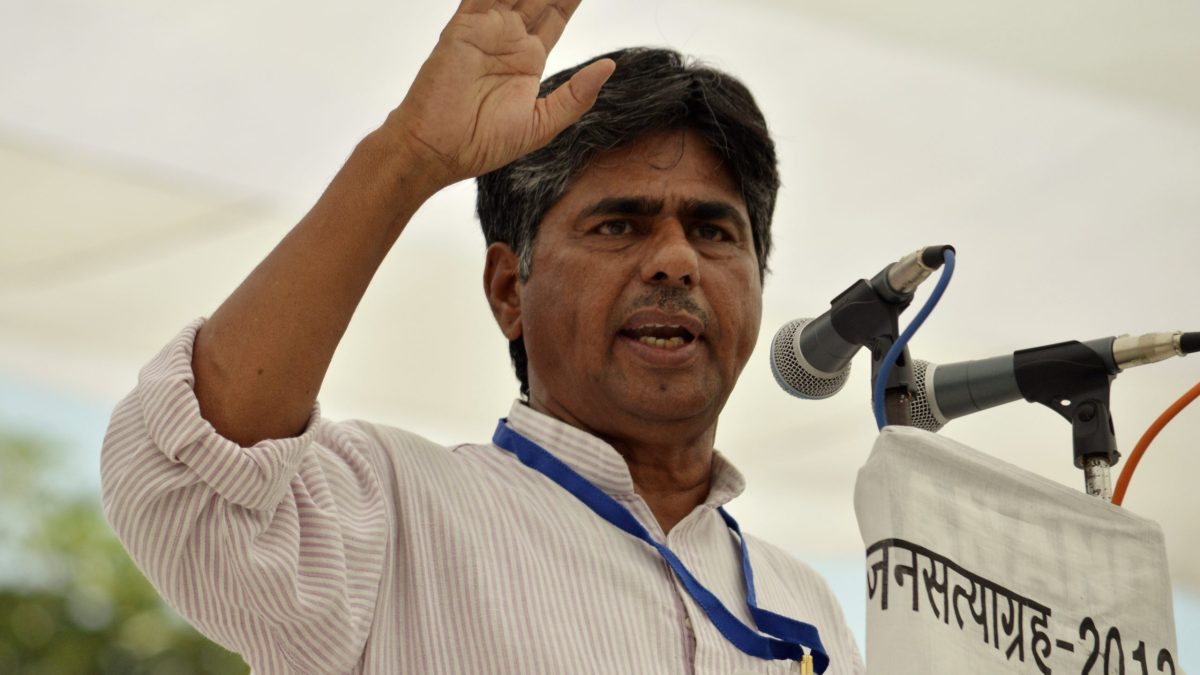
Rajagopal P. V. (born 1948) is an Indian Gandhian activist and the founder of Ekta Parishad, a mass movement of landless and tribal people. He is known for organising very large, disciplined foot marches to press for land reform, above all Janadesh in 2007 and Jan Satyagraha in 2012, in which tens of thousands of the rural poor walked from Gwalior towards Delhi. He was awarded the Niwano Peace Prize in 2023.
Quick Facts
| Full name | Rajagopal Puthan Veetil |
| Born | 1948, Thillenkery, Kannur district, Kerala, India |
| Occupation | Social activist |
| Known for | Ekta Parishad; Janadesh 2007; Jan Satyagraha 2012 |
| Education | Seva Mandir, Kerala; Sevagram, Wardha (agricultural engineering) |
| Spouse | Jill Carr-Harris |
| Awards | Niwano Peace Prize (2023) |
Early Life
Rajagopal was born in Thillenkery in northern Kerala, the son of a freedom fighter. He went to a school run on Gandhian lines and learned classical dance and music. He then studied agricultural engineering at Sevagram, Mahatma Gandhi’s ashram at Wardha in Maharashtra. He uses only his given name in public, to avoid any indication of caste.
Work
In the early 1970s he went to the Chambal valley of Madhya Pradesh to work with the Gandhian S. N. Subba Rao among the region’s dacoits. Several hundred of them laid down their arms in 1972, and Rajagopal spent years on their rehabilitation and that of their families and victims.
Through the 1980s he trained young people in villages across central India to organise against bonded labour, displacement and the loss of land and forest. In 1991 these groups came together as Ekta Parishad, or “unity forum”, which grew to a membership of several lakh, most of them Adivasis and Dalits and many of them women.
In October 2007 he led about 25,000 people on a walk of some 350 kilometres from Gwalior to Delhi. The government responded by setting up a National Land Reforms Council and a committee on land policy. When little followed, he prepared a larger march. In October 2012 about 50,000 people set out again from Gwalior, walking in ordered columns and sleeping on the highway. At Agra the Union rural development minister, Jairam Ramesh, signed a ten-point agreement with him on land for the homeless and faster settlement of land disputes, and the march was called off.
In 2019, the 150th anniversary of Gandhi’s birth, he began Jai Jagat, a year-long march from Delhi to Geneva to carry the idea of non-violence to the United Nations. The walkers had reached Armenia when the Covid-19 pandemic forced them to stop.
Recognition
He has been vice-chairman of the Gandhi Peace Foundation in Delhi. The Niwano Peace Foundation of Japan gave him its 2023 prize for his work for justice and peace by non-violent means.
Personal Life
He is married to Jill Carr-Harris, a Canadian development worker who works with him. They divide their time between Madhya Pradesh, Kerala and Delhi.
Frequently Asked Questions
When was Rajagopal P. V. born?
Rajagopal P. V. was born in 1948, Thillenkery, Kannur district, Kerala, India.
What is Rajagopal P. V. known for?
Known for: Ekta Parishad; Janadesh 2007; Jan Satyagraha 2012.
What honours has Rajagopal P. V. received?
Niwano Peace Prize (2023).
Featured image: Rajagopal P. V. addresses marchers in Gwalior at the start of Jan Satyagraha, October 2012. Photo by Yann, licensed under CC BY-SA 4.0, via Wikimedia Commons.



