Jayant Vishnu Narlikar (19 July 1938 – 20 May 2025) was an Indian astrophysicist, institution builder and writer. With Fred Hoyle he developed an alternative to Einstein’s theory of gravity and championed models of the universe without a Big Bang. He founded the Inter-University Centre for Astronomy and Astrophysics in Pune, and through books, television and science fiction in Marathi, Hindi and English became the best-known science communicator in India.
Quick Facts
| Full name | Jayant Vishnu Narlikar |
| Born | 19 July 1938, Kolhapur, Maharashtra |
| Died | 20 May 2025, Pune (aged 86) |
| Field | Astrophysics, cosmology |
| Education | Banaras Hindu University (B.Sc., 1957); University of Cambridge (B.A., Ph.D., Sc.D.) |
| Known for | Hoyle-Narlikar theory of gravity; quasi-steady-state cosmology; founding IUCAA |
| Positions | Professor, Tata Institute of Fundamental Research (1972–1989); founder-director, IUCAA (1988–2003) |
| Honours | Padma Bhushan (1965), Padma Vibhushan (2004), UNESCO Kalinga Prize (1996), Maharashtra Bhushan (2010) |
| Spouse | Mangala Rajwade (m. 1966; died 2023) |
| Children | 3 |
Early Life
He was born in Kolhapur and grew up on the campus of Banaras Hindu University, where his father, Vishnu Vasudev Narlikar, was professor of mathematics and a specialist in relativity. His mother, Sumati, was a Sanskrit scholar. He stood first in the university in his B.Sc. in 1957.
Cambridge
He followed his father to Cambridge, where he was a Wrangler in the Mathematical Tripos and won the Tyson Medal for astronomy. He took his doctorate in 1963 under Fred Hoyle, the leading advocate of the steady-state theory of the universe, and won the Smith’s Prize in 1962 and the Adams Prize in 1967. He was a fellow of King’s College and a founding staff member of Hoyle’s Institute of Theoretical Astronomy.
Career
The Hoyle-Narlikar theory
In 1964 he and Hoyle put forward a theory of gravity in which the mass of a particle arises from its interaction with all the other matter in the universe. It made the young Narlikar famous in India; he received the Padma Bhushan at twenty-six. In later decades, as evidence for the Big Bang accumulated, he remained one of its few serious critics, and in 1993, with Hoyle and Geoffrey Burbidge, proposed the quasi-steady-state model, in which matter is created in a series of smaller explosions. Most cosmologists did not accept it, but he held that science needs dissenters.
TIFR and IUCAA
He returned to India in 1972 to join the Tata Institute of Fundamental Research in Bombay, where he led the theoretical astrophysics group. In 1988 the University Grants Commission, then chaired by Yash Pal, asked him to set up a centre where university teachers and students from all over India could do research in astronomy. He built the Inter-University Centre for Astronomy and Astrophysics in Pune and directed it until 2003. Its campus was designed by the architect Charles Correa.
In the early 2000s he led an experiment that sent balloons to a height of about 41 kilometres to collect air samples, in which living micro-organisms were found.
Writing
He wrote science fiction, beginning with a prize-winning Marathi story submitted under an assumed name, and many popular books. He explained astronomy on television and campaigned against astrology and superstition. His Marathi autobiography, Chaar Nagarantale Maze Vishwa, won the Sahitya Akademi Award in 2014.
Personal Life
He married the mathematician Mangala Rajwade in 1966. They had three daughters, Geeta, Girija and Leelavati, all of whom took up careers in science. Mangala Narlikar died in 2023. He died in his sleep in Pune on 20 May 2025 and was given a state funeral.
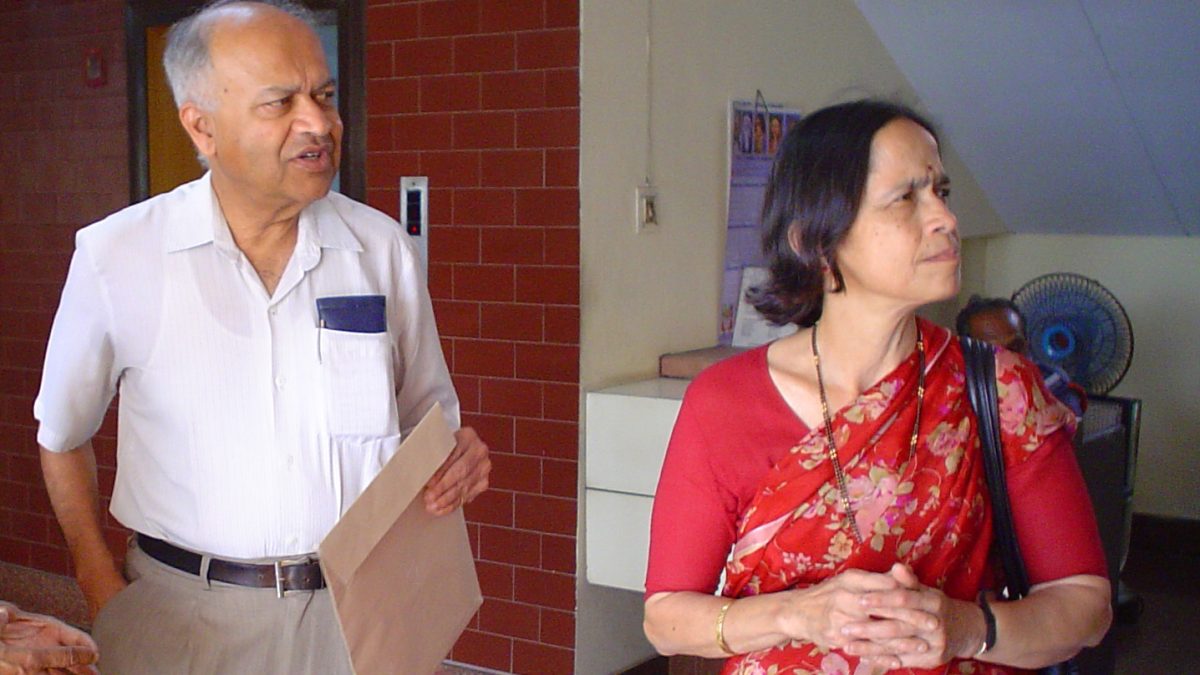
Featured image: Jayant Narlikar with his wife, the mathematician Mangala Narlikar, in Kolkata in March 2007. Photo by Biswarup Ganguly, licensed under CC BY 3.0, via Wikimedia Commons.