
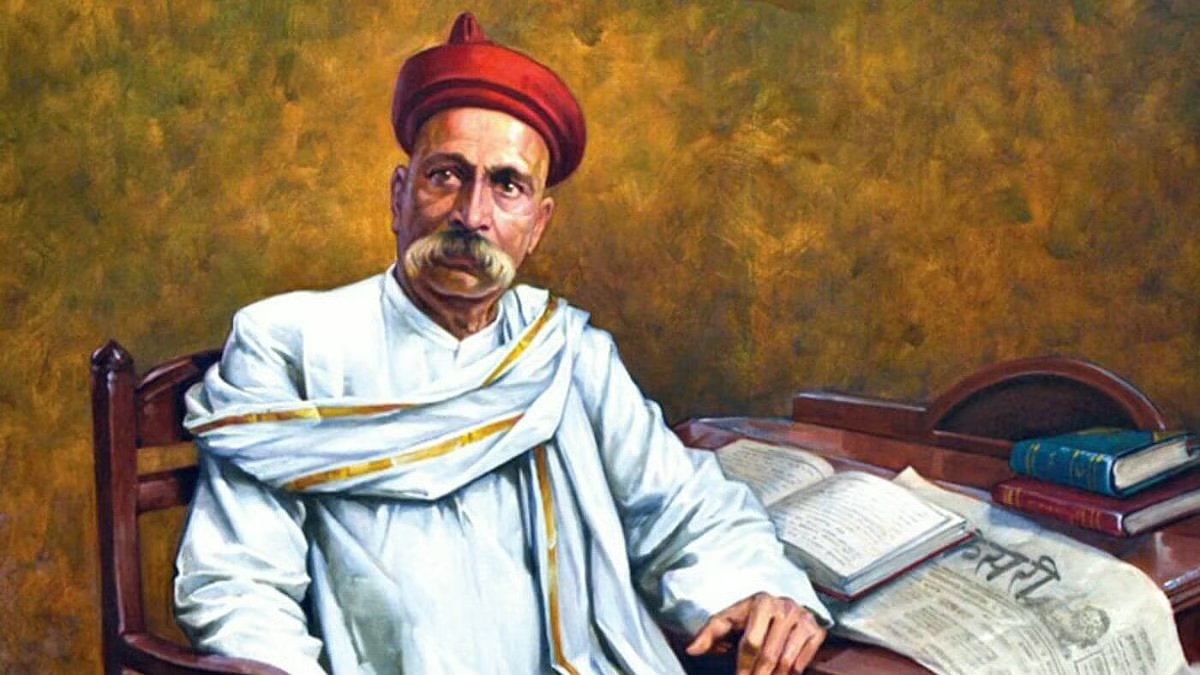
Bal Gangadhar Tilak (23 July 1856 – 1 August 1920), known as Lokmanya Tilak, was an Indian nationalist, teacher, journalist and scholar. He was one of the first leaders to demand complete self-rule and is remembered for the declaration “Swaraj is my birthright, and I shall have it.” Through his newspapers and public festivals he took the freedom movement beyond educated elites to ordinary people. The British called him “the father of Indian unrest”; Mahatma Gandhi called him “the maker of modern India”.
Quick Facts
| Birth name | Keshav Gangadhar Tilak |
| Born | 23 July 1856, Ratnagiri, Bombay Presidency (now Maharashtra), India |
| Died | 1 August 1920, Bombay (now Mumbai) (aged 64) |
| Known as | Lokmanya (“accepted by the people”) |
| Education | Deccan College, Pune (B.A. 1877); LL.B. (1879) |
| Newspapers | Kesari (Marathi), The Mahratta (English) |
| Organisations | Indian National Congress, All India Home Rule League |
| Spouse | Satyabhamabai Tilak |
| Notable works | The Arctic Home in the Vedas, Gita Rahasya |
Early Life
Tilak was born in Ratnagiri on the Konkan coast into a Marathi Chitpavan Brahmin family. His father was a schoolteacher and Sanskrit scholar. The family moved to Pune when he was ten. He graduated in mathematics from Deccan College in 1877 and took a law degree in 1879, but chose teaching over a legal career.
Educator and Journalist
In 1880 Tilak and his friends started the New English School in Pune, followed by the Deccan Education Society (1884) and Fergusson College (1885), to give young Indians a modern education at low cost. In 1881 he founded two weekly newspapers, Kesari in Marathi and The Mahratta in English, which became his main tools for criticising British rule.
Freedom Struggle
To bring people together, Tilak turned the household worship of Ganesh into a large public festival in 1893 and started an annual festival in honour of Shivaji in 1895. In 1897, after his articles were blamed for inspiring the killing of a British plague officer in Pune, he was convicted of sedition and jailed for 18 months.
After the partition of Bengal in 1905 Tilak championed the boycott of British goods, Swadeshi and national education. With Lala Lajpat Rai of Punjab and Bipin Chandra Pal of Bengal he formed the famous trio “Lal-Bal-Pal”. Their differences with the moderate leaders split the Congress at its Surat session in 1907.
In 1908 Tilak was again tried for sedition for articles in Kesari and sentenced to six years’ imprisonment in Mandalay, Burma. In prison he wrote Gita Rahasya, a commentary on the Bhagavad Gita that stressed selfless action.
Released in 1914, Tilak rejoined the Congress and in 1916 founded the Home Rule League, working alongside Annie Besant. The same year he helped bring about the Lucknow Pact between the Congress and the Muslim League. He died in Bombay on 1 August 1920, the day Gandhi launched the Non-Cooperation Movement; a huge crowd attended his funeral on Chowpatty beach.
Scholar
Tilak was also a serious scholar of Sanskrit and astronomy. In The Orion (1893) and The Arctic Home in the Vedas (1903) he tried to date the Vedas using astronomical references.
Legacy
Frequently Asked Questions
When and where was Bal Gangadhar Tilak born?
Bal Gangadhar Tilak was born on 23 July 1856 in Ratnagiri, Bombay Presidency (now Maharashtra), India.
When did Bal Gangadhar Tilak die?
Died: 1 August 1920, Bombay (now Mumbai) (aged 64).
Featured image: Lokmanya Bal Gangadhar Tilak at his desk with a copy of Kesari, a painted portrait.



