
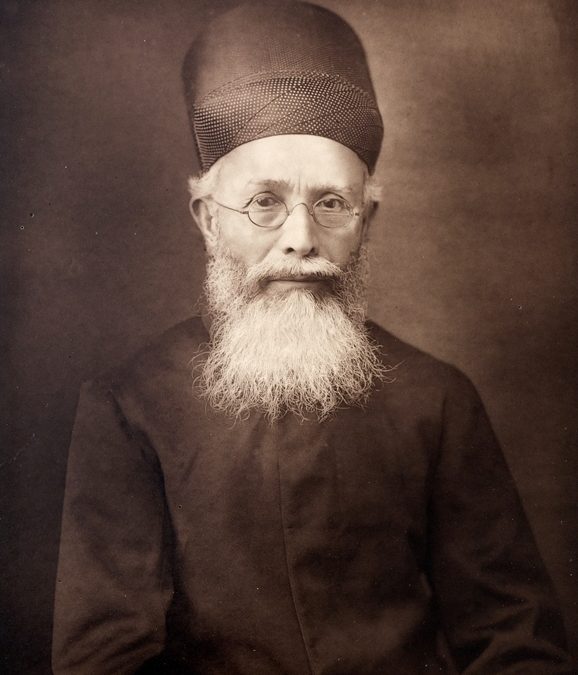
Dadabhai Naoroji (4 September 1825 – 30 June 1917) was an Indian scholar, businessman and statesman, known as the Grand Old Man of India. He was the first to show, with figures, that British rule was draining India of its wealth; he was a founder and three times president of the Indian National Congress; and in 1892 he became the first Indian elected to the House of Commons. In 1906 he gave the national movement its goal: Swaraj, self-government.
Quick Facts
| Full name | Dadabhai Naoroji |
| Born | 4 September 1825, Bombay |
| Died | 30 June 1917, Bombay (aged 91) |
| Community | Parsi |
| Education | Elphinstone Institution, Bombay |
| Occupation | Professor, merchant, politician, writer |
| Offices | Member of Parliament for Finsbury Central (1892–1895); President of the Congress (1886, 1893, 1906); Dewan of Baroda (1874) |
| Notable work | Poverty and Un-British Rule in India (1901) |
| Spouse | Gulbai |
Early Life
He was born in Bombay into a poor Parsi family of priests. His father died when he was four, and his mother, who could not read, saw to it that he was educated. At the Elphinstone Institution he was a brilliant student, and in the early 1850s he was appointed professor of mathematics and natural philosophy there, the first Indian to hold such a chair.
He helped to found societies for the education of girls and the reform of Parsi customs, and a Gujarati newspaper, Rast Goftar, “The Truth Teller”.
England
In 1855 he went to London as a partner in the first Indian firm to open there, and later set up his own cotton business. He was professor of Gujarati at University College London. He made it his task to tell the British public what their government was doing in India, and founded the East India Association for the purpose.
The Drain
In papers and speeches from the 1860s, collected in 1901 as Poverty and Un-British Rule in India, he made the first estimates of India’s national income and showed how low it was. He argued that the cause was a constant transfer of wealth to Britain for which India received nothing in return: the salaries and pensions of British officials, the cost of a foreign army, the interest on debts India had not chosen, and the profits of foreign trade and shipping.
He called it the drain, and held that it bled the country of the capital it needed to grow. A government that claimed to rule by British principles, he said, was in fact un-British. The argument became the economic foundation of Indian nationalism.
Baroda
In 1874 he served for a year as Dewan, chief minister, of the state of Baroda, and resigned after conflicts with the British Resident and the court.
The Congress
He was among the founders of the Indian National Congress in 1885 and was its president in 1886, 1893 and 1906. At Calcutta in 1906, with the party close to breaking between moderates and extremists, he held it together and declared that the aim of India was self-government, Swaraj, like that of the United Kingdom or the colonies.
Member of Parliament
He stood for Parliament as a Liberal. After his first defeat the Prime Minister, Lord Salisbury, remarked that an English constituency was not ready to elect “a black man”, an insult that made him famous. In 1892 he won Finsbury Central, in London, by a handful of votes, and was nicknamed “Mr Narrow-Majority”. He took his oath on a book of the Zoroastrian scriptures.
In the House he spoke for Indian reform, Irish home rule and votes for women. He was a member of the royal commission that examined Indian expenditure. He lost his seat in 1895.
Mentor
The young Mahatma Gandhi, Gopal Krishna Gokhale and Bal Gangadhar Tilak all looked to him as a guide. Muhammad Ali Jinnah served as his secretary at the Congress of 1906.
Death
He returned to India for good in 1907 and lived quietly at Versova, near Bombay. He died on 30 June 1917, aged ninety-one.
Legacy
A road in Mumbai, a neighbourhood in Delhi and a street in London bear his name, and a plaque marks his London home. Later economists have disputed his figures, but not his central insight that a country cannot prosper while its surplus is taken abroad.
Featured image: Dadabhai Naoroji in 1889. Photo by an unknown photographer, in the public domain, via Wikimedia Commons.



