
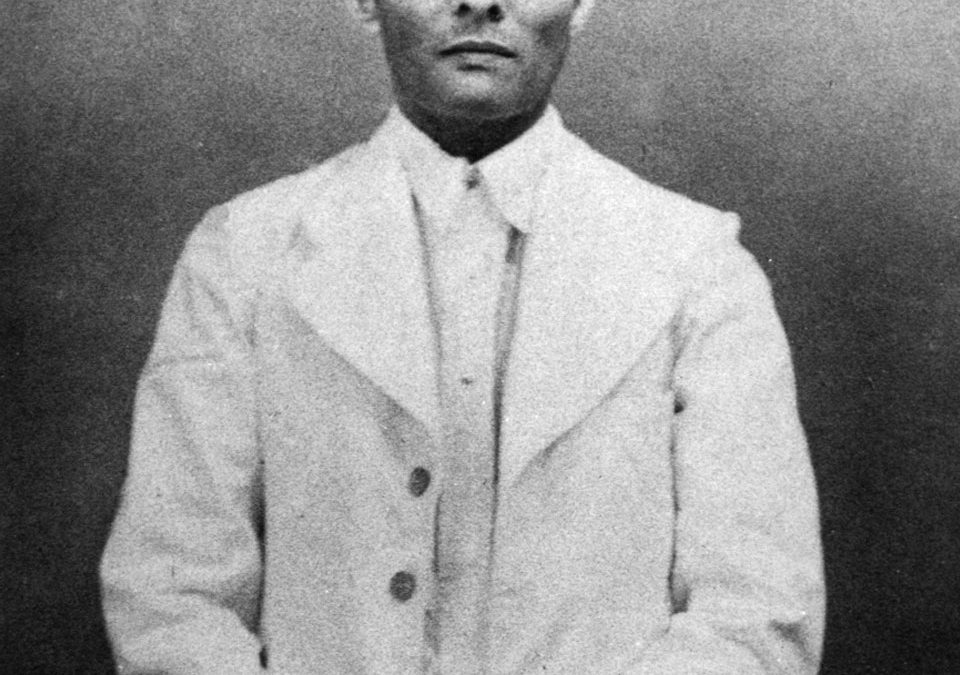
Vinayak Damodar Savarkar (28 May 1883 – 26 February 1966), known to his followers as Veer Savarkar, was an Indian revolutionary, writer and politician. As a young man he organised secret societies in Maharashtra and London and was sentenced to transportation for fifty years, of which he served ten in the Cellular Jail in the Andaman Islands. He later set out the doctrine of Hindutva and was president of the Hindu Mahasabha. He remains one of the most admired and most disputed figures of modern Indian history.
Quick Facts
| Full name | Vinayak Damodar Savarkar |
| Born | 28 May 1883, Bhagur, Nashik district, Maharashtra |
| Died | 26 February 1966, Bombay (aged 82) |
| Education | Fergusson College, Pune; Gray’s Inn, London |
| Occupation | Revolutionary, writer, politician |
| Organisations | Abhinav Bharat; Hindu Mahasabha (president, 1937–1943) |
| Notable works | The Indian War of Independence, 1857; Essentials of Hindutva; My Transportation for Life |
| Spouse | Yamunabai |
Early Life
He was born at Bhagur, near Nashik, into a Chitpavan Brahmin family. His mother died when he was nine and his father in the plague a few years later; his elder brother, Ganesh, brought up the family. As a schoolboy he formed a secret group that became, in 1904, the revolutionary society Abhinav Bharat.
At Fergusson College in Pune he led a bonfire of foreign cloth in 1905, for which he was fined and sent down from his hostel.
London
In 1906 he went to London on a scholarship to study law and lived at India House, a hostel that was a centre of Indian revolutionaries. He wrote The Indian War of Independence, 1857, which presented the rising of that year as a national war in which Hindus and Muslims fought together. The British government banned it before it was published; it circulated secretly for decades.
In 1909 a member of the India House circle shot dead a British official in London, and at Nashik the district magistrate was killed with a pistol from a consignment Savarkar had sent. He was arrested in London in March 1910.
Marseilles
While being taken to India by ship he squeezed through a porthole at Marseilles on 8 July 1910 and swam ashore, hoping to claim asylum in France. He was caught and handed back. France took the matter to the international court at The Hague, which ruled against his return.
He was tried in Bombay and sentenced to two terms of transportation for life, fifty years in all.
The Cellular Jail
He reached the Andamans in July 1911. Political prisoners were kept in solitary cells, yoked to the oil mill, made to pound coir, and punished with fetters and reduced food. He scratched poems on the walls of his cell and learnt them by heart, and campaigned for the prisoners’ rights. His brother was in the same jail.
Between 1911 and 1920 he submitted a number of petitions to the government asking for release and undertaking to give up revolutionary activity. His admirers describe them as a tactic; his critics hold them against him. In 1921 he was moved to jails in India, and in January 1924 he was released on condition that he stay in the Ratnagiri district and take no part in politics. The restrictions lasted until 1937.
Ratnagiri
In 1923 he had published Essentials of Hindutva, which defined a Hindu as one who regards India as both fatherland and holy land, and argued that the Hindus were a nation.
At Ratnagiri he worked against untouchability, itself a striking departure for a man of his background: he organised dinners at which all castes ate together, opened a temple to everyone, and wrote against the bans on sea travel and on intermarriage. He was a rationalist with no patience for ritual.
The Hindu Mahasabha
Freed in 1937, he became president of the Hindu Mahasabha. He opposed the Congress as too yielding to Muslim demands, declared that Hindus and Muslims were two nations within India, while opposing partition, and during the Second World War urged Hindus to enlist in the army to gain military training. He opposed the Quit India movement.
The Gandhi Murder Trial
After the assassination of Mahatma Gandhi on 30 January 1948 by Nathuram Godse, a former follower of his, Savarkar was arrested and tried as a conspirator. He was acquitted in February 1949 for want of evidence corroborating the testimony of an approver. A commission of inquiry in the 1960s, examining material not before the court, cast further suspicion; no court ever found him guilty. The episode ended his public career.
Death
He lived his last years in seclusion in Bombay. In February 1966 he gave up food, water and medicine, holding that a life whose work was done should be ended deliberately, and died on 26 February.
Legacy
The airport at Port Blair was named after him in 2002, and his portrait was placed in the Central Hall of Parliament in 2003, over the protests of opposition parties. To some he is the bravest of the early revolutionaries and the prophet of Hindu unity; to others the author of a divisive ideology. Few figures show so clearly how contested the memory of the freedom struggle remains. Among the revolutionaries of the next generation was Bhagat Singh, who read and reprinted his book on 1857.
Featured image: Vinayak Damodar Savarkar in about 1910. Photo by an unknown photographer, in the public domain, via Wikimedia Commons.



