Ramdhari Singh Dinkar (23 September 1908 – 24 April 1974) was an Indian poet and essayist who wrote in Hindi, the foremost poet of heroic sentiment in the modern language. His verse of defiance stirred a generation during the freedom struggle, and his long poems Kurukshetra and Rashmirathi are recited from memory across north India. He won the Sahitya Akademi Award for a work of cultural history and the Jnanpith Award for the poem Urvashi. He is known as Rashtrakavi, the national poet.
Quick Facts
| Full name | Ramdhari Singh |
| Pen name | Dinkar (“the sun”) |
| Born | 23 September 1908, Simaria, Begusarai district, Bihar |
| Died | 24 April 1974, Madras (aged 65) |
| Language | Hindi |
| Education | Patna College (B.A. in history, 1932) |
| Occupation | Poet, essayist, teacher, parliamentarian |
| Notable works | Renuka, Hunkar, Kurukshetra, Rashmirathi, Urvashi, Parshuram ki Pratiksha, Sanskriti ke Char Adhyay |
| Awards | Sahitya Akademi Award (1959), Padma Bhushan (1959), Jnanpith Award (1972) |
Early Life
He was born in the village of Simaria on the north bank of the Ganga, into a family of small farmers. His father died when he was two, and his widowed mother brought up three sons in hardship. He walked and took a ferry to school and often had no shoes. He graduated in history from Patna College in 1932.
The Poet of Revolt
He worked as a schoolmaster and then, from 1934, as a sub-registrar in the Bihar government. At the same time he was publishing poems, in the collections Renuka (1935) and Hunkar (1938), that called on the young to rise against injustice and foreign rule. The government knew who he was. He was warned, and transferred, by his own count, more than twenty times in four years. He stayed in service because he had a large family to support.
His sympathies in those years were with the revolutionaries, though he later became an admirer of Gandhi.
The Long Poems
- Kurukshetra (1946), written in the shadow of the Second World War. After the great battle of the Mahabharata, the victorious Yudhishthira is tormented by the slaughter, and the dying Bhishma answers him: war is terrible, but while injustice lasts, to refuse to fight it is the greater sin.
- Rashmirathi (1952), the life of Karna, the abandoned son of the sun god, brought up by a charioteer, denied his place because of his birth and loyal to the friend who honoured him. It is a poem against the judging of a man by his caste, and the most popular long poem in modern Hindi.
- Parshuram ki Pratiksha (1963), written in anger after the defeat by China in 1962
- Urvashi (1961), on the love of a heavenly nymph and a mortal king, a meditation on desire and the spirit, quite unlike the rest of his work; it won the Jnanpith Award
His verse is direct, rhythmic and made to be spoken aloud. Lines of his became slogans. “Singhasan khali karo ki janata aati hai”, “vacate the throne, for the people are coming”, written for the first Republic Day, was recited by Jayaprakash Narayan at the rally in Delhi on the eve of the Emergency.
Prose
Sanskriti ke Char Adhyay (“Four Chapters of Culture”, 1956) is a history of Indian civilisation as the product of four great encounters, of Aryan and pre-Aryan, of Vedic religion with Buddhism and Jainism, of Hinduism with Islam, and of India with Europe. Jawaharlal Nehru wrote the foreword. It won the Sahitya Akademi Award in 1959.
Public Life
After independence he taught Hindi at a college in Muzaffarpur. He was a member of the Rajya Sabha from 1952 to 1964, Vice-Chancellor of Bhagalpur University, and then Hindi adviser to the Government of India until 1971. He was close to Nehru and yet criticised him in verse on the floor of Parliament.
Honours
- Sahitya Akademi Award and Padma Bhushan (1959)
- Jnanpith Award (1972)
Death
He died of a heart attack in Madras on 24 April 1974, on a visit to the temple at Tirupati. His family life in his last years had been troubled by quarrels and bereavement, of which he wrote in his diary.
Legacy
His birthplace has a memorial, and his portrait hangs in the Central Hall of Parliament. He is studied with Maithili Sharan Gupt, who bore the title of national poet before him, and Harivansh Rai Bachchan, his friend.
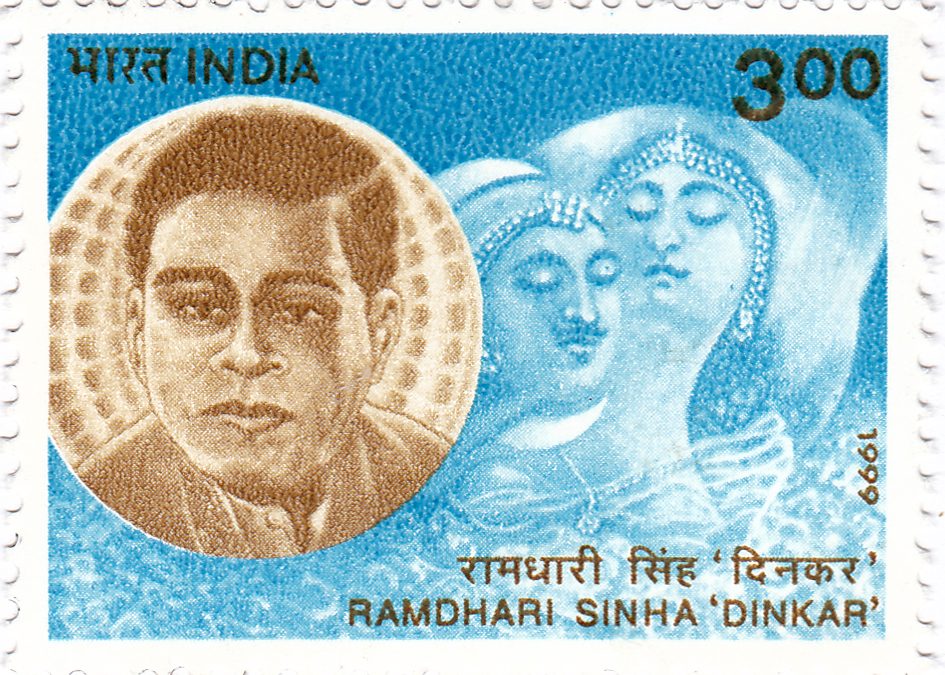
Featured image: Ramdhari Singh Dinkar, from a 1999 postage stamp of India. Photo by India Post, Government of India, licensed under Government Open Data License – India, via Wikimedia Commons.