
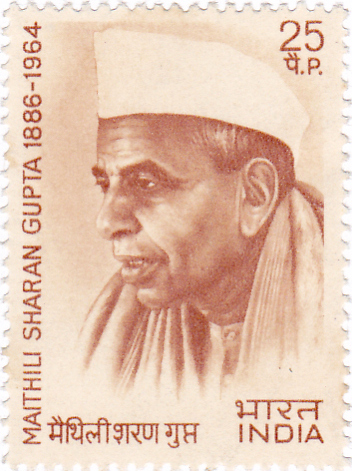
Maithili Sharan Gupt (3 August 1886 – 12 December 1964) was an Indian poet, one of the makers of modern Hindi poetry. At a time when verse was still written in the older dialect of Braj, he wrote in Khari Boli, the spoken Hindi of the day, and by the popularity of his work established it as the language of poetry. His Bharat-Bharati gave voice to the national awakening, and Saket and Yashodhara retold the old epics from the point of view of their neglected women. Gandhi called him Rashtrakavi, the national poet.
Quick Facts
| Full name | Maithili Sharan Gupt |
| Born | 3 August 1886, Chirgaon, Jhansi district, Uttar Pradesh |
| Died | 12 December 1964, Chirgaon (aged 78) |
| Language | Hindi (Khari Boli) |
| Occupation | Poet, playwright, translator |
| Notable works | Rang mein Bhang, Jayadrath Vadh, Bharat-Bharati, Panchvati, Saket, Yashodhara, Dwapar, Jai Bharat |
| Offices | Nominated member of the Rajya Sabha (1952–1964) |
| Awards | Padma Bhushan (1954) |
| Title | Rashtrakavi |
Early Life
He was born at Chirgaon, a small town in Bundelkhand, the third son of a prosperous family of merchants who were devout Vaishnavas. His father wrote devotional verse. He disliked school and left it early; he was taught Sanskrit, Hindi and Bengali at home and read for himself.
Dwivedi
He began by writing in Braj Bhasha, as everyone did. In about 1905 he sent a poem to Saraswati, the leading Hindi monthly, whose editor, Mahavir Prasad Dwivedi, was campaigning to make Khari Boli, already the language of prose, the language of verse as well. Dwivedi corrected his work line by line and became his guide. Gupt always called himself his pupil.
Early Works
Rang mein Bhang (1909) and Jayadrath Vadh (1910), a narrative from the Mahabharata, made his name.
Bharat-Bharati
Published in 1912, it is a long poem in three parts: the glory of India’s past, the misery of its present, and a call to the future. “Who were we, what have we become, and what shall we be?” it asks. It was read aloud at meetings, sold in very large numbers, and was learnt by heart by a generation of nationalists. The government kept a watchful eye on it.
The Epics Retold
- Panchvati (1925), an episode of the Ramayana centred on Lakshmana
- Saket (1931), his major work, a Ramayana told largely through Urmila, the wife of Lakshmana, who is left behind in Ayodhya for fourteen years and of whom the old poets say almost nothing
- Yashodhara (1932), on the wife of the Buddha, abandoned in the night. Her line, “Friend, had he but told me before he went”, is among the most quoted in Hindi.
- Dwapar, Vishnupriya and others, giving a voice to Radha, to the wife of Chaitanya, and to other silent figures
- Jai Bharat (1952), a retelling of the Mahabharata
He has been called the first Hindi poet to take the side of women in the great stories.
Translator
He translated from Bengali the epic Meghnadbadh Kavya of Michael Madhusudan Dutt, from Sanskrit several plays, and from English the Rubaiyat of Omar Khayyam.
Nationalist
He was a follower of Mahatma Gandhi, who is said to have given him the title Rashtrakavi in the 1930s. In 1941 he was jailed for some months for taking part in the individual satyagraha. He wrote poems on Hindu–Muslim unity and on the peasant, and one on the martyrdom at Karbala.
Later Life
He lived nearly all his life at Chirgaon, where he ran his own press and published his books, and kept open house for writers. After independence the President nominated him to the Rajya Sabha, where he sat for twelve years and sometimes spoke in verse. He received the Padma Bhushan in 1954.
Death
He died at Chirgaon on 12 December 1964. His birthday, 3 August, is observed in Hindi-speaking states as Poet’s Day.
Legacy
Later poets found his verse plain and moralising, and the romantic movement that followed, led by Nirala, Prasad and Sumitranandan Pant, turned away from it. But they wrote in the language he had made fit for poetry. His younger brother, Siyaramsharan Gupt, was also a noted poet, and the title of national poet passed in the next generation to Ramdhari Singh Dinkar.
Featured image: Maithili Sharan Gupt, from a 1974 postage stamp of India. Photo by India Post, Government of India, licensed under Government Open Data License – India, via Wikimedia Commons.



