Sumitranandan Pant (20 May 1900 – 28 December 1977) was an Indian poet who wrote in Hindi, one of the four pillars of Chhayavad, the romantic movement that transformed Hindi poetry in the 1920s and 1930s. Born in the Himalaya, he was first and last a poet of nature, and brought to Hindi verse a new delicacy of sound and image. In 1968 he became the first Hindi writer to receive the Jnanpith Award.
Quick Facts
| Birth name | Gosain Dutt Pant |
| Born | 20 May 1900, Kausani, Almora district (now Bageshwar district, Uttarakhand) |
| Died | 28 December 1977, Allahabad (aged 77) |
| Language | Hindi |
| Occupation | Poet |
| Notable works | Veena, Pallav, Gunjan, Yugant, Gramya, Swarna Kiran, Kala aur Budha Chand, Chidambara, Lokayatan |
| Awards | Sahitya Akademi Award (1960), Padma Bhushan (1961), Jnanpith Award (1968) |
Early Life
He was born at Kausani, a village on a ridge in the Kumaon hills that looks across a wide valley to the snow peaks. His mother died a few hours after his birth, and he was brought up by his grandmother. His father managed a tea garden. The mountains, forests and changing light of the place were, he said, his first and best teachers.
He began writing verse at seven. He disliked the name he had been given and chose another for himself, after Lakshmana, the son of Sumitra. He was educated at Almora and Benares and entered Muir College at Allahabad.
The Freedom Movement
In 1921, at Mahatma Gandhi‘s call to students to leave government colleges, he gave up his studies. He did not go to prison or take part in politics; he went home and read, in English, Sanskrit and Bengali, and wrote. The family’s fortunes collapsed soon afterwards, and for years he had no settled income.
Chhayavad
With Jaishankar Prasad, Suryakant Tripathi Nirala and Mahadevi Varma he is counted among the founders of Chhayavad, “the poetry of shadows”: personal, musical, suffused with a sense of mystery in nature, and influenced by the English Romantics and by Rabindranath Tagore.
- Pallav (“New Leaves”, 1926) is the central book of the movement. Its long preface was a manifesto: he argued that Khari Boli Hindi could be as supple and sweet as the older poetic dialect, and showed it in poems such as “Parivartan” and “Maun Nimantran”.
- Veena, Granthi and Gunjan belong to the same period
He had an exceptional ear. He chose words for their sound and softness and gave Hindi verse a music it had not had.
Changes
He was a poet who kept changing.
- **The progressive phase:** in the late 1930s he was drawn to Marx and to Gandhi’s concern for the village. Yugant announced the end of an age; Yugvani and Gramya (1940) turned to the lives of peasants and labourers.
- **Aurobindo:** in 1944 he visited the ashram at Pondicherry, and the philosophy of Sri Aurobindo, of the evolution of human consciousness, shaped the rest of his work. Swarna Kiran, Swarna Dhuli and Uttara belong to this period.
- **The late work:** Kala aur Budha Chand won the Sahitya Akademi Award in 1960. Chidambara, a selection of his poems from two decades, won the Jnanpith Award in 1968. Lokayatan (1964), an epic on the destiny of man, won the Soviet Land Nehru Award.
Critics have generally preferred the early nature poems to the philosophical verse of his later years.
Life
He never married. For long periods he was the guest of friends, among them the poet Harivansh Rai Bachchan at Allahabad; it was Pant who suggested the name Amitabh for Bachchan’s elder son. From 1950 to 1957 he was an adviser on Hindi programmes to All India Radio. He received the Padma Bhushan in 1961.
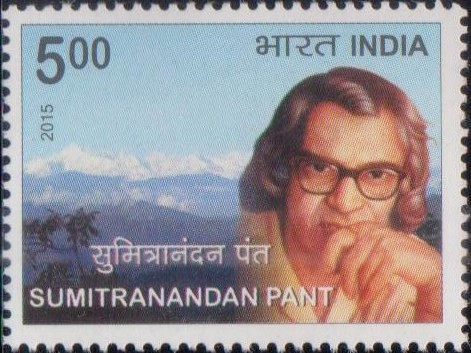
He was a gentle, withdrawn man of striking looks, with long hair that he wore to his shoulders.
Death
He died at Allahabad on 28 December 1977.
Legacy
The house at Kausani where he was born is a museum of his manuscripts and belongings. He left his books and the money from his awards to public institutions. He remains the Hindi poet who wrote best about the hills, and one of the reasons the language of everyday speech became a language of lyric poetry.
Featured image: Sumitranandan Pant, from a 2015 postage stamp of India. Photo by India Post, Government of India, licensed under Government Open Data License – India, via Wikimedia Commons.