
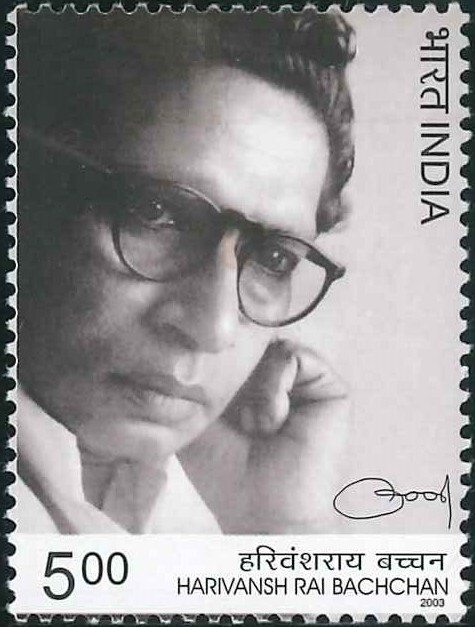
Harivansh Rai Bachchan (27 November 1907 – 18 January 2003) was an Indian poet who wrote in Hindi, one of the most widely loved of the twentieth century. His Madhushala (“The House of Wine”, 1935), a sequence of quatrains built on the images of the tavern, the cup and the wine-bearer, made him famous at twenty-seven and has never been out of print. He taught English at Allahabad University, took a doctorate at Cambridge, and wrote an autobiography in four volumes that is a classic of Hindi prose. He was the father of the actor Amitabh Bachchan.
Quick Facts
| Full name | Harivansh Rai Srivastava |
| Pen name | Bachchan |
| Born | 27 November 1907, Babupatti, Pratapgarh district, Uttar Pradesh |
| Died | 18 January 2003, Mumbai (aged 95) |
| Language | Hindi |
| Education | University of Allahabad (M.A. in English); St Catharine’s College, Cambridge (Ph.D., 1954) |
| Occupation | Poet, teacher |
| Notable works | Madhushala, Madhubala, Madhukalash, Nisha Nimantran, Do Chattanen, Kya Bhooloon Kya Yaad Karoon |
| Awards | Sahitya Akademi Award (1968), Padma Bhushan (1976), Saraswati Samman (1991) |
| Spouse | Shyama (d. 1936); Teji Bachchan (m. 1941) |
| Children | Amitabh and Ajitabh Bachchan |
Early Life
He was born at Babupatti, a village in the Pratapgarh district, into a Kayastha family, and grew up in Allahabad. At home he was called “bachchan”, the child, and he took it as his pen name and later as the family’s surname, dropping the caste name. He was educated in the city’s schools in Urdu and Hindi, took a master’s degree in English at Allahabad University, and gave up his studies for a time in 1930 to join the freedom movement.
He was married at nineteen to Shyama, who was fourteen.
Madhushala
He had translated the Rubaiyat of Omar Khayyam into Hindi. In 1933, at a poetry gathering at Banaras Hindu University, he recited quatrains of his own in the same vein, and the audience would not let him stop. Madhushala was published in 1935.
Its hundred and thirty-five verses each end on the word “madhushala”. The tavern stands for life itself, or for the goal of every search; all paths lead to it, and in it Hindu and Muslim, priest and outcaste, sit together. The poem was attacked for glorifying drink. He had never tasted alcohol, and Gandhi, to whom complaint was made, heard some verses and found nothing wrong with them.
For decades he was the star of the kavi sammelan, the public poetry gathering, where he sang his verses to huge audiences. Madhubala and Madhukalash completed a trilogy.
Grief
Shyama died of tuberculosis in 1936 after a long illness. The poems of the following years, Nisha Nimantran (“Invitation to Night”) and Ekant Sangeet, are songs of loss and solitude, and many think them his best.
In 1941 he married Teji Suri, a Sikh from Lahore who taught psychology and loved the theatre. The marriage across region and community was unusual for the time.
Teacher and Scholar
He taught English literature at Allahabad University from 1941 to 1952. He then went to Cambridge, where in two years he completed a doctoral thesis on the occult in the poetry of W. B. Yeats.
On his return he worked briefly for All India Radio and in 1955 joined the Ministry of External Affairs in Delhi as an officer on special duty for Hindi, helping to make it a working language of diplomacy. He stayed ten years. He was nominated to the Rajya Sabha in 1966.
Later Poetry and Translations
He published some thirty collections. Do Chattanen won the Sahitya Akademi Award in 1968. He translated Macbeth and Othello into Hindi verse, and the Bhagavad Gita into the Awadhi of Tulsidas and into modern Hindi. His poem “Agneepath”, the path of fire, is known to millions from its use in film.
Autobiography
Between 1969 and 1985 he published his life in four volumes, beginning with Kya Bhooloon Kya Yaad Karoon (“What Shall I Forget, What Remember”). It is frank about poverty, desire, failure and his own faults, to a degree new in Hindi. It won the first Saraswati Samman in 1991. An abridged English version appeared as In the Afternoon of Time.
Family
His elder son, Amitabh Bachchan, became the biggest star of Hindi cinema; the younger, Ajitabh, is a businessman. The poet lived his last decades with his elder son’s family in Mumbai, and Amitabh has made a practice of reciting his father’s poems in public.
Death
He died in Mumbai on 18 January 2003, aged ninety-five. Teji Bachchan died in 2007.
Featured image: Harivansh Rai Bachchan, from a 2003 postage stamp of India. Photo by India Post, Government of India, licensed under Government Open Data License – India, via Wikimedia Commons.



