Jaya Bachchan, born Jaya Bhaduri on 9 April 1948, is an Indian actress and politician who has been a Member of Parliament in the Rajya Sabha for the Samajwadi Party since 2004. She is known for a natural style of acting in both mainstream and “middle-of-the-road” cinema, and has received ten Filmfare Awards and the Padma Shri.
She was born into a Bengali family in Jabalpur, in what was then the Central Provinces and Berar. Her father, Tarun Kumar Bhaduri, was a journalist, author and poet, and her mother is Indira. She has two sisters, Rita and Nita. She was educated at St. Joseph’s Convent School in Bhopal and Loreto College in Kolkata, won the Best All-India N.C.C. Cadet Award during the Republic Day celebrations of 1966, and graduated with a gold medal from the Film and Television Institute of India in Pune.
She made her film debut at 14 in Satyajit Ray’s Bengali film Mahanagar (1963), and then appeared in two other Bengali films, a 13-minute short, Suman, and the comedy Dhanyee Meye (1971), in which she played Uttam Kumar’s sister-in-law. Her experience with Ray inspired her to join the FTII. Hrishikesh Mukherjee cast her in the title role of Guddi (1971), a petite schoolgirl obsessed with the film star Dharmendra. The film was a commercial success and created the girl-next-door image she was associated with for the rest of her career.
She played glamorous roles in Jawani Diwani (1972) and a semi-negative character in Anamika (1973), but was best recognised for roles that embodied middle-class sensibility in the films of directors such as Gulzar, Basu Chatterjee and Mukherjee. These include Uphaar (1971), Piya Ka Ghar (1972), Parichay (1972), Koshish (1972) and Bawarchi (1972). In Gulzar’s Koshish, she and Sanjeev Kumar played a deaf couple facing the difficulties of disability.
She first acted with Amitabh Bachchan in Bansi Birju (1972). When he had faced a string of flops and most leading women refused to work with him in the Salim–Javed script Zanjeer (1973), she agreed to step in, and the film was a big hit that created his angry-young-man image. She married him on 3 June 1973. All their later films as a pair were hits: Abhimaan (1973), Chupke Chupke (1975), Mili (1975) and Sholay (1975). She won the Filmfare Award for Best Actress for Abhimaan, Kora Kagaz (1974) and Nauker (1979). Their daughter, Shweta, was born around the time they were working on Sholay.
After Sholay she retired from films to raise her children, with an exception for Yash Chopra’s Silsila (1981), once again opposite her husband. In the late 1980s she wrote the story for Shahenshah (1988), in which he starred. After a gap of 17 years she returned with Govind Nihalani’s Hazaar Chaurasi Ki Maa (1998), a film about the Naxalite movement, which earned critical acclaim and her second Filmfare Special Award.
Her comeback brought a run of character parts. She won three Filmfare Awards for Best Supporting Actress for playing emotionally troubled mothers in Fiza (2000), Kabhi Khushi Kabhie Gham (2001) and Kal Ho Naa Ho (2003). In Fiza she played a mother waiting for a son who disappeared during the 1993 Bombay riots; the film grossed about Rs 322 million worldwide. She worked with her son Abhishek in Laaga Chunari Mein Daag (2007) and Drona (2008) and returned after another break in Karan Johar’s Rocky Aur Rani Kii Prem Kahaani (2023).
The couple has two children, Shweta and Abhishek. Shweta is married to the industrialist Nikhil Nanda, a grandson of Raj Kapoor, and has two children, Navya Naveli and Agastya, while Abhishek is married to the actress Aishwarya Rai, Miss World 1994, with whom he has a daughter, Aaradhya. A speech she made at the 2008 music launch of Drona was criticised by some politicians in Maharashtra. Her career spans a debut in a Ray film, five decades of cinema and more than two decades in the Rajya Sabha.
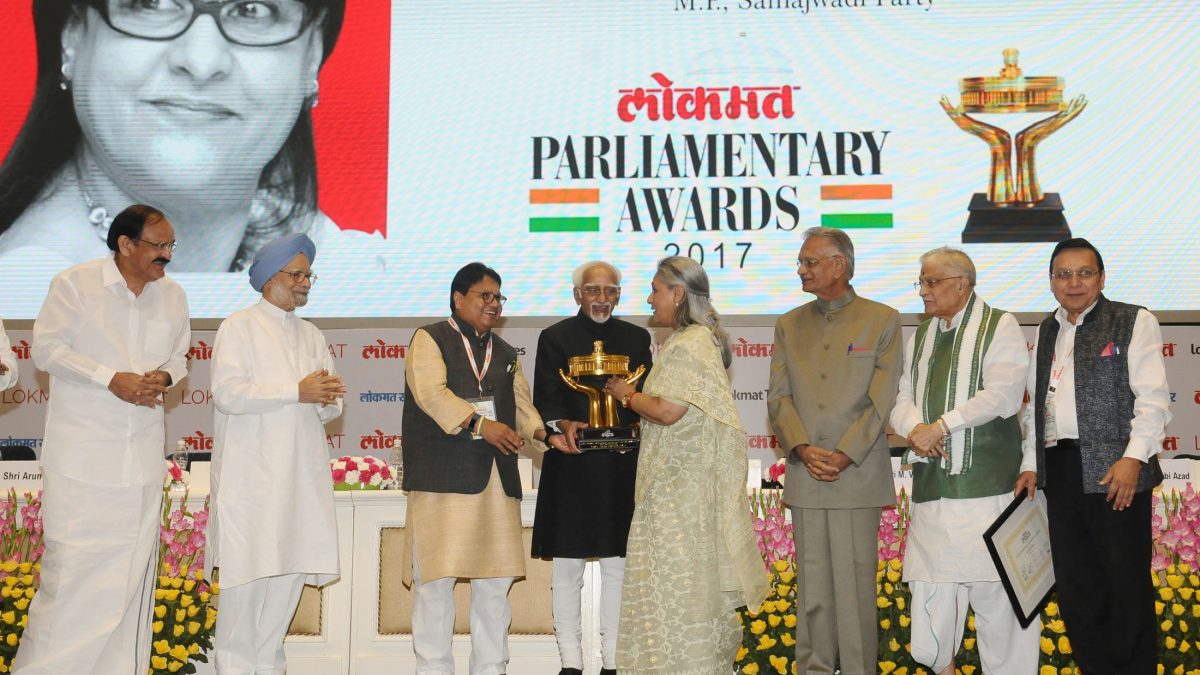
Featured image: Jaya Bachchan receiving the Lokmat Parliamentary Award 2017 from Vice President M. Hamid Ansari in New Delhi (file photo). Photo by Vice President’s Secretariat, licensed under Government Open Data License – India, via Wikimedia Commons.