Thanu Padmanabhan (10 March 1957 – 17 September 2021), known to colleagues and students as Paddy, was an Indian theoretical physicist and cosmologist. Working at the Inter-University Centre for Astronomy and Astrophysics in Pune, he made major contributions to the study of gravity, the formation of structure in the universe and the nature of dark energy, and is best known for developing the idea that gravity is not a fundamental force but emerges, like heat, from a deeper microscopic level. He was also among the finest writers of physics textbooks and popular science of his time.
Quick Facts
| Full name | Thanu Padmanabhan |
| Born | 10 March 1957, Thiruvananthapuram, Kerala |
| Died | 17 September 2021 (aged 64), Pune, Maharashtra |
| Field | Theoretical physics, cosmology, quantum gravity |
| Known for | Emergent gravity; structure formation; dark energy |
| Education | University College, Thiruvananthapuram (B.Sc., M.Sc.); Tata Institute of Fundamental Research (Ph.D.) |
| Institutions | TIFR, Mumbai (1979–1992); IUCAA, Pune (1992–2021) |
| Awards | Shanti Swarup Bhatnagar Prize (1996); Padma Shri (2007); Infosys Prize (2009); TWAS Prize (2011) |
| Spouse | Vasanthi Padmanabhan |
Early Life
Padmanabhan was born in Thiruvananthapuram into a family of modest means in which mathematics was a passion; his father and other relatives worked through geometry problems with him for pleasure. As a schoolboy he joined the Trivandrum Science Society, a group of young enthusiasts who taught one another advanced physics. He took his bachelor’s and master’s degrees at University College, Thiruvananthapuram, with gold medals, and published his first research paper, on general relativity, when he was twenty and still an undergraduate.
Career
TIFR
He joined the Tata Institute of Fundamental Research in Mumbai in 1979 and was made a member of the faculty the following year, before completing his doctorate, which he received in 1983 for work on quantum cosmology under Jayant Narlikar. He spent a year at the Institute of Astronomy in Cambridge in 1986–87.
IUCAA
In 1992 he moved to the newly founded Inter-University Centre for Astronomy and Astrophysics in Pune, where he remained for the rest of his life, serving as dean of its academic programmes for eighteen years. He guided many doctoral students who went on to hold positions around the world, and lectured tirelessly at universities and colleges across India.
Research
His early work concerned the way galaxies and clusters of galaxies grew from small irregularities in the early universe under gravity, including the statistical mechanics of systems held together by gravity. He later turned to the cosmological constant, the unexplained energy of empty space that drives the accelerating expansion of the universe.
From about 2002 he developed his most original line of thought. It had been known since the 1970s that black holes have a temperature and an entropy. Padmanabhan showed that Einstein’s equations for gravity can be rewritten, in a wide range of situations, as equations of thermodynamics, and argued that this is no accident: space-time, like a fluid or a solid, must be made of microscopic constituents, and gravity is the large-scale, statistical behaviour of those “atoms of space-time”. He went on to derive the equations of gravity from thermodynamic principles and to propose an explanation for the small observed value of the cosmological constant. His essays on these ideas won prizes from the Gravity Research Foundation several times, including the first prize in 2008.
He published about three hundred research papers.
Books
His graduate textbooks are used worldwide: Structure Formation in the Universe (1993), the three-volume Theoretical Astrophysics, Gravitation: Foundations and Frontiers (2010) and Quantum Field Theory: The Why, What and How. Sleeping Beauties in Theoretical Physics collects elegant and little-known results. For general readers he wrote After the First Three Minutes; The Story of Physics, a history of the subject told through comic strips, which was translated into many Indian languages; and, with his wife, The Dawn of Science.
Honours
He received the Shanti Swarup Bhatnagar Prize in 1996, the Padma Shri in 2007, the Infosys Prize for physical sciences in 2009 and the prize of the World Academy of Sciences in 2011. He was president of the cosmology commission of the International Astronomical Union. Kerala gave him its highest science award shortly before his death.
Death and Legacy
He died of a heart attack at his home in Pune on 17 September 2021, at sixty-four. His wife, Vasanthi, and their daughter, Hamsa, are both astrophysicists. He is remembered as a scientist who stayed in India by choice and showed that work of the first rank in fundamental physics could be done there.
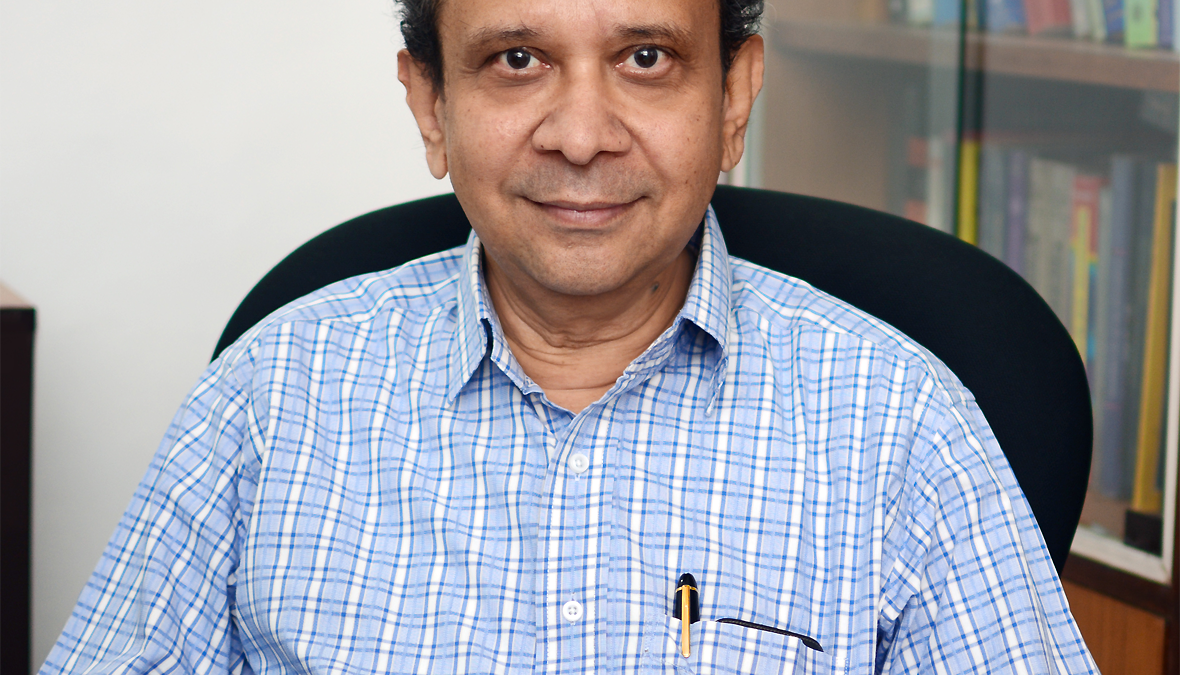
Featured image: Thanu Padmanabhan in his office at IUCAA, Pune, August 2014. Photo by Scipop, licensed under CC BY-SA 4.0, via Wikimedia Commons.