Sir Shanti Swarup Bhatnagar (21 February 1894 – 1 January 1955) was an Indian chemist and the first Director-General of the Council of Scientific and Industrial Research. He set up twelve national laboratories in the years around independence and is remembered as the father of research laboratories in India. The country’s best-known science prize bears his name.
Quick Facts
| Full name | Shanti Swarup Bhatnagar |
| Born | 21 February 1894, Bhera, Shahpur district, Punjab (now in Pakistan) |
| Died | 1 January 1955, New Delhi (aged 60) |
| Field | Physical chemistry, colloid chemistry, magneto-chemistry |
| Education | Forman Christian College, Lahore; University College London (D.Sc., 1921) |
| Known for | First Director-General of CSIR; India’s national laboratories |
| Positions | Professor at Banaras Hindu University and Punjab University; first Chairman of the University Grants Commission |
| Honours | Knighthood (1941), Fellow of the Royal Society (1943), Padma Bhushan (1954) |
| Spouse | Lajwanti |
Early Life
He was born at Bhera in Punjab. His father, a schoolteacher, died when he was eight months old, and he grew up in the house of his maternal grandfather, an engineer, at Sikandrabad in present-day Uttar Pradesh, where he developed a liking for science and for building mechanical toys, and also for Urdu poetry.
Education
He studied at Forman Christian College in Lahore, taking his M.Sc. in chemistry in 1919. On a scholarship he went to University College London, where he worked under Professor F. G. Donnan and received his D.Sc. in 1921.
Career
Professor
He taught for three years at Banaras Hindu University, whose anthem, the Kulgeet, he wrote. In 1924 he moved to Punjab University in Lahore as professor of physical chemistry and director of its chemical laboratories, and stayed sixteen years. His research was on emulsions, colloids and the magnetic properties of chemicals; with K. N. Mathur he devised a sensitive magnetic balance that was later manufactured in Britain.
He had a talent for solving industrial problems. When an oil company found its drilling mud hardening on contact with salt water, he solved the difficulty with a simple additive. He asked that the money the firm offered him be given to the university for research.
CSIR
In 1940, during the war, the government appointed him Director of Scientific and Industrial Research. When the Council of Scientific and Industrial Research was formed in 1942, he became its head. After independence he worked closely with Jawaharlal Nehru, who shared his faith in science, and set up laboratories across the country, among them:
- National Chemical Laboratory, Pune
- National Physical Laboratory, New Delhi
- National Metallurgical Laboratory, Jamshedpur
- Central Fuel Research Institute, Dhanbad
- Central Food Technological Research Institute, Mysore
- Central Drug Research Institute, Lucknow
- Central Glass and Ceramic Research Institute, Calcutta
Other offices
He was Secretary of the Ministry of Education and the first Chairman of the University Grants Commission in 1953, and helped establish the National Research Development Corporation to carry discoveries into industry.
Personal Life
His wife, Lajwanti, died in 1946, and he published a volume of his Urdu verse in her memory. He died of a heart attack in New Delhi on 1 January 1955.
Legacy
The Shanti Swarup Bhatnagar Prize for Science and Technology, instituted by CSIR in 1958, was for decades the highest honour for Indian scientists under the age of forty-five.
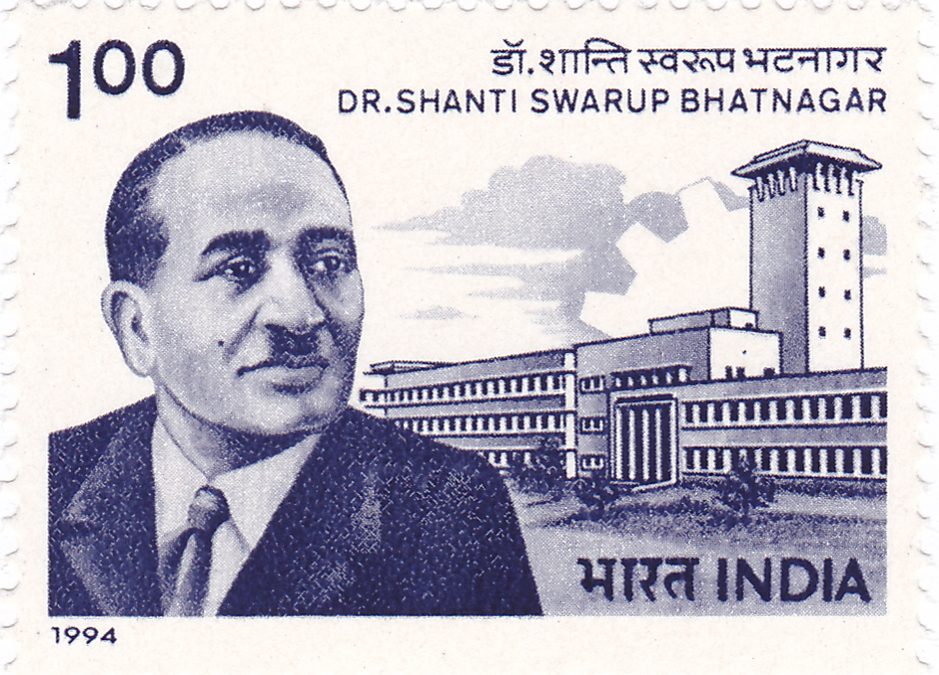
Featured image: Shanti Swarup Bhatnagar on a 1994 postage stamp of India. Photo by India Post, Government of India, licensed under Government Open Data License – India, via Wikimedia Commons.