
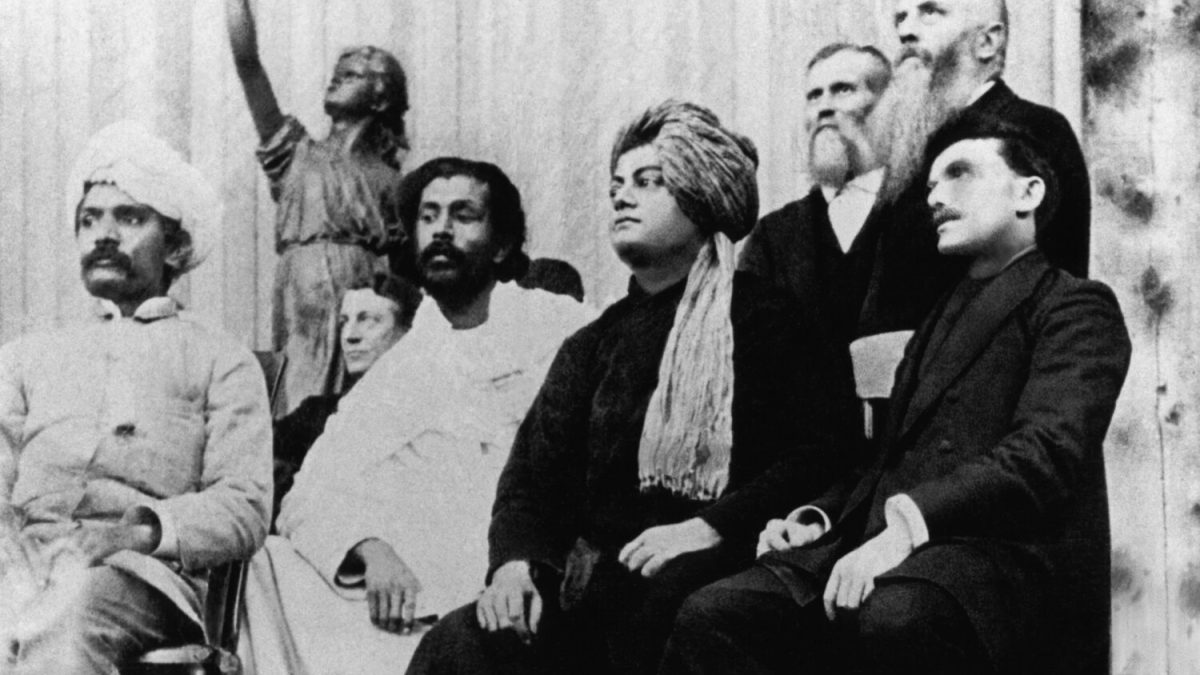
Swami Vivekananda (12 January 1863 – 4 July 1902), born Narendranath Datta, was an Indian Hindu monk, philosopher and social reformer. He was the chief disciple of the mystic Ramakrishna Paramahamsa. His speech at the Parliament of the World’s Religions in Chicago in 1893, which began “Sisters and brothers of America”, introduced Hindu philosophy to a Western audience. He founded the Ramakrishna Mission and inspired generations of Indian nationalists. His birthday is celebrated in India as National Youth Day.
Quick Facts
| Birth name | Narendranath Datta |
| Born | 12 January 1863, Calcutta (now Kolkata), Bengal Presidency, India |
| Died | 4 July 1902, Belur Math, Bengal Presidency (aged 39) |
| Parents | Vishwanath Datta, Bhuvaneswari Devi |
| Education | Presidency College; Scottish Church College, Calcutta |
| Guru | Ramakrishna Paramahamsa |
| Founded | Ramakrishna Mission (1897), Belur Math |
| Known for | 1893 Chicago speech, Vedanta, Raja Yoga |
| Remembered on | National Youth Day (12 January) |
Early Life
Narendranath, called Naren, was born into a well-off Bengali family in north Calcutta. His father, Vishwanath Datta, was a lawyer at the Calcutta High Court, and his mother, Bhuvaneswari Devi, was deeply religious. As a boy he was energetic and curious, and he was interested in meditation from an early age. He studied at Presidency College and at the General Assembly’s Institution (now Scottish Church College), where he read Western philosophy and logic and became involved with the reformist Brahmo Samaj.
Spiritual Journey
In 1881 Narendranath met Ramakrishna, a priest at the Dakshineswar Kali temple near Calcutta. He famously asked him whether he had seen God, and Ramakrishna replied that he had. At first doubtful, Narendranath gradually accepted him as his guru. After his father’s death in 1884 left the family in poverty, he grew closer to Ramakrishna, who before his death in August 1886 asked him to look after his other young disciples.
Narendranath and other disciples took monastic vows and formed a monastery at Baranagar. From 1888 he travelled across India on foot as a wandering monk, seeing the poverty of ordinary people first-hand. In December 1892 he meditated on a rock off the coast at Kanyakumari, where he resolved to work for the uplift of India’s poor. Supported by the Maharaja of Khetri, he took the name Vivekananda and set out for America.
Chicago and the West (1893–1897)
On 11 September 1893 Vivekananda spoke at the opening of the Parliament of the World’s Religions in Chicago. His first words, “Sisters and brothers of America”, received a standing ovation, and his talks on religious tolerance and the unity of faiths made him famous. He spent the next few years lecturing in the United States and Britain, founded the Vedanta Society of New York in 1894 and gathered Western followers, including the Irish teacher Margaret Noble, who later became Sister Nivedita.
Ramakrishna Mission and Final Years (1897–1902)
Vivekananda returned to India in 1897 to a hero’s welcome and gave a series of lectures across the country calling on Indians to be strong and self-confident. On 1 May 1897 he founded the Ramakrishna Mission to combine spiritual practice with social service, and soon afterwards he set up its headquarters at Belur Math on the Hooghly river. He made a second trip to the West in 1899–1900. His health declined, and he died at Belur Math on 4 July 1902, aged 39.
Teachings and Works
Vivekananda taught Advaita Vedanta, the idea that the divine is present in every being, and stressed service to the poor as a form of worship. His books include Raja Yoga, Karma Yoga, Bhakti Yoga and Jnana Yoga, based on his lectures.
Legacy
Vivekananda’s ideas influenced leaders such as Mahatma Gandhi, Subhas Chandra Bose and Rabindranath Tagore. Since 1985 his birthday has been celebrated as National Youth Day in India. The Vivekananda Rock Memorial at Kanyakumari, opened in 1970, marks the place where he meditated. The Ramakrishna Mission runs schools, hospitals and relief work across India and abroad.
Frequently Asked Questions
When and where was Swami Vivekananda born?
Swami Vivekananda was born on 12 January 1863 in Calcutta (now Kolkata), Bengal Presidency, India.
When did Swami Vivekananda die?
Died: 4 July 1902, Belur Math, Bengal Presidency (aged 39).
What is Swami Vivekananda known for?
Known for: 1893 Chicago speech, Vedanta, Raja Yoga.
Featured image: Swami Vivekananda (centre) on the platform of the Parliament of the World’s Religions, Chicago, September 1893. Photo by Ramakrishna Mission archives, licensed under CC BY-SA 2.5, via Wikimedia Commons.



