
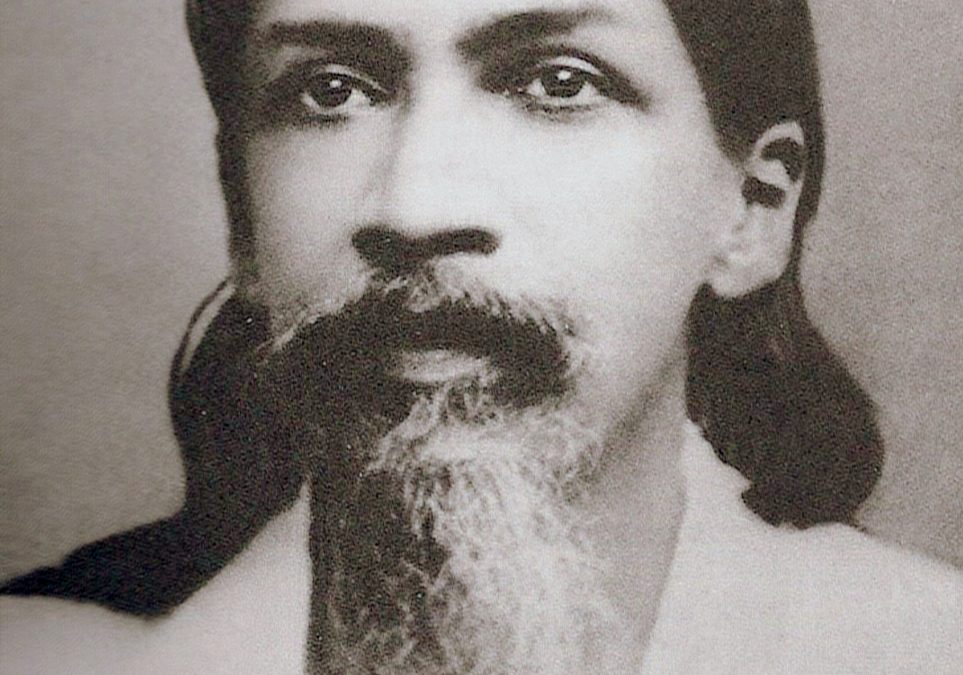
Sri Aurobindo (15 August 1872 – 5 December 1950), born Aurobindo Ghose, was an Indian nationalist leader, philosopher, yogi and poet. Between 1905 and 1910 he was one of the most radical voices of the freedom movement in Bengal, among the first to demand complete independence. After a year in prison in the Alipore Bomb Case he withdrew to the French enclave of Pondicherry, where he developed a system of thought he called Integral Yoga and wrote The Life Divine and the epic Savitri.
Quick Facts
| Birth name | Aurobindo Ghose |
| Born | 15 August 1872, Calcutta, Bengal |
| Died | 5 December 1950 (aged 78), Pondicherry |
| Occupation | Nationalist leader, philosopher, yogi, poet |
| Education | St Paul’s School, London; King’s College, Cambridge |
| Known for | Bande Mataram newspaper; Integral Yoga; Sri Aurobindo Ashram |
| Notable works | The Life Divine, The Synthesis of Yoga, Essays on the Gita, Savitri |
| Spouse | Mrinalini Devi |
Early Life
He was the third son of Krishna Dhun Ghose, a surgeon who admired everything English and wanted his children to grow up without Indian influence. At seven Aurobindo was taken to England with his brothers. He studied at St Paul’s School in London and won a scholarship to King’s College, Cambridge, where he took a first in classics. He passed the examination for the Indian Civil Service but failed to appear for the riding test and was disqualified, by his own later account on purpose.
Baroda
He returned to India in 1893 and served the princely state of Baroda for thirteen years, in the revenue department and then as professor of English and vice-principal of its college. He taught himself Sanskrit and Bengali, studied the epics, began the practice of yoga and wrote anonymous articles attacking the timid politics of the Congress. Through his younger brother Barindra he made contact with secret societies in Bengal.
Nationalist Leader
The partition of Bengal in 1905 brought him to Calcutta, as the first principal of the new Bengal National College. In the English daily Bande Mataram he set out a programme of boycott, national education, self-reliance and passive resistance, and declared that the aim was freedom from foreign control and nothing less. With Bal Gangadhar Tilak he led the Extremist group that broke with the Moderates at the Surat Congress of 1907.
In May 1908, after the bomb attack at Muzaffarpur, the police raided a garden house in Calcutta where his brother’s group made explosives, and Aurobindo was arrested. He spent a year as an undertrial prisoner in Alipore Jail, much of it in solitary confinement, where he had the spiritual experiences that changed the direction of his life. Defended by Chittaranjan Das, he was acquitted in May 1909. He resumed writing and speaking, but in early 1910, warned of another arrest, he left for Chandernagore and then sailed to Pondicherry, arriving on 4 April 1910.
Pondicherry
He never returned to British India. From 1914 to 1921 he published a monthly review, Arya, in which most of his major prose works appeared in instalments. He argued that evolution does not end with the human mind; a higher consciousness is destined to emerge, and yoga should aim at transforming life on earth, not escaping from it. Mirra Alfassa, a Frenchwoman who joined him and came to be known as the Mother, organised the community that formed around him. In November 1926 he retired from public view, and the Sri Aurobindo Ashram dates from that time.
He spent his last decades revising Savitri, a poem of nearly twenty-four thousand lines based on a legend from the Mahabharata. He continued to follow world events, and on 15 August 1947, his seventy-fifth birthday, he broadcast a message on India’s independence.
Death and Legacy
He died in Pondicherry on 5 December 1950. The ashram continues, and Auroville, an international township inspired by his ideas, was founded nearby in 1968. In Bengal he is remembered first as the prophet of nationalism who gave the Swadeshi movement its philosophy.
Frequently Asked Questions
When and where was Sri Aurobindo born?
Sri Aurobindo was born on 15 August 1872 in Calcutta, Bengal.
When did Sri Aurobindo die?
Died: 5 December 1950 (aged 78), Pondicherry.
What is Sri Aurobindo known for?
Known for: Bande Mataram newspaper; Integral Yoga; Sri Aurobindo Ashram.
Featured image: Sri Aurobindo about 1900, during his years in Baroda. Photo by an unknown photographer, in the public domain, via Wikimedia Commons.



