
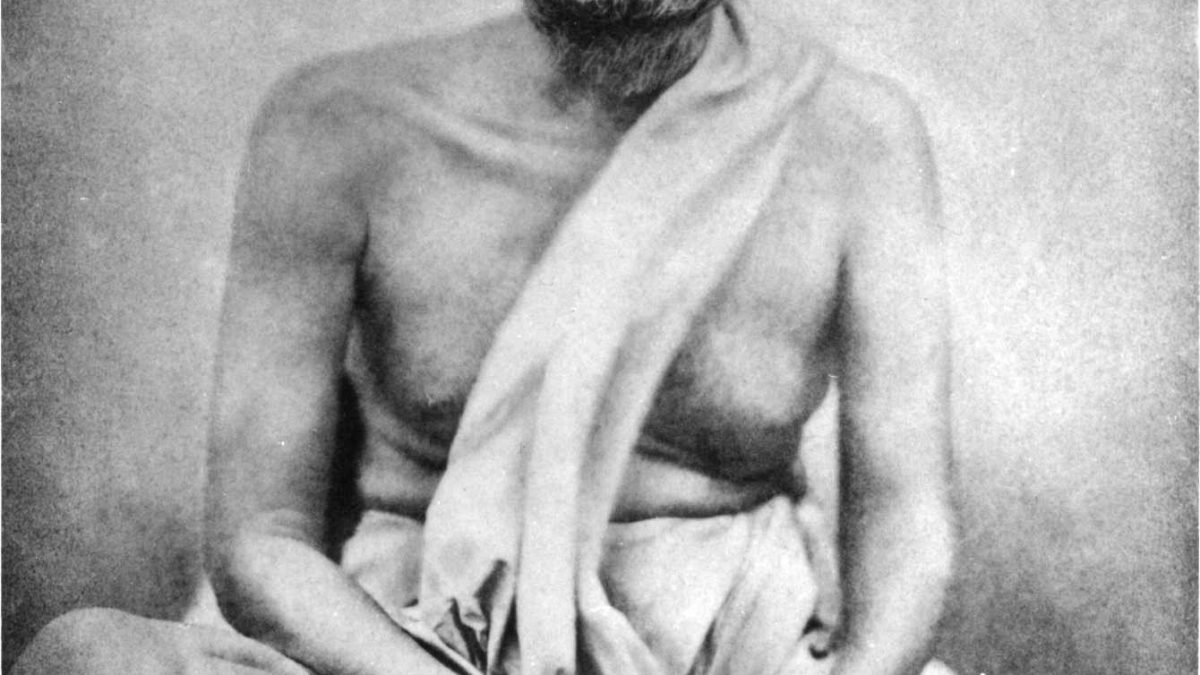
Ramakrishna Paramahamsa (18 February 1836 – 16 August 1886), born Gadadhar Chattopadhyay, was an Indian mystic and religious teacher of nineteenth-century Bengal. A barely schooled village Brahmin who served as priest of the Kali temple at Dakshineswar near Calcutta, he practised the disciplines of several Hindu traditions and of Islam and Christianity and taught that all religions are paths to the same reality. His disciples, led by Swami Vivekananda, founded the Ramakrishna Mission in his name.
Quick Facts
| Birth name | Gadadhar Chattopadhyay |
| Born | 18 February 1836, Kamarpukur, Hooghly district, Bengal |
| Died | 16 August 1886 (aged 50), Cossipore, Calcutta |
| Occupation | Priest, mystic, religious teacher |
| Associated with | Dakshineswar Kali Temple |
| Spouse | Sarada Devi |
| Chief disciple | Swami Vivekananda |
| Legacy | Ramakrishna Math and Ramakrishna Mission |
Early Life
He was born into a poor and devout Brahmin family in the village of Kamarpukur. He disliked school arithmetic and cared little for a “bread-winning education”, but he had a remarkable memory for the religious stories and songs performed by travelling players, modelled images of the gods and acted in village dramas. From childhood he was subject to states of rapture, the first, by his own account, at the sight of white cranes flying against a dark storm cloud.
After his father’s death he followed his elder brother to Calcutta in 1852. In 1855 a wealthy widow of a lower caste, Rani Rashmoni, dedicated a great temple of Kali at Dakshineswar on the Hooghly, and the brother became its priest. When he died the following year, Gadadhar succeeded him.
Spiritual Practice
Serving the image of the goddess, he was seized by a longing to see her as a living presence. He neglected the ritual, wept, went without sleep, and at last, he said, saw the temple dissolve into an ocean of light. Those around him thought him mad. His family married him in 1859 to a small girl from a nearby village, Saradamani, hoping to steady him; the marriage was never an ordinary one, and he later regarded her as an embodiment of the Divine Mother.
Over the next years teachers came to Dakshineswar. A wandering woman ascetic guided him through the practices of Tantra. A monk named Totapuri initiated him into non-dualist Vedanta and gave him the name Ramakrishna. He followed the devotional paths of the worshippers of Rama and Krishna, and for brief periods lived as a Muslim and meditated on Christ. Each, he reported, led to the same experience. From this came his best-known saying: as many faiths, so many paths.
Teacher
From about 1875, after the Brahmo leader Keshub Chandra Sen wrote about him, educated Calcutta began to visit the small room by the river. He taught in the village Bengali of his childhood, through parables drawn from everyday life: the salt doll that went to measure the sea, the blind men and the elephant, the woman who thinks of her lover while doing her housework. He warned against attachment to “woman and gold”, by which he meant lust and greed, and urged his visitors to serve human beings as manifestations of God.
Among those who came was a sceptical college student, Narendranath Datta, the future Vivekananda, who asked whether he had seen God and was told, “Yes, I see Him as I see you, only more clearly.” A schoolmaster, Mahendranath Gupta, recorded his conversations day by day; published as the Kathamrita and translated as The Gospel of Sri Ramakrishna, they are the main record of his teaching.
Death
In 1885 he developed cancer of the throat. He was moved to a garden house at Cossipore, where his young disciples nursed him and were formed into a brotherhood. He died there on 16 August 1886.
Legacy
The monastic order and mission founded by his disciples in 1897, with its headquarters at Belur Math across the river from Dakshineswar, runs hospitals, schools and relief work around the world. His life gave educated Hindus under colonial rule a new confidence in their own tradition, and his message of the harmony of religions remains his chief gift.
Frequently Asked Questions
When and where was Ramakrishna Paramahamsa born?
Ramakrishna Paramahamsa was born on 18 February 1836 in Kamarpukur, Hooghly district, Bengal.
When did Ramakrishna Paramahamsa die?
Died: 16 August 1886 (aged 50), Cossipore, Calcutta.
What is Ramakrishna Paramahamsa’s occupation?
Occupation: Priest, mystic, religious teacher.
Featured image: Ramakrishna Paramahamsa, photographed in October 1885. Photo by Abinash Chandra Dna, in the public domain, via Wikimedia Commons.



